
Most pianists practice sight reading, but very few practice it correctly. The method matters more than the time you put in. This guide covers the exact approach that builds real fluency, from choosing the right level to training your eyes to move ahead.
Put a piece of music you have never seen in front of you. Set a tempo. Start playing. Do not stop.
That is sight reading. And for most piano students, it is the moment everything falls apart.
Not because they lack ability. Because they have never been taught to practice it correctly. Sight reading is a specific skill that requires a specific method. This guide covers that method, step by step.
If you want a deeper look at what sight reading is and why it matters, our complete guide to piano sight reading covers the foundations in full. This post focuses on the practice method itself.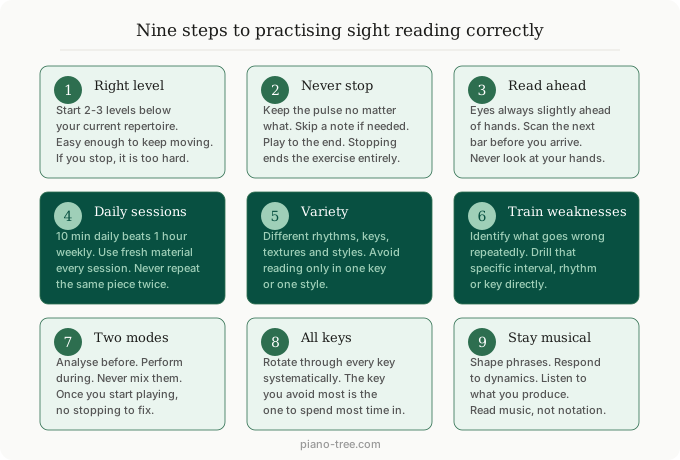
Step 1: Choose the Right Level
The most consistent mistake I see is students practicing material that is too difficult.Sight reading should feel manageable from the start. If you are stopping frequently or struggling to hold a steady tempo, the level is too high. The material needs to be easy enough that your attention is free: free to read ahead, free to maintain the pulse, free to process what is coming rather than what you just played.
In practice, this usually means starting two or three levels below your current repertoire. If you are working on a Beethoven sonata in lessons, your sight reading material should be closer to an early-grade study. Most students find this uncomfortable. Do it anyway.
Sight reading material should feel almost easy. If you are struggling with the notes, you are slow-reading, not sight reading.
Think of it like learning a new language. A beginner does not develop fluency by watching political debates or reading academic papers. They start with simple, clear material where understanding is immediate. Simplicity builds the foundation that fluency later depends on. Sight reading works exactly the same way.
Step 2: Do Not Stop When Sight Reading
This is the single most important rule in sight reading practice, and the one that is broken most often.Stopping to fix mistakes is the correct approach when you are learning a piece of repertoire. It is exactly wrong when you are sight reading. The moment you stop, you have ended the exercise. You are no longer training sight reading. You are doing something else.
The skill being built is forward momentum under pressure: the ability to process music in real time, keep the pulse going, and recover from mistakes without losing your place. You cannot build that by pausing every time something goes wrong.
- Keep a steady pulse throughout
- Skip a note or a beat if needed and keep going
- Play to the end of the piece no matter what
This matters in real musical situations too. When you are accompanying a singer, playing in a chamber group, or performing with a band, the music does not stop because you missed a chord. Small mistakes in a steady performance are almost always invisible. A pause is never invisible.
Practicing with backing tracks helps reinforce this habit because the accompaniment keeps moving regardless of what you play. This is one of the reasons Piano Tree uses live backing tracks during sight reading practice: it makes stopping feel as unnatural as it should.
Step 3: Read Ahead, Not Note by Note
Weak sight readers focus on the note they are playing. Strong sight readers are already looking at what comes next.
This is not a natural habit. It has to be trained deliberately. At first, looking even one beat ahead feels difficult. With consistent practice it becomes automatic, and when it does, fluency improves dramatically.
Your eyes should always be slightly ahead of your hands. You are preparing the next phrase while playing the current one.
Some practical strategies for building this habit:
- Look at the next beat while playing the current one
- Focus on patterns and shapes rather than individual notes
- Avoid looking down at your hands
- Scan the bar ahead before you arrive at it
Piano Tree includes a dedicated read-ahead mode where the bar you are currently playing disappears from the screen, forcing your eyes to move forward. It is uncomfortable at first. That discomfort is the skill being built.
Step 4: Practice in Short, Daily Sessions
Consistency matters far more than duration. Ten minutes of sight reading every day produces better results than an hour-long session once a week. Sight reading is a fluency skill, and fluency develops through regular, repeated exposure, not occasional intense effort.Use fresh material every session. Avoid repeating the same piece more than once or twice. The moment you start to remember a piece, you are no longer reading it. You are recalling it, which is a different skill entirely.
A practical way to structure a daily session:
- 5 minutes: Short reading exercises at a comfortable level
- 5 minutes: Rhythmic patterns or hand coordination work
- 5 minutes: Harmonic material: cadences, sequences, chord shapes
As each element becomes easier, increase the difficulty or change the key rather than spending more time. A few days of simple material in D-flat major will do more for your fluency in that key than an hour of difficult pieces in C major.
Step 5: Use a Variety of Material
Sight reading is not about mastering one piece. It is about adapting to anything.Reading exclusively in one style or one key creates blind spots that only show up when you encounter something different. A student who has only read classical pieces will struggle with a jazz lead sheet. A student who has only read in major keys will slow down the moment a flat key signature appears.
Vary your material across:
- Different rhythmic patterns (syncopation, compound time, triplets)
- Different key signatures, including the ones you tend to avoid
- Different textures (melody only, melody with accompaniment, both hands independent)
- Different styles (classical, jazz, folk, contemporary)
Short fragments are often more useful than long pieces. Working through eight to twelve bars of something unfamiliar, then moving to something different, builds adaptability faster than playing through an entire sonata movement.
Step 6: Train Specific Weaknesses
Most sight reading problems are not random. They are patterns. The same things go wrong repeatedly: a particular interval that always causes hesitation, chord shapes that slow you down, a rhythmic figure you consistently misread, hand coordination that breaks down in certain textures.Identify one or two specific weaknesses and give them focused attention alongside your general sight reading practice. Isolating a problem and drilling it directly builds recognition faster than hoping it improves through general reading alone.
A focused session might look like this:
- 5 minutes: Easy sight reading in a key you find difficult
- 5 minutes: Targeted work on a specific weak area: intervals, chord shapes, a rhythmic pattern
- 5 minutes: Free-flow reading across mixed material
Piano Tree's Sight-Reading Focus Packs are built for exactly this: targeted collections for intervals, cadences, ledger lines, rhythm, hand coordination, polyrhythms, and more, each using real musical material rather than isolated exercises.
Step 7: Separate Practice Mode from Reading Mode
These two modes require a completely different mindset and should not be mixed in the same run-through.Practice mode (analysis)
Read through a piece once or twice, no more than three times. Use this pass to analyse the key, identify the time signature, spot any patterns or potential difficulty spots, and get a sense of the shape of the music before you play. This is the preparation phase.
Reading mode (performance)
Once you start playing in reading mode, you do not stop. You do not correct. You focus entirely on keeping the pulse and moving forward. This is the sight reading itself. The goal is not accuracy. It is continuity.
Over time, reduce the amount of analysis you do before playing until you can move directly into reading mode with only a brief glance at the key and time signature. That is what real sight reading looks like in performance.
Step 8: Practice in All Keys
Most students have favourite keys and avoid the rest. This creates a permanent ceiling. You can read fluently in G major and C major, but the moment a piece opens in D-flat or F-sharp minor, everything slows down.The fix is not to spend months on difficult keys in isolation. It is to rotate through all keys systematically using material that is easy enough to read comfortably. Take a simple exercise you can already play well in C major and spend a few days reading it in B-flat. Then in E-flat. Then in A-flat. The patterns stay familiar while the key becomes less foreign.
Think of keys the way you think of vocabulary in a language. You do not become fluent in a new word by studying it once. You become fluent by encountering it repeatedly in context, until recognition is automatic.
If there is a key you consistently avoid, that is the key to spend the most time in. The avoidance is the signal.
Step 9: Keep Your Sight Reading Musical
Sight reading practice can become mechanical very quickly. You focus on getting the right notes in the right order, keeping the pulse, not stopping, and somewhere in that process the music disappears. You are reading notation, not playing music.This matters because the goal of sight reading is not accuracy. It is communication. A performance of sight-read music that is rhythmically steady, phrased with some intention, and dynamically alive is far more valuable than a technically correct one that sounds like a printer reading a document.
Even in practice, keep these habits active:
- Shape phrases: notice where they breathe, where they arrive, where they push forward
- Respond to dynamics and articulation marks even when reading quickly
- Listen actively to what you are producing, not just monitoring whether the notes are correct
- Let your body feel the pulse rather than just counting it
A metronome gives you time. It does not give you music. Both things need to be present in your practice from the start, even at very simple levels.Practice sight reading the right way with Piano Tree, free for 7 days
Common Questions About Sight Reading Practice
How long does it take to improve piano sight reading?
With ten to fifteen minutes of daily practice at the right level, most students notice a meaningful improvement within four to six weeks. That does not mean fluency: the process starts to feel less effortful and the hesitation between notes shortens. Real fluency, where you can sit down with unfamiliar music and play it comfortably, typically takes several months of consistent work. The skill compounds over time. Progress that feels slow in week three looks dramatic by month five.
How often should I practice piano sight reading?
Daily, even if only for ten minutes. Sight reading is a fluency skill, which means frequency matters more than duration. One long session per week will not build the same automatic recognition that ten short daily sessions will. If your schedule is tight, ten minutes of sight reading at the start of every practice session is enough to produce real improvement over time.
Can adults learn to sight read piano from scratch?
Yes, and often more effectively than younger students. Adult learners tend to be more disciplined about structured practice, more willing to start at an easy level without ego getting in the way, and more consistent in their habits. Starting from scratch is not a disadvantage. In many cases it is an advantage, because there are no ingrained bad habits to unlearn. The method is the same regardless of age: right level, daily exposure, keep going.
Should I use a metronome when practicing sight reading?
Yes, especially early on. A metronome makes it impossible to unconsciously slow down at difficult passages, which is one of the most common ways students mask weaknesses rather than fixing them. It forces a commitment to a tempo that stays honest. Once your internal pulse is reliable, you can practice more freely, but the metronome builds that pulse in the first place. Backing tracks serve the same purpose and feel more musical than a click.
What is the best sight reading material for piano beginners?
Short pieces with simple key signatures, clear rhythms, and minimal hand independence. ABRSM publishes official sight reading material graded by level, which is reliable and well-structured. Beyond that, any graded piece collection works if the material is genuinely easy enough that you can keep moving without stopping. The biggest mistake beginners make is choosing material that is too hard. If it feels too easy, it is probably the right level.
Sight reading improves through method, not through talent and not through effort alone. The nine steps in this guide are not complicated, but they are specific. Choosing the right level, keeping the pulse, reading ahead, practicing daily with varied material, drilling weaknesses directly: none of this happens automatically. It has to be built deliberately.
The students who improve fastest are almost never the most musically gifted. They are the most consistent, and they practice in a way that is actually building the skill rather than reinforcing the habits that hold them back.
Start simpler than feels right. Stay in time. Keep going.