
Before comparing any apps, there is one question worth asking: what does a piano sight reading app actually need to do?
The answer sounds obvious but most apps get it wrong. A sight reading app needs to build the ability to sit down with music you have never seen before and play it. Not to help you learn specific songs. Not to show you which keys to press. To build the cognitive and physical skill of reading notation in real time.
That distinction separates the apps that genuinely develop musicians from the ones that create a convincing illusion of progress.
What to Actually Look For in a Sight Reading App
Most app comparison articles lead with price, interface design, and song library size. These matter, but they are the wrong starting point. The right questions are:Does the app use real music or generated exercises?
Generated exercises (algorithmically produced sequences of notes) can be useful for targeted drilling. But real music, actual pieces with harmonic logic, melodic shape, and rhythmic character, develops sight reading much faster because it trains the brain to recognise musical patterns, not just note sequences. A student who has read thousands of real pieces has a richer internal library to draw on than one who has drilled thousands of generated exercises.
Does the app provide real-time feedback on rhythm as well as pitch?
Most apps check whether you played the right notes. Far fewer check whether you played them at the right time. Rhythm is at least as important as pitch in sight reading. An app that ignores rhythmic accuracy is training an incomplete skill.
Does the app sequence difficulty in a musically meaningful way?
Difficulty in sight reading is not linear. Key signatures, rhythmic complexity, polyphony, hand independence, tempo, and harmonic density all contribute in different ways and at different rates. An app that simply adds more notes as you progress is not sequencing difficulty. It is adding noise.
Does the app build independence or dependence?
This is the most important question. When a student stops using the app, are they a better reader than when they started? Or have they learned to navigate the app's specific interface? Some apps, particularly the falling-dot systems, train app navigation rather than music reading. The test of a good sight reading app is whether the skill transfers to a piano bench with a printed score.
The best sight reading app is the one that makes itself unnecessary. It builds a skill that works everywhere, not just within its own interface.
The Apps Compared
Piano Tree
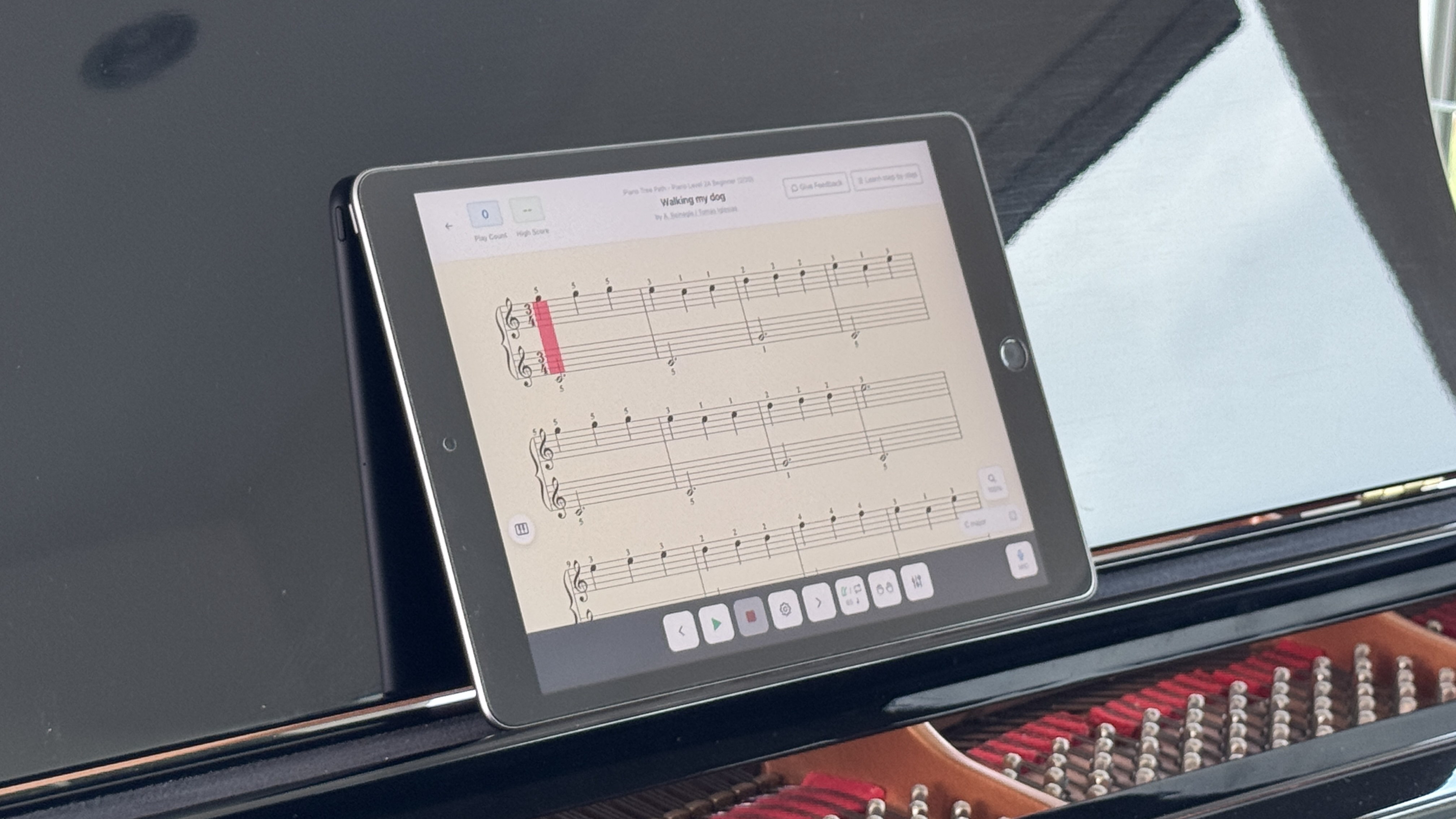
Best for: Structured daily sight reading that builds real musical independence Piano Tree was built specifically to solve the problem described above. The entire design philosophy starts from one premise: a student who uses this app for six months and then stops should read better, know more chords, and feel more rhythmically confident than when they started. The app should make itself unnecessary.The library contains close to 10,000 real pieces, not generated exercises, with new music added every day. The Piano Tree Path grades them into levels, each split into sub-levels of twenty pieces, and the grading accounts for several variables at once: key signature, rhythmic complexity, polyphony, hand independence, and harmonic density. Building that progression took years of iteration because music reading difficulty is not linear. A D7 chord in G major reads very differently from a D#7 chord in G# minor, which contains a double sharp that most students rarely encounter. These distinctions are built into the sequencing.
Real-time feedback covers rhythmic placement with any input, and pitch accuracy as well when a MIDI keyboard is connected. A sight reading test places you at the right level and tracks your reading over time. The backing tracks keep the pulse moving, which means stopping to correct mistakes is not an option. That constraint is intentional. Stopping is the habit that prevents sight reading fluency from developing. The app removes the option.
Around the Path, the library is organised the way a piano teacher actually thinks: Sight-Reading Focus Packs for rhythm, melodic and harmonic intervals, cadences and species counterpoint; chorales and hymns graded from a single soprano line up to four voices; Chords and Scales Training and Ear Training; etudes from Czerny, Hanon, Burgmüller and Schmitt; and repertoire by period and style, from Corelli and Scarlatti through Mozart, Haydn, Chopin and Bartók to jazz phrase sets, pop grooves and tango accompanying patterns. That range reflects the reality that most professional pianists spend more of their careers accompanying and reading than performing memorised solos.
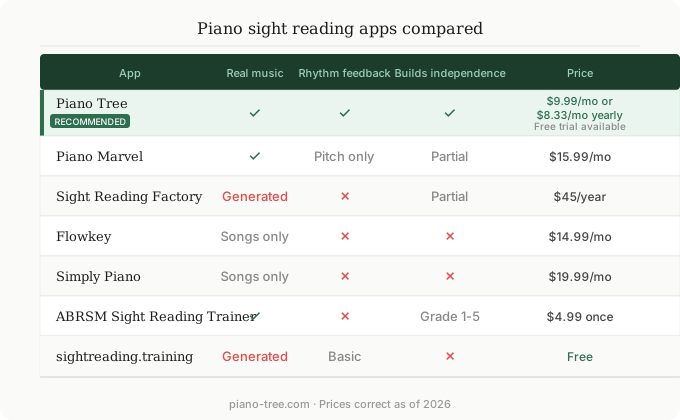
Pricing: $9.99 per month, or $8.33 per month on the annual plan. Free trial available. At roughly half the price of Piano Marvel and Flowkey, it is the most affordable dedicated sight reading platform in the market.
Works with: an acoustic piano or any digital piano through your device's microphone, or a MIDI keyboard over USB or Bluetooth. Microphone mode scores your rhythm and shows the notes it hears but does not flag wrong notes; MIDI gives full note-by-note feedback.
Piano Tree works as a 15-minute daily practice tool alongside regular lessons and the real piano books. It is not designed to replace a teacher or a curriculum. It fills the specific gap that most curricula leave open: daily reading of new material with immediate feedback.
Piano Marvel
Best for: Students who want structured assessment alongside practicePiano Marvel has been around since 2010 and has a large library of over 25,000 pieces. Its headline feature is the SASR assessment, a numerical score that tracks sight reading progress over time.
The limitations are significant for what you are paying. At $15.99 per month it is the most expensive option in this comparison, and the interface is widely considered dated and slow compared to modern apps. Some users also report accuracy issues with the feedback system. The curriculum can feel rigid, and the overall experience does not match what a student in 2026 expects from a music app at that price point.
The library size is the main argument in its favour. If breadth of repertoire is your primary concern, it has that. But breadth without an engaging interface or accurate real-time feedback is a harder sell when more modern alternatives exist at lower prices.
Best suited to: Students who specifically need a large graded repertoire library and are not bothered by an older interface.
Sight Reading Factory
Best for: Targeted exam drilling with unlimited materialSight Reading Factory does one thing very well: it generates an unlimited number of sight reading exercises customised to your specifications. You choose the key, time signature, note range, rhythmic complexity, and number of voices, and the app produces exercises on demand.
This is genuinely useful for targeted drilling, particularly for students preparing for ABRSM or other graded exams where they need to practise specific difficulty parameters repeatedly.
The limitation is significant though. Generated exercises are not real music. They do not have the harmonic logic, melodic shape, or stylistic character that real pieces have. A student who drills only generated exercises develops a narrower skill than one who reads real music across a variety of styles. They may pass the exam sight reading test and still struggle with a real piece placed in front of them.
Best suited to: Students specifically preparing for graded exams who need to drill particular technical parameters.
Flowkey and Simply Piano
Best for: Complete beginners who want to learn songsThese two apps dominate the consumer market and are genuinely excellent at what they do, which is helping complete beginners learn to play recognisable songs quickly. The interfaces are beautiful, the song libraries are large, and the onboarding experience is polished.
But these are not sight reading apps. They are song learning apps. The distinction matters enormously.
The falling-dot systems that both apps use do not teach you to read music. They teach you to respond to visual cues in the app's specific interface. When a student who has used Simply Piano for a year sits down with a piece of printed sheet music, they are typically unable to read it independently. The skill does not transfer.
I have seen this in my own studio. A student came to me after three years of Simply Piano. Her technique was minimal and her reading ability was close to zero. Three years of correct practice would have put her at ABRSM Grade 3 standard. She started from scratch.
That is not a criticism of those apps for what they are. Entertainment and engagement have value. But if your goal is genuine musical literacy, these apps are a detour rather than a path.
Best suited to: Complete beginners who want to play songs for pleasure and are not concerned with developing musical independence.
ABRSM Sight Reading Trainer
Best for: Students preparing specifically for ABRSM exams up to Grade 5The official ABRSM app uses genuine exam content and accurately reflects the difficulty and style of the actual ABRSM sight reading tests. For students preparing for Grades 1 through 5, it is a reliable and affordable resource.
The limitations are real: it only covers up to Grade 5, has no MIDI feedback, is iOS only, and the content library is naturally limited. It is a specific tool for a specific purpose rather than a general sight reading development platform.
Best suited to: Students actively preparing for ABRSM Grades 1 to 5 exams.
Free Browser Options
Several free browser-based tools exist for basic sight reading practice. Sightreading.training supports MIDI in the browser and is completely free, making it a reasonable starting point for beginners who want to test MIDI sight reading before committing to a paid app. The interface is minimal, the exercises are generated rather than real music, and there is no progress tracking. But as a free entry point it serves its purpose.The Honest Verdict
If you are serious about developing genuine sight reading ability, the choice comes down to what kind of skill you want to build.Sight Reading Factory is the right choice if you are drilling for a specific exam and need unlimited generated material at a particular difficulty level.
Piano Marvel is worth considering if a large repertoire library is your primary requirement and you are comfortable with a dated interface at a premium price.
Piano Tree is the right choice if you want to build the kind of sight reading fluency that transfers off-screen: to printed music, to ensemble playing, to accompanying, to learning new repertoire faster. At $9.99 per month or $8.33 per month on the annual plan, it is also the most affordable dedicated sight reading platform available, so there is no reason to pay more for less. The combination of real music, real-time rhythmic feedback, genuine difficulty sequencing, and a design philosophy that prioritises musical independence over app engagement is what distinguishes it from every other option in the market.
For students working with a teacher, fifteen minutes of Piano Tree daily is enough to produce measurable improvement in reading fluency within weeks. It works alongside lessons and real piano books. It does not replace them.
The music book and the real teacher remain irreplaceable. But in the specific gap between lessons, structured daily sight reading with immediate feedback is the single most effective habit a developing pianist can build. Piano Tree is designed to make that habit as easy as possible to sustain.
Try Piano Tree and start building real sight reading fluency todayFor more on what genuine piano sight reading practice looks like, read How to Practice Piano Sight Reading and Why Most Piano Apps Don't Teach Sight Reading.