
Many piano students spend years solving theory exercises on paper, yet still struggle to improvise, realise a lead sheet, or understand harmony at the keyboard. The reason is simpler than most teachers admit: they studied music without sound. And music without sound is not music. It is notation.
If you want to truly learn harmony, it must be studied at the piano.
This post connects closely with two others in our path series: The Composer Path and The Jazz Piano Path. Both paths depend on the kind of harmonic understanding described here.
Why Studying Harmony Only on Paper Is Not Enough
Traditional music theory education often focuses on:
- Labelling chords
- Roman numeral analysis
- Four-part exercises on paper
- Written harmonic reduction
Analysis has genuine value. Understanding what has already happened in a piece of music is a legitimate intellectual exercise.
But without hearing and physically playing harmony, learning remains incomplete. Unless a student has developed advanced audiation, harmony should not be studied in silence. The moment you remove sound from harmonic study, you are no longer studying music. You are studying a representation of music.
Music is sound. Without sound, theory becomes abstract. And abstract theory produces students who can label chords but cannot use them.
This is the gap between knowing and doing. A student can correctly identify every chord in a Bach chorale and still be unable to harmonise a simple melody at the keyboard. The two skills feel related but develop through completely different kinds of practice.
The Piano Is the Laboratory of Harmony
When you play harmony at the piano rather than writing it on paper, something different happens.
You hear tension and resolution as physical events, not as theoretical descriptions. You feel voice leading under your fingers, the pull of a leading tone, the satisfaction of a suspension resolving. You understand bass motion not as an abstract concept but as a direction your left hand travels. You experience counterpoint in real time, two or more lines moving simultaneously, each with its own logic.
Theory becomes musical. The piano does not just demonstrate harmony. It makes harmony audible, physical, and therefore genuinely learnable.
This is why the greatest harmony teachers throughout history, from the Baroque era through to the present, have insisted on working at the keyboard. Written harmony produces analysts. Keyboard harmony produces musicians.
The Most Effective Method: Figured Bass and Practical Counterpoint
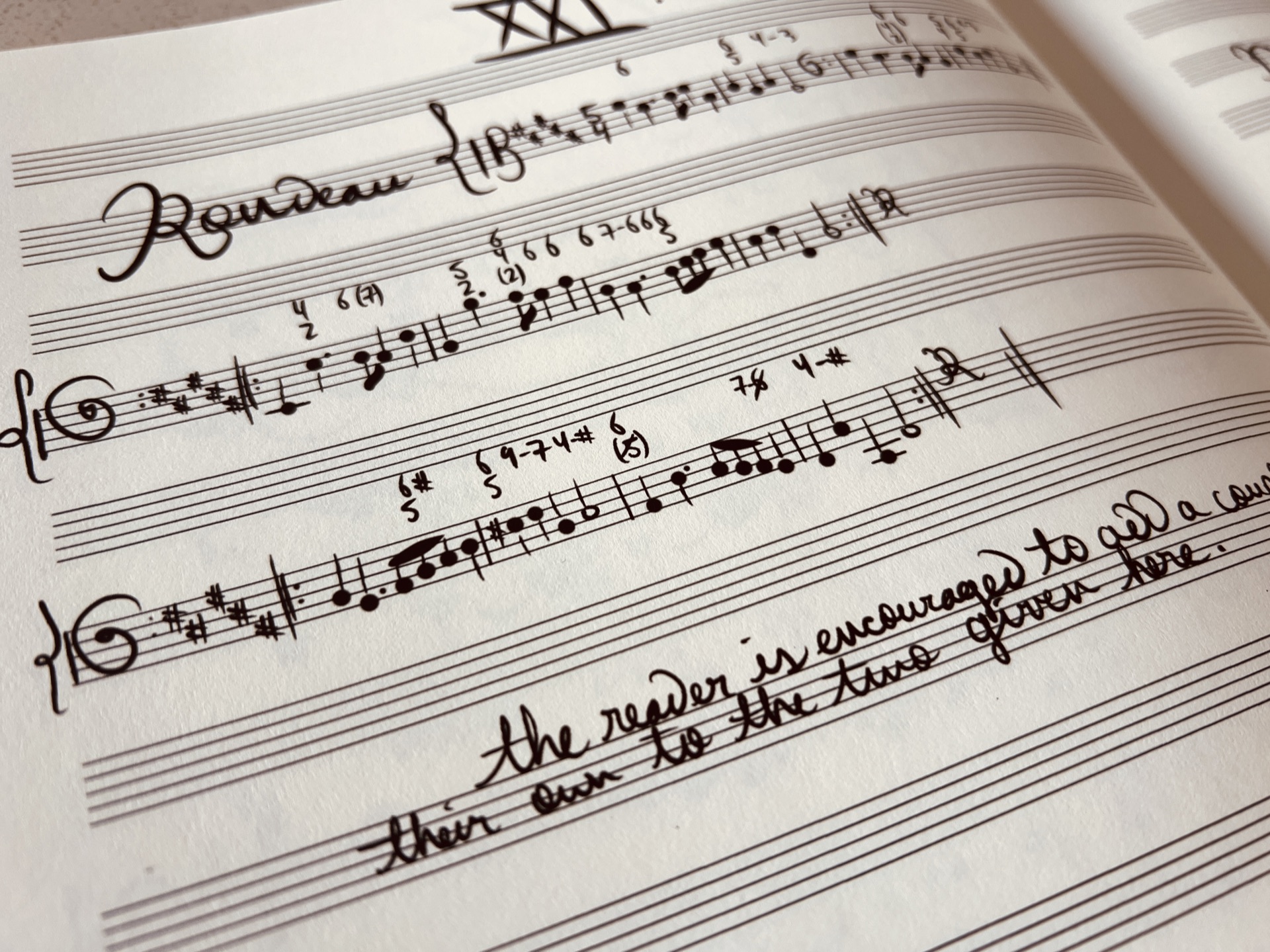
One of the most powerful historical methods for learning harmony at the piano is figured bass.
Unlike modern harmonic analysis, which describes what already happened in a piece of music, figured bass is generative. The bass moves. The figures guide your hands. Harmony unfolds through motion rather than through labelling.
Through this process, students internalise:
- Voice leading as a physical habit, not a theoretical principle
- Chord function through repeated experience of how harmonies behave
- Suspensions and resolutions as moments of tension and release
- Structural bass patterns that recur across centuries of music
- Improvisational thinking, because figured bass realisation is a form of real-time composition
This is not passive theory. This is active musicianship.
Figured bass was the actual compositional language of the Baroque era. Composers like Bach and Handel did not analyse harmony after the fact. They generated it in real time from a bass line and a set of figures. Learning this system gives you access to the same generative thinking they used.
Closely related is practical counterpoint: working with two or more independent melodic lines at the keyboard, hearing how they interact, feeling where they pull against each other and where they resolve together. Counterpoint studied at the piano is a completely different experience from counterpoint written on paper. The physical reality of managing two lines simultaneously with two hands teaches things that writing exercises cannot.
For a structured approach to harmony and counterpoint at the keyboard built on these historical methods, the Harmony and Counterpoint course covers this methodology in depth.Harmony Is Not Style-Dependent
One of the most important things to understand about harmonic training is that the principles transfer across every musical style.
The vocabulary changes. The structure does not.
- Classical: Voice leading, cadential patterns, figured bass realisation, chorale writing
- Jazz: Chord extensions, ii-V-I progressions, lead sheet realisation, improvisation
- Popular music: Chord symbols, accompaniment patterns, song harmonisation
- Film scoring: Functional harmony, modal colour, harmonic rhythm, underscore
- Tango and Latin: Chromatic harmony, idiomatic left hand patterns, rhythmic displacement
A pianist who genuinely understands harmony understands it across all of these contexts. The jazz musician who knows what a ii-V-I does harmonically is using the same understanding as the classical musician who knows what a predominant-dominant-tonic progression does. The labels differ. The logic is the same.
The vocabulary changes. The structure does not. A pianist who understands jazz harmony understands harmony.
This is why thorough harmonic training is not just for classical musicians or just for jazz musicians. It is the foundation that makes genuine musical freedom possible in any style.
Why Sight Reading Alone Is Not Enough
Sight reading fluency is foundational. Without it, a pianist cannot access new music independently, and the entire learning process slows dramatically. Building strong sight reading skills through structured daily practice, exactly what Piano Tree is designed to support, is one of the most important investments a developing pianist can make.But reading alone builds repetition, not freedom.
A complete pianist can do things that a fluent reader who has not studied harmony cannot:
- Realise a lead sheet with appropriate voicings rather than just playing the melody
- Improvise over chord changes with genuine harmonic understanding
- Understand why a bass line moves the way it does
- Hear harmonic direction in unfamiliar music
- Play stylistically across different genres because the harmonic logic is the same
The integration of reading, harmony, and ear training is what produces musical independence. Each of the three reinforces the others. None of them alone is sufficient.
This integration is what separates a competent performer from a genuinely musical one. The pianist who reads fluently, understands harmony deeply, and has trained their ear to hear what they understand, can walk into almost any musical situation and contribute meaningfully.
How to Practise Harmony at the Piano
A practical structure for building harmonic understanding at the keyboard:
- Daily: Realise figured bass exercises: bass moves, figures guide the hands, harmony unfolds
- Daily: Practise with lead sheets: harmonise melodies using triads, then seventh chords, then extensions
- Regular: Play with backing tracks: apply harmonic knowledge in a rhythmic, musical context
- Regular: Integrate ear training: sing the bass, sing the soprano, identify progressions by ear
- Progressive: Advance gradually from simple cadences to complex harmonic structures
The key principle throughout: harmony must always be audible. Every exercise, every progression, every realisation must be heard, not just written. If you cannot play it and hear it, you have not yet learned it.
A common mistake is to treat harmonic exercises as written tasks with a piano nearby for checking. Reverse this. Sit at the piano first. Work out the realisation at the keyboard. Notate afterward if you need to. The hands and ears should lead; the pen follows.
The Real Goal: Freedom at the Piano
The purpose of harmony study is not to pass exams or accumulate theoretical knowledge. It is to gain genuine musical freedom.
Freedom to understand what you are playing, not just to execute it mechanically. Freedom to create your own harmonisations of a melody rather than depending on a written arrangement. Freedom to improvise confidently because the harmonic language is internalised rather than looked up. Freedom to move across styles because you understand the underlying logic that all styles share.
When theory stays connected to sound, technique serves expression. The piano stops being a place where you reproduce notation and becomes a place where you make music.
That is the goal. And it is achievable by any pianist willing to do the work at the keyboard rather than just on the page.
Build the reading foundation that makes harmonic study more effective with Piano TreeFor a deeper look at how harmonic training fits into specific musical paths, see The Composer Path and The Jazz Piano Path.