
Some students reach Grade 5 and can barely read new music without weeks of struggle. Others at the same level sit down at an unfamiliar piece and work through it confidently. The difference rarely comes down to talent. It comes down to what was built in the early years, and specifically whether sight reading was treated as a priority or an afterthought.
This is Part 1 of a 4-part series on ideal piano training. Part 2 covers the intermediate years, Part 3 the advanced years, and Part 4 explores the professional paths a serious pianist can take.
Every piano journey begins somewhere. For most students, that starting point is somewhere between ages 5 and 7, a beginner book, and a teacher trying to balance encouragement with technique.
But not all beginnings are equal.
This post is about those early years: what they should look like, what matters most, and why the foundations you build between ages 6 and ABRSM Grade 3 determine almost everything that follows.
When Should a Child Start Piano Lessons?
In an ideal scenario, most children begin between ages 5 and 6. If a child is not quite ready at 5, perhaps attention span is still short or fine motor skills are still developing, starting at 6 or 7 makes no meaningful difference in the long run.What matters far more than the starting age is the quality of the early training.
Even students who begin at 10, 15, or as adults can reach a very high level if the foundations are built correctly. The process is the same. The timeline is different.
Three Goals for the Early Years
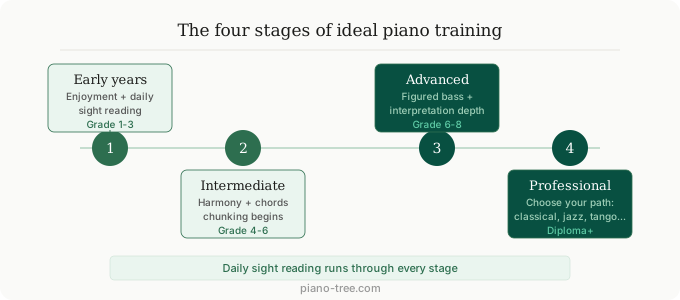
At this stage, covering roughly the period from first lessons to ABRSM Grade 3, there are three goals. One is non-negotiable. Two are foundational.Goal 1: The Child Must Enjoy Piano
Nothing else matters if this one fails.The logic is simple. If a child enjoys lessons, they practice. If they practice, they improve. If they improve, they enjoy it even more. That cycle is self-sustaining once it starts, but it has to start somewhere.
Young children enjoy:
- Playing short pieces they can actually manage
- Clapping rhythms and musical games
- Feeling successful quickly
- Laughing during activities
Piano at age six should feel like structured play. The teacher can gradually raise expectations, but in the beginning it is far safer to be slightly too encouraging than too strict. If lessons become associated with stress or constant correction, a child forms a negative emotional memory around music that can last a lifetime.
The atmosphere in early lessons matters as much as the content.
Goal 2: Piano Sight Reading for Beginners
This is where most teaching systems fail, and it is the most important technical skill you can build in the early years.A child should be reading new music every single day. Not the same pieces on loop. New music, regularly, from the very beginning.
A student who develops strong sight reading early:
- Learns repertoire faster at every stage
- Feels independent at the piano
- Can join school ensembles and bands without panic
- Moves through ABRSM grades smoothly
- Never dreads being handed an unfamiliar piece
More importantly, a child who can read fluently can make real music from early on. And making real music is what keeps students motivated.
The challenge with daily sight reading at home
Parents who want to support this habit traditionally face a real problem. Borrowing a stream of graded beginner books requires musical knowledge to choose the right level and catch errors in real time. Most families are not trained musicians. It becomes stressful for everyone.
A structured system removes that guesswork entirely. If daily sight reading has been trained consistently from the start, the student no longer fears new music. Piano Tree was built specifically for this: it provides instant feedback on accuracy and rhythm, adjusts difficulty automatically, and sequences new material so students are always reading something just at the edge of their ability. Parents do not need musical training to support daily practice because the system handles the feedback and progression.
If you are a parent supporting a young beginner, the single most valuable habit you can build is five to ten minutes of new sight reading every day. Consistency matters far more than the length of each session.
Goal 3: Technique, But in Proportion
Technique matters in the early years, but it must be taught with an understanding of what a six-year-old's body can actually do.Children at this age are still developing physically. Their bones are not fully formed. Demanding perfect finger five strength or rigid hand position from lesson one is not only unnecessary, it can frustrate a child and slow musical progress at exactly the stage where enjoyment is everything.
In the early years, technique means:
- Relaxed arms and wrists
- Natural hand shape, not forced position
- Basic posture at the bench
- Simple finger independence without rigidity
Perfection is not the goal here. Healthy development over time is. Strong technique gets built progressively through the intermediate years once the body is ready for it.
What a Good Early Practice Routine Looks Like
For a student working toward ABRSM Grade 3, a practical daily routine is short and consistent:- 5–10 minutes: Sight reading on new material
- 10–15 minutes: Repertoire practice on current pieces
- 5 minutes: Simple technical exercises
- Occasional: Rhythm clapping or counting aloud
Ten focused minutes every day is significantly more effective than one long session at the weekend.
What Should Be in Place by ABRSM Grade 3?
By the end of this stage, an ideally trained student should be able to:- Read basic notation fluently without guessing
- Keep a steady rhythm independently
- Play with both hands with reasonable coordination
- Show relaxed, natural technique
- Practice independently with light supervision
- Approach the piano with genuine enthusiasm
The last point is easy to underestimate. A child who reaches Grade 3 genuinely enjoying piano is a student who will continue. That enjoyment is not a soft outcome. It is the precondition for everything that follows.
Why This Stage Sets the Ceiling
The habits formed in the early years are the hardest to change later. A student who reaches Grade 5 without having built daily reading habits faces a real obstacle, because the pieces at that level assume a fluency that takes years of consistent exposure to develop.Conversely, a student who reads new music every day from the beginning arrives at the intermediate years with a skill that accelerates everything: learning repertoire faster, understanding harmony more quickly, and feeling like a musician rather than someone still figuring out the notes.
Sight reading is not a separate subject to add once the basics are covered. It is the basic. Building it from day one is the single biggest advantage you can give a young piano student.
See how Piano Tree builds sight reading from day oneNext in this series: Part 2 covers the intermediate years, from ABRSM Grade 3 to Grade 6, where harmony enters the picture and many students either accelerate or quietly give up.