
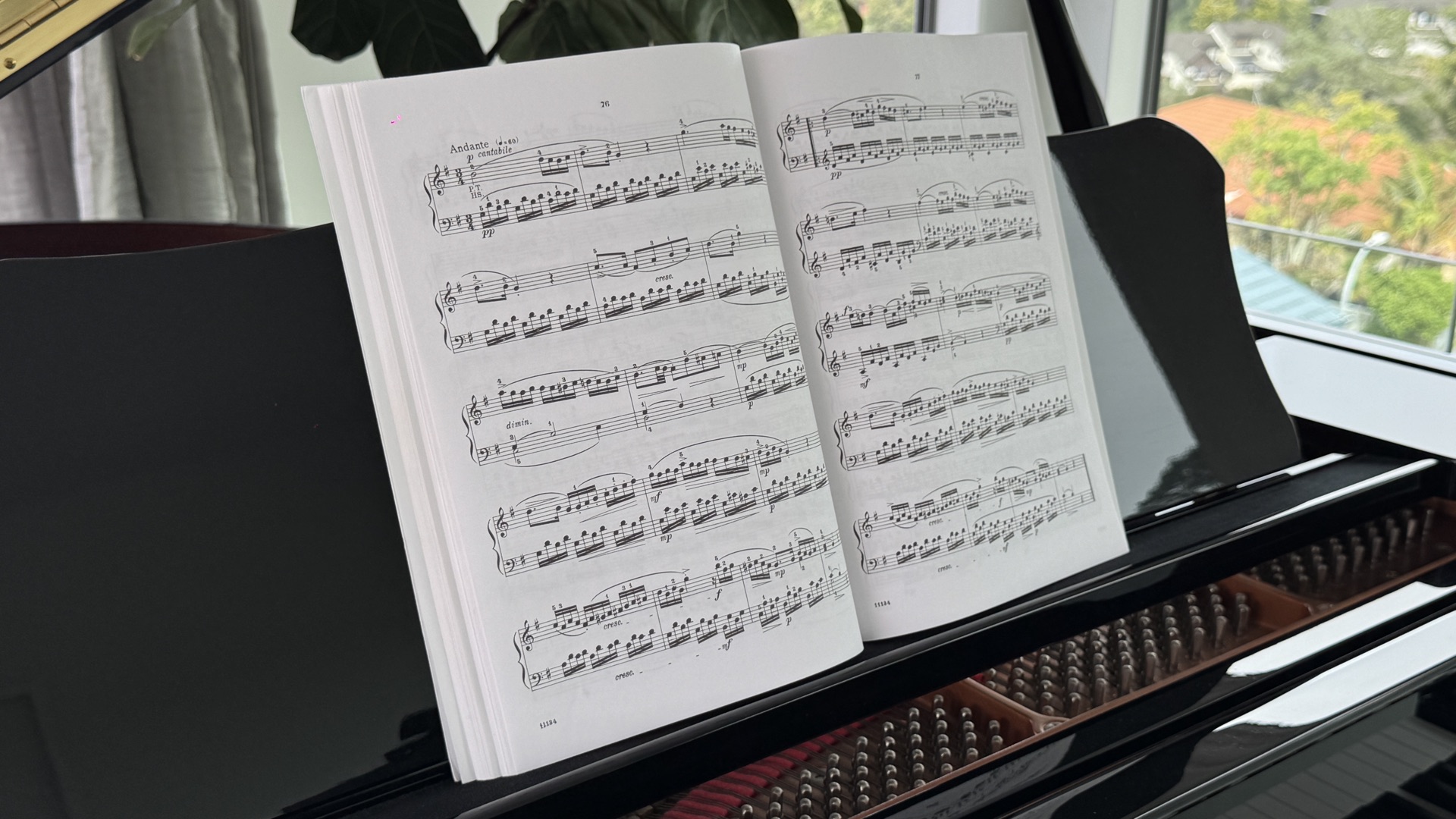
Most advanced piano students spend too much time learning notes and not enough time making music. At Grade 7 and 8, a student with strong sight reading learns the notes of a new piece in days. A student without it spends weeks on the same task, leaving almost no time for the refinement that actually produces a polished performance. The best way to practice piano at this level is not to work harder. It is to decode faster so that the real work, tone, phrasing, interpretation, can actually begin.
This is Part 3 of a 4-part series on ideal piano training. Part 1 covers the early years. Part 2 covers the intermediate years and how harmony unlocks faster sight reading. Part 4 explores the professional paths a serious pianist can take after Grade 8.
By ABRSM Grade 6, a student who has followed a structured training path has already achieved something significant. Sight reading is reliable. Technique is natural. Chords and harmonic progressions are understood. Rhythm is stable.
Now comes the stage where depth replaces breadth. The advanced years, covering Grade 6 to Grade 8, are not about adding more skills. They are about taking everything built so far to a level of genuine musical maturity.
Why Finishing Grade 8 Matters
At this stage a choice often appears. The student can continue toward ABRSM Grade 8, or branch into popular music, jazz, or another style entirely. Both paths are valid and both are explored in Part 4 of this series.But in an ideal training system, finishing the grades first is strongly worth considering.
Grade 7 and 8 repertoire exposes students to architecturally complex music in a way that no other stage does. Fugues. Extended sonatas. Large Romantic works with multiple sections and dramatic contrasts. These pieces are not simply harder. They demand structural awareness, interpretative maturity, and the ability to sustain musical thinking across long spans of time.
Completing Grade 8 builds a depth of musical understanding that transfers to every other style afterward, including popular music, jazz, and composition.
The student who skips it often finds, years later, that something fundamental is missing from their playing.
The Hidden Accelerator: Advanced Sight Reading
Here is something most students and parents do not realise about the advanced years.The biggest drain on practice time at Grade 7 and 8 is not the technical difficulty of the pieces. It is the time spent simply learning which notes to play.
A student without strong sight reading can spend two to three weeks on the note-learning phase of a single advanced piece before any real musical work can begin. A student with strong sight reading reduces that phase to a few days. The pieces are identical. The practice time available for tone control, voicing, phrasing, and tempo development is completely different.
Daily sight reading at this level is not a beginner habit that can be dropped. It is a professional skill that directly determines how efficiently a student can learn and polish advanced repertoire.
If daily sight reading has been trained consistently at every stage, the student learns notes faster, leaving more time for interpretation and technique rather than decoding. A structured system keeps this habit consistent even at advanced level.
At Grade 7 and 8, measure your practice efficiency not just by how many hours you put in, but by how quickly you move from note-learning into musical refinement. Faster decoding means more time for the work that actually shows in performance.
Harmony at an Advanced Level: Beyond Chord Symbols
At intermediate level, understanding major and minor triads, inversions, and common chord progressions is sufficient. At advanced level, that understanding needs to go deeper.For students working with Baroque and Classical repertoire, which dominates Grade 7 and 8 syllabuses, Roman numeral analysis and chord symbols describe the music but do not explain the thinking behind it. To truly understand how a fugue works, or why a sonata creates the tension it does at a particular moment, a student needs to understand figured bass.
Figured bass was not a theoretical decoration invented after the fact. It was the actual compositional language of the Baroque period. Composers thought in bass lines first. Harmony was understood simultaneously in both its vertical and horizontal dimensions.
Analysing a fugue using only Roman numerals is like trying to understand an Argentine tango poem using German grammar. Technically possible, but culturally incomplete.
Figured bass reveals:
- The voice leading decisions that create tension and resolution
- The structural function of suspensions and their resolutions
- Cadential patterns and how they articulate musical form
- The horizontal logic of bass motion that drives harmonic direction
- How counterpoint emerges from overlapping melodic lines
When a student understands figured bass, a fugue stops being a collection of voices to coordinate and becomes a logical conversation between lines. A sonata stops being three movements to memorise and becomes dramatic architecture with a clear internal logic.
How Deep Harmony Training Changes Interpretation
The practical effect of figured bass understanding on performance is immediate and significant.A student who only knows that a passage is in D minor plays the notes. A student who understands that the bass is outlining a descending tetrachord, with suspensions creating a chain of tension and resolution, makes interpretative choices that are grounded in the structure of the music itself.
Phrasing becomes motivated rather than instinctive. Dynamics follow harmonic logic rather than vague impressions of loud and soft. Tempo decisions reflect structural awareness rather than habit.
This is not an abstract or academic benefit. It shows directly in how the music sounds.
What an Ideal Advanced Practice Routine Looks Like
The best way to practice piano at this level is structured around three distinct phases within each session:- 5–10 minutes: Daily sight reading on new material to open every session
- 20–30 minutes: Repertoire work in structural sections, not whole pieces
- 10 minutes: Harmonic analysis of the passage before practicing it
Phase 1: Daily sight reading
Even at Grade 8, five to ten minutes of new sight reading material at the start of every session. This maintains the habit, keeps reading fluency sharp, and warms up the reading-to-playing connection before any other work begins. Piano Tree keeps this habit structured and progressive even at advanced levels.Phase 2: Repertoire work in sections
Advanced pieces should never be practiced as a whole until they are already nearly learned. Work in structural sections: an exposition, a development section, a fugal episode. Isolate the technically demanding passages and build them slowly before integrating them into context.
Phase 3: Harmonic analysis alongside practice
At this level, understanding what you are playing is not optional. Identify the harmonic framework of a passage before practicing it. Know where the structural cadences are. Understand the voice leading in complex textures. Five minutes of genuine understanding before a practice section saves significant time in the learning phase.
What Should Be in Place by ABRSM Grade 8
By the end of the advanced years, a well-trained student should have:- Advanced sight reading fluency that makes new repertoire learning efficient
- Solid technical control at higher tempos with genuine tone production
- Harmonic understanding that goes beyond chord symbols into voice leading and structural logic
- Working knowledge of figured bass principles and how they apply to Classical and Baroque repertoire
- Confident and stable rhythm across complex textures
- Efficient practice habits that prioritise musical refinement over note-learning
A student finishing Grade 8 with these foundations in place does not do so because the pieces were easy. They do so because the foundations made the difficulty manageable.
Why This Stage Protects Long-Term Growth
Many students plateau at Grade 7. The cause is almost never lack of talent.It is incomplete foundation: sight reading that was never properly built, harmony that was never deepened beyond basic chords, practice habits that default to repetition without structural understanding.
When the full system is in place, daily sight reading, structured chord and harmonic training through to figured bass, and intelligent practice routines, the plateau rarely happens. Momentum continues because every new piece builds on a framework that the student genuinely understands.
That understanding is what separates a student who finishes Grade 8 from one who almost does.
See how Piano Tree supports structured sight reading through every levelNext in this series: Part 4 explores the professional paths that open after Grade 8, from the diploma track and jazz piano to film composition and teaching, and what each path demands from the foundations built in the earlier years.