
Imagine we spend a few hours together and I teach you a poem in Spanish. My first language is Spanish and I am assuming you do not speak it. I help you perfect the pronunciation, the accent, the nuances. I even tell you to smile at a particular line, to show a sad expression at another, to let curiosity appear on your face as you speak certain words. You never read the poem. You just listen and repeat, maybe with some visual cues to help you remember.
Finally you can recite the entire poem. You are proud of it. You decide to perform it for someone important.
They listen. Then they ask: "Beautiful. But what does it mean?"
You have no idea.
They ask you a question about the poem. You cannot reply. They hand you another poem and ask you to read it. You cannot. You never learned to read Spanish. You only learned to reproduce one specific sequence of sounds.
The poem was a party trick. An impressive one. But a party trick.
This is how millions of people learn piano. They watch notes scroll across a YouTube screen, copy the finger movements, and eventually produce a recognisable song. Then someone hands them a piece of sheet music and they are lost. Or someone plays a chord and asks what it is. Nothing.
This post is about the difference between that, and actually learning to play piano.
The Party Trick Problem
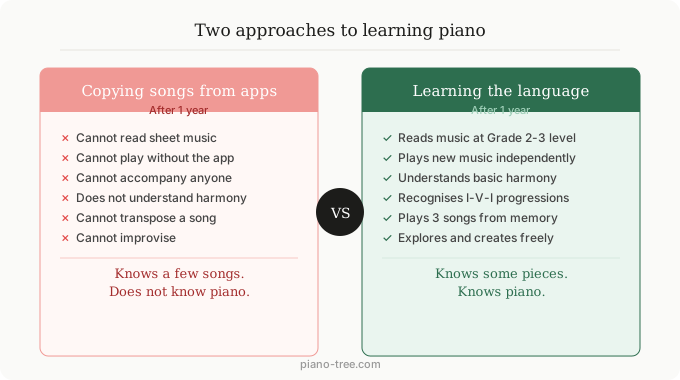
The explosion of piano tutorial videos and song-learning apps has made it easier than ever to produce a recognisable version of a popular song on the piano. This is genuinely appealing. There is real satisfaction in playing something you love, even incompletely.But there is a ceiling to this approach that most people hit within a year or two, and it is a ceiling made of everything they skipped.
They cannot read music, or can only read it very slowly. They do not understand why one chord follows another. They cannot transpose a song to a different key. They cannot improvise, even simply. They cannot accompany a singer. When they want to learn a new song they have to go back to YouTube and start the copy-and-repeat process again from scratch.
They have learned songs. They have not learned piano.
Learning the Language, Not Just the Sounds
When you learn a language properly, you learn to read it, write it, speak it, and understand it when others speak it. You develop a relationship with the grammar that lets you construct new sentences you have never heard before, not just reproduce phrases you memorised.Music is a language. It has grammar. It has syntax. It has idioms and patterns that recur across centuries of repertoire. A student who learns that grammar has access to all of it. A student who only learned to reproduce specific pieces has access only to those pieces.
The way I like teaching is simple: you learn the language. You learn to read the notes, but then you also understand the progressions, the cadences, the counterpoint. You learn what the music is saying, not just how to produce its sounds.
This does not mean the learning has to be joyless or abstract. Quite the opposite. Understanding makes music more interesting, not less. When a student recognises that the left hand of a simple Czerny exercise is outlining a I-V-I progression, they have not been burdened with theory. They have been given a key that opens thousands of doors.
Reading: The Foundation of Independence
The first and most fundamental gap between playing songs and learning piano is reading ability.A pianist who cannot read music is permanently dependent on someone or something else to show them what to play. They can only learn what they can hear and copy. Their repertoire is limited to what exists in tutorial form. Their progress is always mediated by someone else's choices.
A pianist who reads fluently is independent. They can walk into a music shop, pick up a book of Chopin nocturnes, sit down at the piano, and begin. They can read through a new piece at a lesson and immediately start working on it. They can join an ensemble, read the part, and contribute.
Reading fluency does not develop by copying YouTube videos. It develops through daily exposure to new notation, which is exactly what structured sight reading practice builds. This is the core of what Piano Tree is designed to do: provide the daily reading experience that builds genuine fluency over time, with real-time feedback and automatic progression.A student who reads new music for ten minutes every day will develop more reading fluency in three months than a student who spends hours copying the same songs repeatedly. Fluency comes from variety and consistency, not from repetition of the same material.
Understanding What You Are Playing
Reading is necessary but not sufficient. The second gap is understanding.All of my students doing simple Czerny exercises know how to recognise the basic I-V-I progression. They can tell me what the left hand is doing harmonically. They can identify the cadence. They understand that when the music resolves from the dominant back to the tonic, something has arrived. They feel it before they can name it, and naming it simply confirms what they already sense.
This level of understanding does not require years of formal theory study. It develops naturally when a teacher points things out consistently from the beginning. "Do you hear how the music wants to come home there? That's the V going to the I." After hearing this explanation applied to dozens of different pieces across months of lessons, the student internalises it without effort.
And once it is internalised, they start hearing it everywhere. In the radio. In film scores. In the hymns at church. In the songs they already knew how to play by copying from YouTube.
The copy suddenly has meaning it never had before.
The Czerny Swapping Technique
One of my favourite ways to bridge the gap between reading and understanding is what I call the swapping technique, which we use with Czerny exercises and which is built into Piano Tree's expanding library.
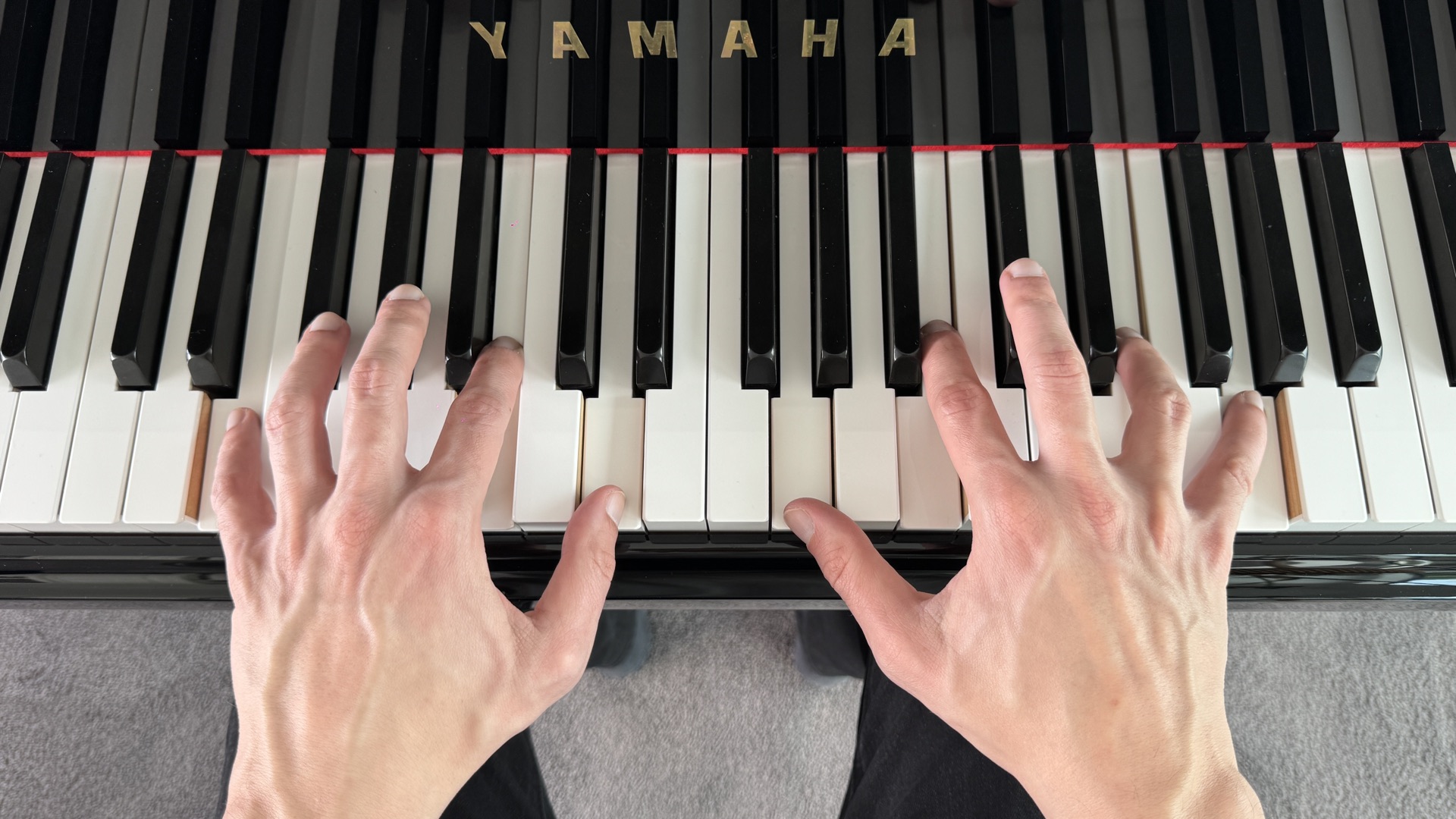
Take two exercises that share the same harmonic content but present it differently. In Czerny Op. 777, Exercise 2 has a minim playing a C chord: simple, slow, clear. Exercise 4 takes the same C chord and presents it as an Alberti bass: the same three notes, but broken up into a pattern that creates rhythmic momentum.
Now swap. Take the melody from Exercise 2 and play it with the left hand pattern from Exercise 4. Or take the same melody but use the waltz pattern from Exercise 3 as the accompaniment, adjusting from three-four to two-four time.
You see how they are getting creative with very simple material. They start speaking the language. The equivalent of having a basic conversation in Spanish where you ask and I reply, where you can read simple things and understand what you read.
This technique does several things simultaneously. It develops reading flexibility because the student must read the same notes in a new context. It develops harmonic understanding because they hear the same chord function expressed through different textures. And it develops creativity because they are making musical decisions, not just reproducing someone else's.
A student who can do this with simple Czerny exercises is no longer copying. They are beginning to compose. The language is starting to become theirs.
When Students Start Speaking the Language
The moment I know a student has crossed from copying to understanding is when they start asking "what if" questions.What if I played this part faster? What if I used a different rhythm in the left hand? What if I changed this chord? What if I tried the same piece in a minor key?
These questions cannot come from a student who only knows how to copy. They can only come from a student who understands enough of the language to imagine variations they have not been shown.
This is the goal. Not any specific piece or any specific grade level. The goal is the moment when the piano stops being a machine for reproducing sounds and becomes a language the student can use to express something of their own.
It starts earlier than most people think. With a student who has been reading daily and who has been shown the harmonic patterns underneath even simple beginner pieces, this creative spark can appear within months of starting lessons. Not because the student is exceptionally talented, but because they have been taught the language rather than just the sounds.
How Piano Tree Teaches the Language
Everything described in this post is reflected in how Piano Tree is designed.The daily sight reading practice builds reading fluency through consistent exposure to new material, real-time feedback, and automatic progression to harder levels as the student is ready. This is the foundation of independence.
The expanding library includes the exercises and techniques described here, including the swapping approach that lets students encounter the same harmonic content through different textures and patterns. The lead sheet function teaches students to apply different left hand arrangements to the same melody, which is exactly the kind of creative variation that bridges reading and understanding.
The ear training exercises develop the ability to recognise what you are hearing, not just reproduce what you are reading. Because a musician who can read, understand, and hear is a musician who speaks the language, not one who has memorised a party trick.
Start learning piano the right way with Piano TreeFor a deeper look at how these foundations connect to the full piano learning journey, read The Ideal Piano Training Part 1: The Early Years and How to Learn Harmony at the Piano.