

Every year, somewhere in November, a student sits down at their lesson and asks the same question: can I play Jingle Bells for my family this Christmas?
The answer is almost always yes. The hard part is finding a version that fits. Most of the Christmas music students bring to lessons is either too hard, full of chords and leaps they haven't met yet, or simplified so far that the carol no longer sounds like itself. And even when the arrangement is right, there's a second problem: at home, there's no one to play with.
This guide covers which carols to start with, which ones are harder than they look, how to learn a carol in time for the holidays, and how to practise playing with other people when you don't have a band in the living room.
What Christmas songs can a beginner play on piano?
Good beginner carols share three things: a small range of notes, simple rhythms (mostly steady beats and longer notes), and a tune everyone already knows. That last one matters more than people think. When you know how a song should sound, your ear catches mistakes before your teacher does.The easiest carols to start with
- Jingle Bells (the chorus). The famous chorus stays within five notes, so the hand hardly has to move. Start here, not with the verse. The verse wanders more, and almost nobody sings it anyway.
- Jolly Old Saint Nicholas. Lots of repeated notes and small steps, in short phrases that come back again and again.
- Up on the Housetop. Repeated notes, a steady beat and a "Ho, ho, ho" chorus that children love to sing while they play.
- Away in a Manger. Gentle and slow enough to think. A good first carol for counting in three.
- We Wish You a Merry Christmas. Bright and repetitive, also in three. The range is a little wider, so it suits students who are already comfortable in one hand position.
- O Christmas Tree. Slow and singable, but it starts on an upbeat and uses a dotted rhythm. A nice second or third carol.
Carols that look easy but aren't
- Joy to the World. It opens with a complete scale running down a whole octave, starting on a dotted note. Great fun once it works, but the hand has to move or the scale has to be shared between the hands.
- Silent Night. Because it's slow and quiet, people assume it's simple. The lilting rhythm is easy to rush, and the melody climbs higher in the middle than most people remember.
- O Holy Night. A wide range and a big climax near the top. Beautiful, but a better goal for later, or in a version that uses only part of the song.
- Carol of the Bells. The four-note pattern is easy to learn and hard to keep even at speed. It's a test of steadiness more than of notes.
- The Twelve Days of Christmas. Simple pieces, long song. Each verse adds a line, and "five gold rings" breaks the pattern. Good for concentration, tiring for a beginner.
- Hark! The Herald Angels Sing. Brisk, with a wide range. Better once the student can move around the keyboard with confidence.
Why do Christmas arrangements feel too hard or too simple?
An arrangement is a set of decisions: which key, how much of the song, what each hand does. A good one is made for a particular stage of learning. When a piece doesn't fit, the student usually blames themselves, when really the music is the problem.Signs an arrangement is too hard
- A key with more sharps or flats than the student has learned.
- Left-hand chords before the student can comfortably play single bass notes.
- The hands jump to new positions every bar or two.
- After two weeks of short daily practice, it still can't be played through slowly.
Signs an arrangement is too simple
The tune has been cut or the rhythm flattened until it doesn't sound like the carol the family knows. Students notice straight away, and they lose interest just as fast. A simple arrangement should still sound like the song.
A simple arrangement should still sound like the song.
Playing the same carol at more than one level
One of my favourite ways to use Christmas music is to bring the same carol back as a student grows. This year it's the Jingle Bells chorus in one hand position. Next year it's the whole song with a left-hand part. Later it has chords in both hands and a key with a few flats. The student can hear their own progress in a tune they know by heart, and because the melody is familiar, their attention goes to reading and playing rather than guessing how it should sound.
How do you match a Christmas piece to the player?
Levels and grades vary between methods and countries, so here's what to look for rather than a label:- First months of lessons: the tune in one hand position, one note at a time, perhaps shared between the hands around middle C. Quarter notes (crotchets) and longer. Familiar keys like C, G and F major.
- After a year or so: both hands playing together, with single notes or simple patterns in the left hand, a few new keys and the occasional change of hand position.
- Early intermediate and beyond: chords in both hands, keys with three or four flats, and a fuller sound that can carry a room on its own.
A useful rule for a holiday deadline: if a student can't play through a piece slowly within the first week or two, it's probably a level too high for this Christmas. Save it for next year.
What are the two jobs a pianist does at Christmas?
When the family gathers round the piano, the pianist usually does one of two things: plays the tune, or accompanies while everyone else carries it. Most lessons only train the first. But accompanying is how a huge number of pianists actually play in real life: at church, at school assemblies, for a choir, or for a room full of relatives singing slightly out of tune.Playing the tune
As the soloist, your job is to make the melody sing. Let it sound a little louder than anything underneath it, shape each phrase like a sentence, and breathe at the ends of lines the way a singer would.
Accompanying: keeping time with other people
Accompanying is usually left for the more advanced grades, but I believe the accompanist's role should be taught from the very beginning. Students don't need to wait until they're very good to play with others. At Piano Tree, students start accompanying in Level 1: the orchestra plays the tune as the soloist, and the student accompanies. In real life, the soloist could be a friend, a relative or a teacher, playing the melody on the piano or on any other instrument. The greatest joy in music is playing with others.
Students don't need to wait until they're very good to play with others.
As the accompanist, the rules change. The tune belongs to someone else, and your job is to support it and keep everyone together. The golden rule is simple: don't stop. If you miss a note, let it go and land on the next beat. Singers can't wait while you fix a wrong note, and learning to keep going is one of the most valuable skills a young pianist can build. It's also one of the best sight reading skills there is.
No one to play with? How can you practise with an orchestra?
Practising alone with a metronome is useful, but it isn't the same as playing with people. With others, you have to listen, fit in and keep going, and the music doesn't wait for you. That's exactly what students need before a Christmas performance, and exactly what's missing at home.Playing along with a backing track or orchestra fills that gap. A good way to use one:
- Listen to the full version once, with the tune, so you know how it goes.
- Play the tune with the backing. Aim to stay with the beat, even if a few notes slip.
- Then swap roles and accompany while the orchestra plays the tune. This is where students really learn to listen.
How can you learn a carol in time for Christmas?
- Choose early. Mid-November is ideal. One carol you can play well beats three you half know.
- Learn the chorus first. It's the part everyone sings, and it's often the easiest.
- Hands separately, then together, slowly. Speed comes last.
- Keep sessions short. Ten to fifteen minutes a day does more than one long session at the weekend.
- Do a dress rehearsal. A week before the big day, play it all the way through without stopping, for one person.
For parents of young pianists
Let your child choose the carol, as long as it's at their level. Sing along while they practise, because nothing helps rhythm more. And celebrate one verse played well. That's a real performance.
For adult beginners
Choose by what you can play reliably, not by what you wish you could play. A simple carol played steadily, with everyone singing, is a much better evening than an ambitious one that stops and starts. If you'd like to join in without the pressure of the tune, try accompanying instead.
For teachers planning December lessons
Christmas is a gift for teaching. Students practise more when the music is familiar, and having the same carols at different levels means siblings, group classes and studio concerts can all share a programme. It's also a natural time to teach accompanying and keeping time with others, skills that often get squeezed out the rest of the year.
What's in Piano Tree's Christmas song books?
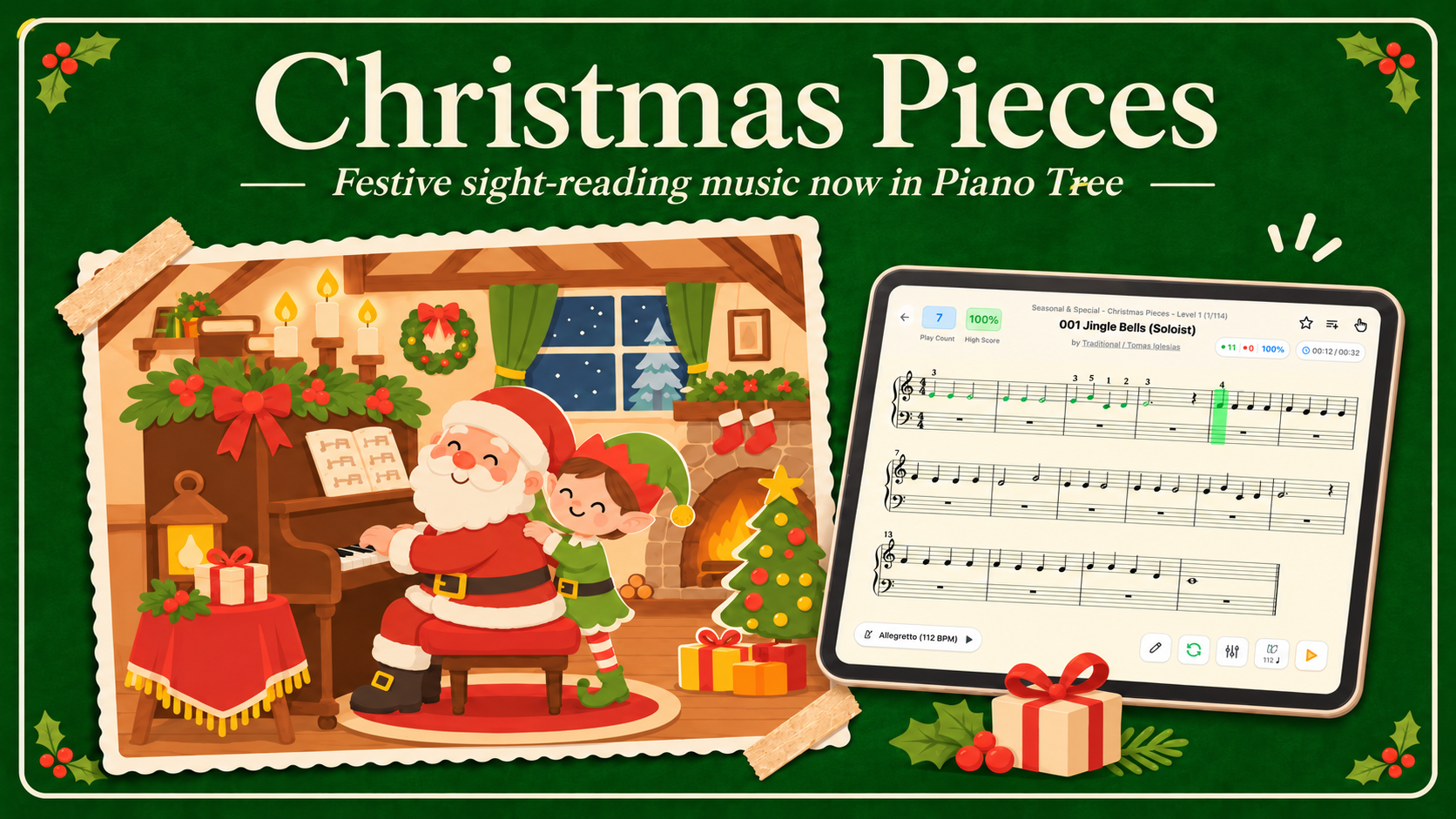
Everything above is the problem we set out to solve with our Christmas song books: music that fits the player, carols the family knows, and someone to play with.- Five books, one for each Piano Tree Path level (Levels 1 to 5). The same public domain carols are arranged at every level, so a student can come back to the same song as they grow.
- Every tune in two versions. In the Soloist version the piano plays the tune. In the Accompanist version the orchestra has the tune and the piano accompanies. Together they teach both roles a pianist plays in real life.
- Over 100 pieces in each book, 556 in total.
- A full orchestra behind every piece: flute, oboe, clarinet, bassoon, horn, harp, celesta, glockenspiel, sleigh bells and strings, with the Christmas touches you'd expect, like sleigh bells, celesta and harp sweeps.
- Works with the piano you have. Piano Tree listens to an acoustic piano through your device's microphone, or connects to a MIDI keyboard.
What changes from level to level
- Level 1: The tune stays in five-finger positions, shared by the hands around middle C, in quarter notes and longer. Keys of C, G, F and D major, and C, G, D and A minor. Some carols use just their best-known section (Level 1 Jingle Bells starts at the chorus). In the Accompanist versions the piano plays simple bass notes, a gentle first step into reading bass clef from middle C.
- Level 2: Adds A major, and the hands start playing together.
- Level 3: Adds B flat major and B minor, and eighth notes (quavers).
- Level 4: Adds E flat major, A flat major and F minor, with chords in both hands.
- Level 5: Chords in both hands, and some runs in sixteenth notes (semiquavers).
The carols
Each book is ordered by how popular the carol is, so the songs your family is most likely to sing come first: Jingle Bells, Silent Night, We Wish You a Merry Christmas, Deck the Halls, Joy to the World, O Christmas Tree, Hark! The Herald Angels Sing, O Come All Ye Faithful, The Twelve Days of Christmas, Away in a Manger, O Holy Night, The First Nowell, God Rest Ye Merry Gentlemen, O Little Town of Bethlehem, Carol of the Bells, Up on the Housetop, Jolly Old Saint Nicholas, We Three Kings, Angels We Have Heard on High, What Child Is This, and many more.
Where to find them
You'll find all five books in the Piano Tree app, in the Seasonal & Special category.
Pick the level that fits, choose a carol, and play it with the orchestra this Christmas. Then come back next year and play it again, one level up.
Try Piano Tree free for 7 days, with full access to all five Christmas song books and no credit card needed.Frequently asked questions
What is the easiest Christmas song to play on piano?
The chorus of Jingle Bells. It uses only five notes, so one hand can stay in a single position the whole way through, and almost everyone knows how it should sound.
How long does it take to learn a Christmas song on piano?
If the arrangement matches your level, one to two weeks of short daily practice is usually enough to play a carol through comfortably. If it's taking much longer, try an easier version rather than practising harder. And if an arrangement is well below your playing level, don't dismiss it: easy carols make great sight reading practice.
What Christmas songs are good for kids to learn on piano?
Jingle Bells (the chorus), Jolly Old Saint Nicholas, Up on the Housetop and Away in a Manger are all good first carols. They have small ranges, simple rhythms and words children enjoy singing while they play.
Is Silent Night easy on piano?
It's slow, which helps, but the lilting rhythm is easy to rush and the melody covers a wider range than it seems. In a version arranged for your level it's very playable. It just isn't usually the very first carol to learn.
Can I play Christmas carols with an orchestra at home?
Yes. Playing along with an orchestral backing is one of the best ways to practise keeping time with others. Every piece in Piano Tree's Christmas books has a full orchestral backing, in both a Soloist and an Accompanist version.