
Grade 6 piano sight reading: 12 to 16 bars, with triplets, 5/8, 9/8, clef changes and pedal. What ABRSM, Trinity and AMEB ask, and how to get ready.
Grade 6 is where sight reading stops looking like a test and starts looking like real music. Triplets, irregular metres, clef changes and the pedal are not harder notes: they are the notation of the pieces you will play for the rest of your life. And from Grade 6, sight reading is compulsory with both ABRSM and Trinity, so there is no way around it any more.
This post is part of our sight reading series. For the whole ladder, from first notes to Grade 8, see Piano Sight Reading Levels Explained.
Grade 6 Sight Reading at a Glance
| Board | Is it compulsory? | Preparation time | Marks |
|---|---|---|---|
| ABRSM Practical Grades | Yes | 30 seconds, and you may try any of it out | 21 of 150 |
| ABRSM Performance Grades | No sight reading test. You film four pieces and submit the video | None | None |
| Trinity College London | Yes. From Grade 6 sight reading is compulsory, and you add one of aural or improvisation | 30 seconds, and you may try any of it out | 10 of 100 |
| AMEB | Yes in Comprehensive exams. Piano for Leisure lets you choose aural or sight reading. Repertoire exams have none | Not stated in the syllabus | Not listed separately in the syllabus |
ABRSM's Performance Grades have no sight reading test: you film four pieces and send in the video. So the rest of this page is about Practical Grades. Even if you choose Performance Grades, keep reading every day. Sight reading is what lets you learn new music quickly for the rest of your life, exam or no exam. At my school we keep a tradition: students taking Performance Grades still do a sight reading test, on a piece chosen by another teacher. I want to keep it alive, because music is a language. You learn to read it, write it and speak it, and then you learn its dialects and accents: the different styles.
Trinity sets its test at about two grades below the exam you are taking. AMEB sets its test within the technical standard of the grade. Either way, the test is easier than your pieces, and that changes how you should practise.
Other Exam Boards
| Board | Nearest level | Length | Keys | Preparation | Marks |
|---|---|---|---|---|---|
| LCM (London College of Music) | Grade 6 | Up to 10 bars | Up to three sharps or flats | 1 minute | 10 of 100 |
| RCM (Royal Conservatory, Canada and USA) | Level 6 | About 8 bars, like Level 3 pieces | Up to three sharps or flats | Not stated in the syllabus | 10 of 100 |
LCM's 2026 syllabus lets you choose a keyboard harmony test instead of sight reading, for the same 10 marks. At RCM, sight reading is part of every level, and for remote exams the passage is sent 22 hours in advance. RCM levels and ABRSM grades don't match exactly, so the table gives the nearest level. RCM also tests rhythm reading on its own, within the same 10 marks. From Level 5, you can choose to read a lead sheet instead of the passage. MTAC's Certificate of Merit, in California, includes sight reading at every level, but its syllabus is sold only to member teachers, so ask your teacher for the details.
What's New at Grade 6
ABRSM publishes the clearest parameters, and they build up: everything from earlier grades can still appear, including four-part chords, syncopation and the slowing down at the end. Grade 6 adds:- Length: about 12 to 16 bars
- Time signatures: 9/8, 5/8 and 5/4
- New keys: C sharp and F minor
- Triplets
- Clef changes
- The right pedal
Altogether, an ABRSM Grade 6 test can be in C, G, D, A, E, F, B flat, E flat or A flat major, or in A, D, E, G, B, F sharp, C, C sharp or F minor. These requirements are the same in ABRSM's 2025 & 2026 and 2027 & 2028 syllabuses.
Trinity's Grade 6 test, set about two grades below the exam, adds F sharp and C minor to the earlier keys, and the music can modulate further: major keys to the dominant or the relative minor, minor keys to the dominant or the relative major. Pedalling is now required, but not always marked, so you decide where it goes. AMEB sets its test within the technical standard of the grade; its Piano Sight-reading book (2018) has practice examples.
How the Examiner Marks It
For a top ABRSM mark, the performance is fluent and rhythmically accurate, with the right notes and key and the musical details in place. A pass needs continuity, with note values mostly right, even if some notes are wrong. Trinity's examiners look at three things: fluency and control of pulse, rhythm and tonality; accuracy of notes; and musical detail. AMEB looks for accuracy of notes, time and rhythm, and fluency.What I See in My Studio
By Grade 6, a student's pieces are real repertoire, and this is where the gap between playing and reading shows most. A student can play a Brahms waltz they have polished for months and still stumble through a Grade 3 piece they have never seen. That is not a talent problem. It is a training problem: reading gets trained on its own, or it does not get trained at all.So from this grade I treat sight reading as its own subject, with its own daily slot, and I am honest with students about where they really are. Many read well below the official test when we start. Read daily at that true level, and the gap closes faster than they expect.
Six Things to Practise for Grade 6
1. Read below your level, and read a lot
The test is easier than your pieces, so your daily reading should be too. The exam boards build in a gap of about two grades between your pieces and your sight reading. In my studio, the real gap is often five grades or more. To move up a reading level, a student needs to read many pieces at the level they are on, something closer to two hundred than four. Sight reading should always feel on the easier side, the same as reading a book. Imagine a story where every word came from a thesaurus and you had to look each one up: it would take forever. A few new words here and there are fine, and actually fun.
2. Use your 30 seconds the same way every time
A fixed routine stops you panicking. In this order:
- Key signature, then check the bass: the harmony tells you the real key
- Time signature, and how the beats are grouped
- Clef changes: where does a hand change clef?
- Triplets, and any dotted rhythms near them
- Pedal marks, or where the harmony changes if there are none
- Try the hardest bar out loud, then choose a tempo you can keep all the way to the end
3. Feel triplets as one beat
A triplet is three even notes in the time of one beat. In my head I count "1 2 3, 1 2 3", one group per beat, or "ta-te-ti, ta-te-ti", the way I learned it in Spanish. Whatever words you use, keep the beat itself steady: the triplet fills the beat, it doesn't stretch it. The hard moment is switching between triplets and ordinary quavers, or playing a dotted rhythm in one hand against triplets in the other. Tap both hands on the lid before you play.
4. Count 5/8, 5/4 and 9/8 by their groups
9/8 has three dotted crotchet beats, like 6/8 with one more beat. 5/8 has two uneven beats, 2 + 3 or 3 + 2, and the beaming shows you which. 5/4 is five crotchets, usually felt as 3 + 2 or 2 + 3. Find the grouping in your 30 seconds and count it in your head before you start: "1 2, 1 2 3".
5. Watch for clef changes
At Grade 6, a hand can move into the other clef, usually the left hand going up into the treble. Find the clef changes during your 30 seconds and read the notes after them twice. The danger is not the new clef, it's forgetting it changed, and reading treble notes as if they were bass.
6. Pedal with the harmony
The pedal now appears in the test, and Trinity expects you to use it even when it isn't marked. The rule is simple: change the pedal when the harmony changes. Press it just after the new chord sounds, lift it as the next chord arrives. If you can read the bass, you know where the chords change, and so you know where to pedal.
Of course, that rule is a simplification. Good pedalling depends on the style and on the details of the melody: a Baroque dance, a Chopin nocturne and a jazz ballad all want something different. Your ears are always the best guide. If it sounds good, it is good. If it sounds bad, it is bad.
Using the 30 Seconds on a Real Piece
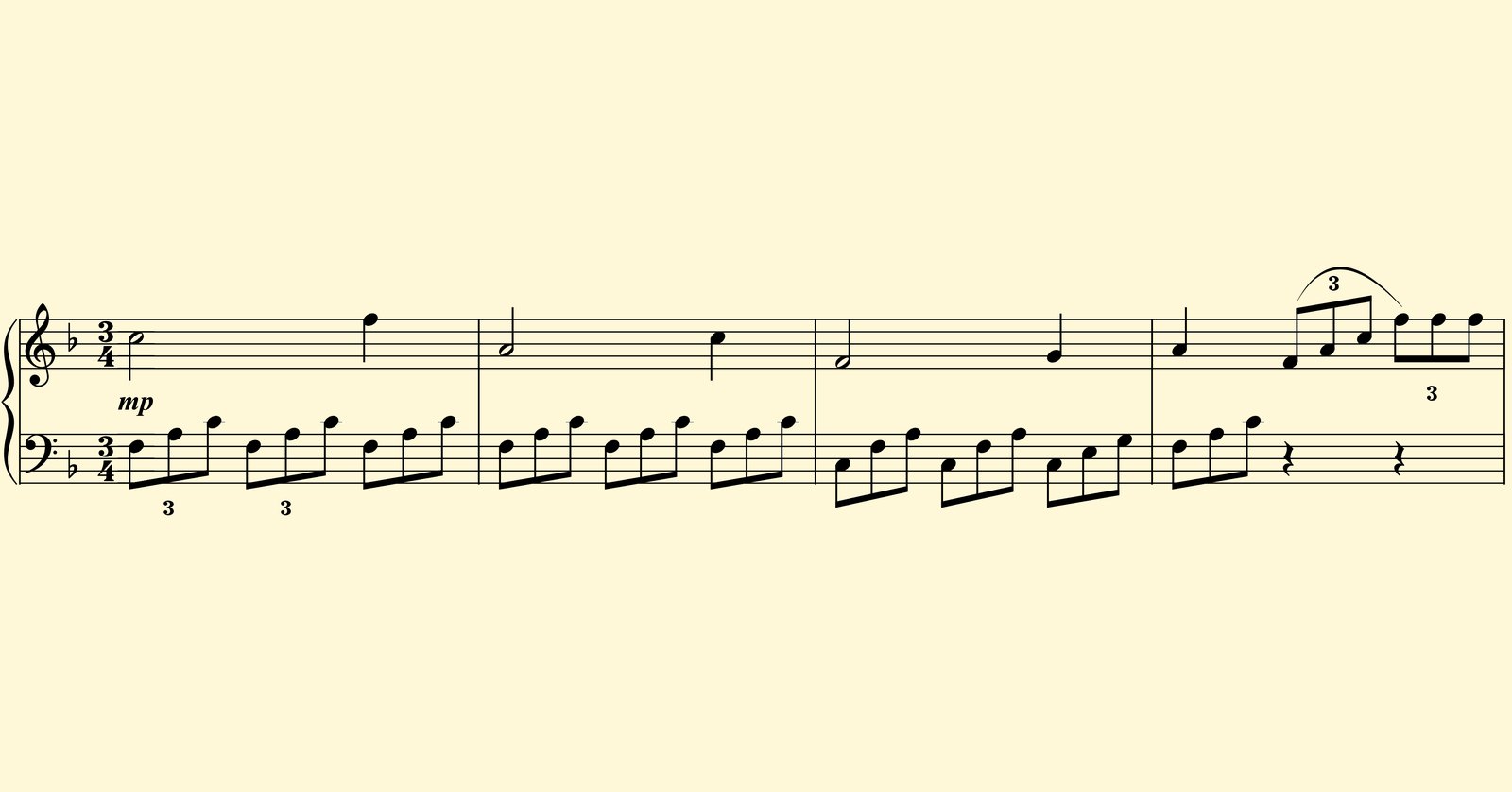
Here's how I'd prepare Clementi Triplets, a Level 9B piece in Piano Tree, in the 30 seconds.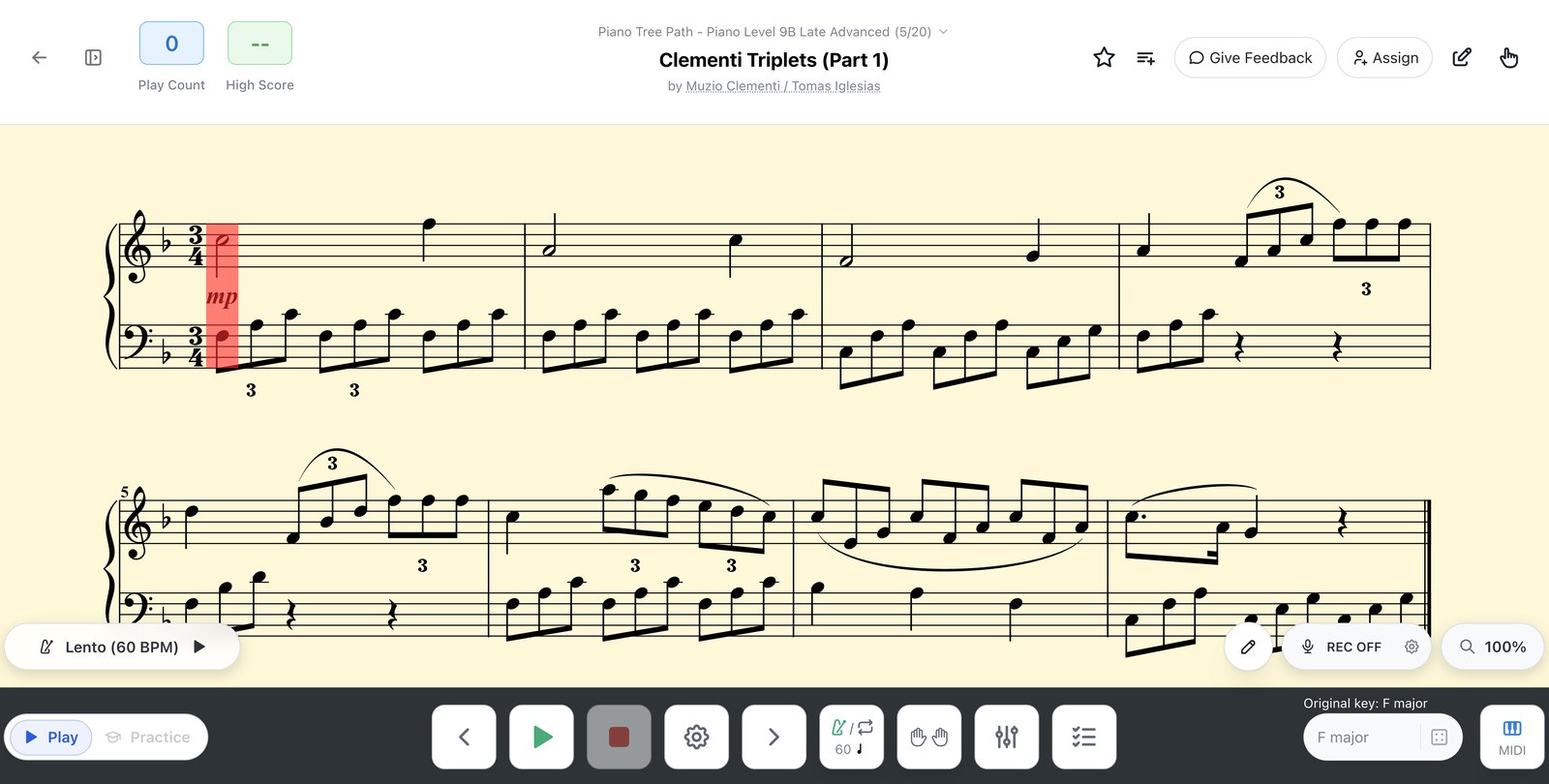
Clementi Triplets (Part 1), Level 9B: 3/4, with triplet broken chords in the left hand and a singing melody above them.
- Key: one flat, and the left hand opens with F, A and C: F major. There isn't a single accidental on the page, so the key is the easy part.
- Time: 3/4, lento, at 60 to the crotchet. Every beat in the left hand is a triplet, so before I start I count "1 2 3, 1 2 3, 1 2 3" in my head, one group per beat.
- Harmony: the left hand triplets are broken chords, so each beat is one chord shape, not three notes. Bars 1 and 2 are F major. In bar 3 the bass drops to C under F and A, a 6-4 chord in figured bass, and moves to C, E, G: the cadential 6-4 going to the dominant. Bar 5 keeps F in the bass with B flat and D above it, a 6-4 again, this time the subdominant over a tonic pedal. In bar 7 the bass moves B flat, A, F under the triplets: B flat is the seventh of the C chord in the bass, a 4-2 chord, and it resolves down to A, F major in first inversion. Bar 8 ends on another cadential 6-4 to C: a half close, waiting for Part 2. The melody outlines the same chords: C, F, A, C, F are all notes of F major, and the only note outside it in the first three bars is the G on beat 3 of bar 3, because there the harmony has moved to C, the dominant.
- The easy part: in bars 1 to 3 the right hand plays just two notes a bar, a minim and a crotchet. My eyes can stay ahead, and the left hand repeats one shape per beat.
- The hard part: bars 7 and 8. In bar 7 the triplets jump to the right hand while the left hand plays crotchets, and in bar 8 the right hand plays a dotted quaver and semiquaver against triplets in the left. The semiquaver comes just after the left hand's last triplet note. That's the bar I'd try out loud.
- Tempo: I keep it at 60. Lento triplets want to rush, so I let the left hand set the pace and the melody float on top.
Read this way, the piece is a long breath. The melody climbs to the high A in bar 6, then falls in a triplet scale, and the 4-2 chord in bar 7 pulls it down towards the half close. Let the line grow towards bar 6 and relax as it falls. Pedal once per chord, changing wherever the bass changes, and the whole page sounds like Clementi instead of an exercise.
A 15-Minute Daily Routine for Grade 6
- 2 minutes: Scale and arpeggio in one of the Grade 6 keys, including C sharp and F minor. Rotate the key each day.
- 3 minutes: Rhythm: tap triplets against duplets, and a few bars in 5/8, 5/4 and 9/8.
- 8 minutes: Read four to six short new pieces. Prepare each one for 30 seconds, then play it once without stopping, with pedal.
- 2 minutes: Look back at the piece that went worst. Was it the metre, the triplets, a clef change or the pedal? That's tomorrow's focus.
How to Prepare for Grade 6 Sight Reading in Piano Tree
Master Levels 8, 9 and 10
If you've mastered Path Levels 8, 9 and 10, you're ready for the Grade 6 sight reading test. Music isn't an exact science, so let the levels overlap a little and go over: reading some of the next level as well will give you more confidence. Here is where the new Grade 6 elements start in the Path:
- 9/8 time: Level 7
- F minor: Level 6
- Triplets: Level 9
Not sure where you are? The free Sight Reading Test gives you a Piano Reading Level and tells you which level to start from. For Grade 6, the tests to aim for are Advanced (Levels 7B to 8B) and Late Advanced (Levels 8C to 11E).
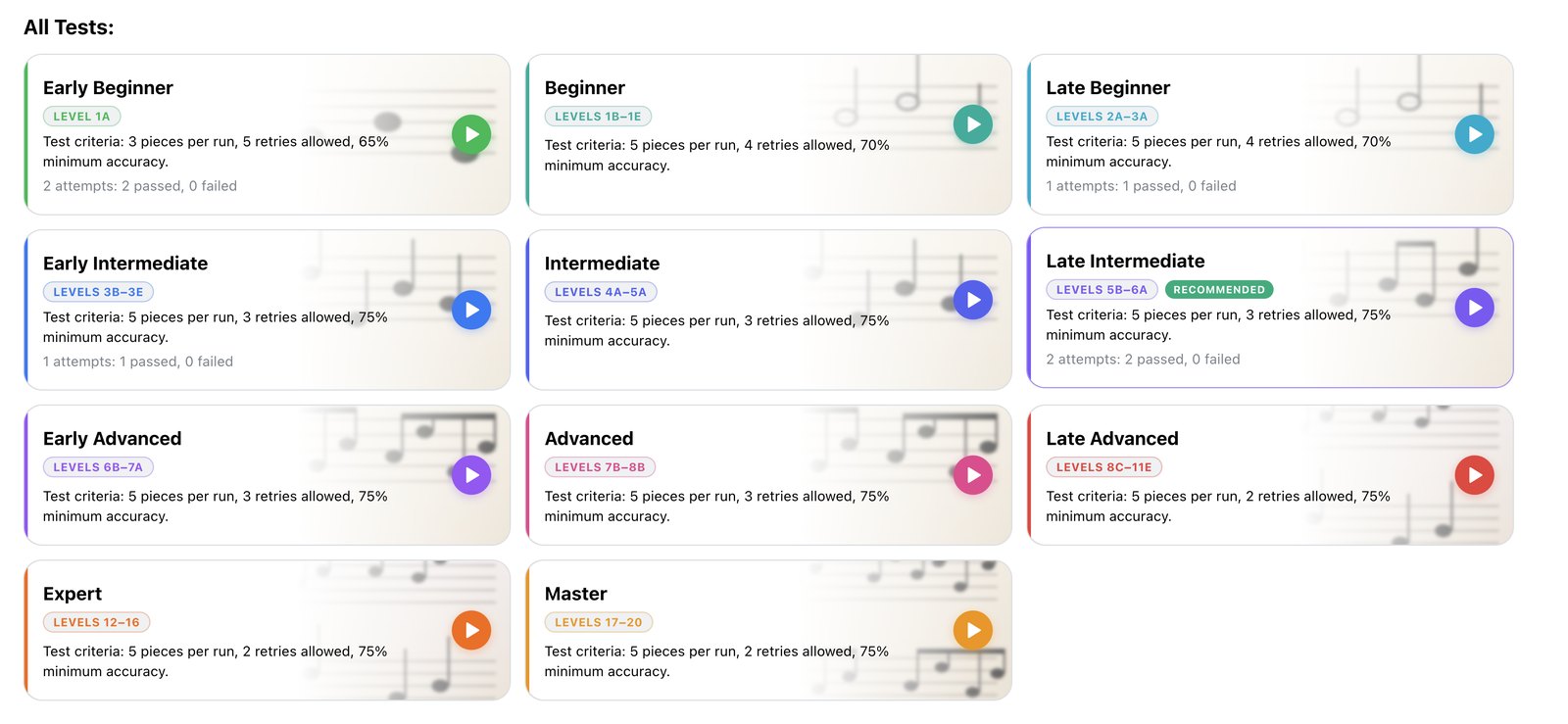
The free Sight Reading Test. Each of the eleven tests covers a band of Path levels and gives you a Piano Reading Level.
Read enough pieces at each level
Each Path level holds around 100 pieces, but I believe a student needs about 200 per level, sub-levels included. That's why we added the Supplementary Pieces: another 100 pieces at each level. For even more reading at this standard, explore the Christmas and Halloween collections, the hymn books and the Bach chorales. Between them there are thousands of pieces.
Use the Paul Harris books
Paul Harris's Improve your sight-reading! series is in the library, as published, along with his A Piece a Week books. Improve your sight-reading! Piano Grade 6 gives you short tests at exactly this level.
Know your chords and scales
For real mastery, students should know their chords and scales. Piano Tree has a chords and scales category in the library, and chord drills in the Learn tab.
The tools that help most
- Read ahead: set it from one beat up to several bars, so you are always looking past the note you are playing.
- Transposition: move any piece into C sharp or F minor to give the new Grade 6 keys extra practice.
- The Rhythm book: part of the Sight Reading Focus Pack, it isolates rhythm on its own, triplets included.
Piano Tree is a piano sight reading app built by piano teachers: 25,000+ graded pieces, real-time feedback by MIDI or microphone, from first notes to diploma level. The free plan includes hundreds of pieces and unlimited sight reading tests, with no credit card.
Start reading today: try Piano Tree freePieces at Grade 6 Standard
Sight reading is only one part of the exam. If you're learning Grade 6 pieces, you'll find music at that standard at Levels 13 and 14, in the Path itself and in the Supplementary Pieces for those levels, with a mix of Baroque, Classical and Romantic pieces at each sub-level. These levels describe pieces you prepare, not reading: as a sight reading level, Level 13 is already about Grade 7, and Level 14 about Grade 8. That gap is the whole point of reading below your level, and I explain it in piano sight reading levels explained. A few examples:| Piece | Level |
|---|---|
| Brahms: Waltz, Op. 39 No. 15 | 13A |
| Chopin: Waltz in A minor, B. 150 (posthumous) | 13B |
| Schubert: Waltz in B minor | 13B |
| J. S. Bach: Prelude in G, BWV 902 | 13C |
| Scarlatti: Sonata in F, K. 446, "Pastorale" | 13D |
| Beethoven: Andante from Sonata in G, Op. 14 No. 2 | 13E |
| Couperin: Les Petits Moulins à vent | 14A |
| Field: Nocturne No. 13 in D minor | 14B |
| Mozart: Sonata in C, K. 545, 1st movement | 14C |
| Mozart: Fantasia in D minor, K. 397 | 14E |
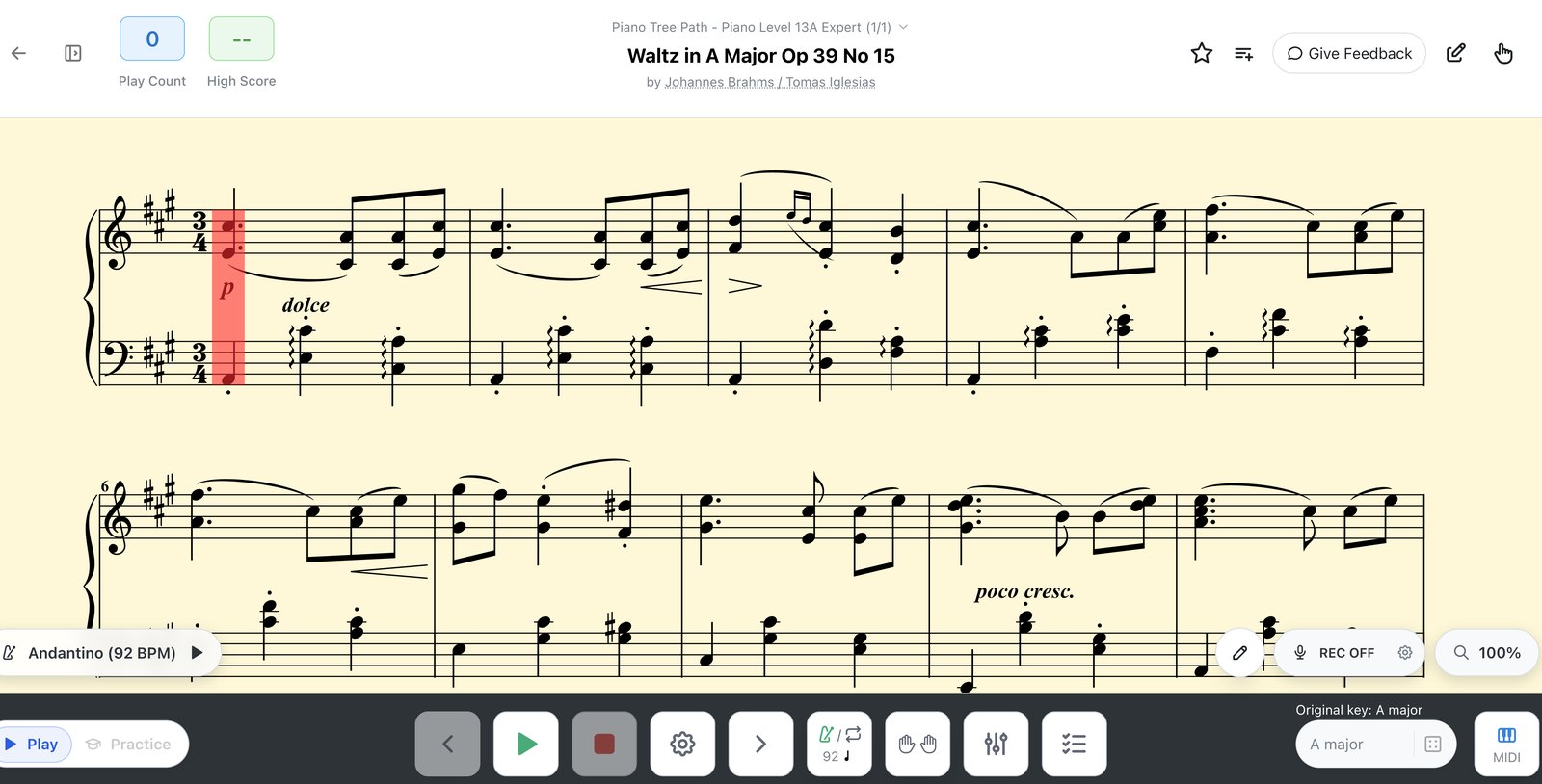
Brahms, Waltz, Op. 39 No. 15, open in Piano Tree in A major: a piece at Grade 6 standard, with spread chords in the left hand.
Common Mistakes at Grade 6
- Trusting the key signature alone. Check the bass and the accidentals.
- Stretching the beat to fit a triplet. The beat stays the same; the triplet fills it.
- Reading the wrong clef. Mark every clef change in your 30 seconds.
- Pedalling through chord changes. Change the pedal when the bass changes.
- Stopping to correct. It costs more marks than the wrong note did.
Common Questions
Is sight reading compulsory at Grade 6?
Yes, for both ABRSM Practical Grades and Trinity. At Trinity, Grades 6 to 8 have two supporting tests: sight reading, which is compulsory, and one of aural or improvisation. ABRSM Performance Grades have no sight reading test, only four filmed pieces. For AMEB, it is part of Comprehensive exams, optional in Piano for Leisure, and not part of Repertoire exams.
How long is the Grade 6 sight reading test?
For ABRSM, about 12 to 16 bars.
How much time do I get to prepare?
ABRSM and Trinity both give you 30 seconds, and you may try out any part of the test before you play it for the examiner.
What keys can come up at ABRSM Grade 6?
C, G, D, A, E, F, B flat, E flat and A flat major, and A, D, E, G, B, F sharp, C, C sharp and F minor.
How many marks is sight reading worth?
21 out of 150 at ABRSM, and 10 out of 100 at Trinity.
Do I need Grade 5 theory to take ABRSM Grade 6?
Yes. To enter ABRSM Grades 6, 7 or 8, you must already have passed ABRSM Grade 5 (or above) in Music Theory, Grade 5 (or above) in Practical Musicianship, or Grade 5 in a Practical Grades solo jazz instrument. ABRSM lists accepted alternatives on its website.
Which Piano Tree levels prepare me for Grade 6?
For the sight reading test, master Path Levels 8, 9 and 10, with the Supplementary Pieces for extra reading. For Grade 6 exam pieces, look at Levels 13 and 14.
How long does it take to get ready?
With 15 minutes a day, most students see a clear change in about three months. Starting a term before the exam is ideal.
Sources and How We Checked
- ABRSM, Practical Music Grades: Piano Syllabus 2027 & 2028, Qualification Specification: sight reading parameters, preparation time, mark allocation, marking criteria and entry requirements for Grades 6 to 8. ABRSM states that the sight reading requirements are unchanged from the 2025 & 2026 syllabus, which remains valid until 31 December 2027.
- Trinity College London, Piano Syllabus, face-to-face graded exams: supporting tests, sight reading parameters, 30 seconds' preparation, tests set about two grades below the exam, and marking.
- AMEB, Piano Syllabus 2026: exam structure for Comprehensive, Piano for Leisure and Repertoire exams, and sight reading requirements.
- London College of Music Examinations, Piano Syllabus 2026 and Piano Sight Reading Tests, Grades 1 to 8: exam options, parameters and preparation time.
- The Royal Conservatory, Piano Syllabus, 2022 Edition: sight reading requirements and marks for each level.
- All checked in November 2026. Piano Tree is not affiliated with ABRSM, Trinity College London, AMEB, LCM, RCM or MTAC.
Part of the Piano Tree sight reading series. Continue with Grade 5 Piano Sight Reading, Grade 7 Piano Sight Reading, Piano Sight Reading Levels Explained and ABRSM Sight Reading: What Examiners Are Listening For.