
Sight reading levels climb a ladder of vocabulary, not speed: hands separate before hands together, fixed positions before free movement, single notes before chords, simple time before compound. On paper, your reading level sits about two grades below the pieces you play; in real studios the gap is often far wider. Here is what each stage adds, from complete beginner to Grade 8, and how to find where you actually are on the ladder.
The stages below follow the ABRSM grades because they are the ladder most of the world can point to, and the board publishes exactly which elements its sight reading tests introduce at each grade. But the ladder itself is universal: whichever system you learn in, the vocabulary arrives in roughly this order.
This post is part of our sight reading series. The full method is in How to Practice Piano Sight Reading.
What Does a Sight Reading Level Measure?
Not the same thing as your repertoire grade. Your pieces show what you can polish over weeks; your sight reading level is what you can play correctly the first time, in tempo, without stopping, and for almost everyone it sits well below. The boards build a gap in by design, roughly two grades: an ABRSM candidate gets a short unseen piece pitched below their repertoire, half a minute to scan and try things out, and 21 of the exam's 150 marks for the result.The official gap is also optimistic. In my studio, and colleagues tell me the same everywhere, the honest distance today is often five grades or more: Grade 8 students who struggle to sight read Grade 2 or 3 material are not the exception, they are close to the norm. That is not a scandal. It is a diagnosis: reading gets trained separately, or it does not get trained at all.
So a sight reading level measures vocabulary under pressure: which keys, rhythms, textures and distances you can process in real time. That is why the ladder below is written in terms of what arrives at each stage, not how hard you have to work.
The Ladder, Stage by Stage
Complete beginner (ABRSM Initial)
One hand at a time, sitting still. The music lives in a five-finger position, C major or its relative minor, in plain time with nothing faster than paired quavers, four to six bars long. The whole job at this stage is note recognition and a steady pulse, and it is worth doing properly: everything above rests on it.
Grade 1
Still one hand at a time, but the hand can now start anywhere: any five-finger position, with G major, F major and A minor joining the family, plus the first accidentals, dotted rhythms, rests and real dynamics. The skill being born here is orientation: finding a position from the page and trusting it.
Grade 2: the threshold
The hands play together, and this single line in the parameters changes everything. Reading one staff was the challenge until now; reading two staves at once, vertically, as one object per beat, is the actual skill of piano reading, and it is why so many students feel Grade 2 as a wall. Ties, dotted crotchet patterns and a few more keys arrive too, but they are footnotes next to the coordination leap.
Grades 3 and 4: leaving home
The hand leaves the five-finger position, and reading now includes travel: shifts, stretches, and the first two-note chords in either hand. Flat keys multiply, semiquaver patterns appear, then compound time, chromatic notes, upbeats and pauses. This is where the eye-hand span and touch security stop being nice ideas and become survival equipment.Grade 5: the full toolkit
Remote keys on both sides of the circle, four-part chords split between the hands, simple syncopation, and the first expressive demands like easing the tempo at a close. Tests stretch toward twelve bars. A Grade 5 reader is no longer decoding: they are managing texture, and harmony knowledge starts paying its rent visibly, because chords now come too fast to assemble.
Grades 6 to 8: reading music, not tests
Irregular and compound metres, triplet rhythms, clef changes, pedalling, tempo changes, octave signs, spread chords, three-part chords in one hand, simple ornaments, and by Grade 8 a full page of music. Notice what these are: not harder notes, but the notational surface of real repertoire. The ladder's top rungs are simply the moment the training material stops pretending and becomes the literature, which is why strong Grade 8 readers can sit down with most intermediate music and simply play it.
The Rule That Makes the Ladder Work
Every element is cumulative: once a key, rhythm or texture enters the ladder, it never leaves, it only deepens. That has a practical consequence most students miss. A gap low on the ladder, a shaky key from Grade 2, a dotted rhythm never really absorbed, does not stay at Grade 2. It travels upward with you and resurfaces in every test above, wearing harder clothes. When an advanced reader keeps stumbling, the missing rung is almost always several floors down, which is exactly why sight reading practice belongs well below your repertoire level.Sight reading vocabulary never expires. A gap at Grade 2 does not stay at Grade 2. It climbs the ladder with you.
How Do You Find Your Level?
Three honest methods, in ascending order of precision. Take your repertoire grade and subtract two for the official theory, or subtract five for what I actually see in players who have never trained reading as its own skill; either way, that is where practice material should start. Or use the boredom test: read something and drop levels until you can keep a steady pulse to the end without stopping, because the level where that first becomes true is your level, whatever your pride says. Or take a graded placement test and let it tell you, which has the advantage of giving you the same measure again next month, when the improvement will be too gradual to feel and very visible to count.How the Piano Tree Path Maps Onto It
An exact conversion chart is impossible, and I would distrust anyone who published one. Two reasons. First, the Path keeps absorbing pop, jazz and other popular styles, and those styles run on syncopation and anticipation: without syncopated rhythm they simply do not work, so we hold them back until the levels where that rhythm has been trained, which bends any mapping. Second, the boards' own rungs are uneven: the size of the step from one ABRSM grade to the next varies noticeably, and every student who has crossed the wide ones knows it. The Path was built to be more gradual than that on purpose, with levels split into sub-levels of twenty pieces each, so a single ABRSM grade can stretch across several Piano Tree levels. Where the two ladders agree closely is keys, which arrive in much the same order on both.So treat this as a working approximation from my own teaching, not a conversion chart. Complete means you read that level's material fluently, not merely that you have visited it:
- Levels 1 to 2 complete: ABRSM Initial
- Level 3 complete: Grade 1
- Level 4 complete: Grade 2
- Levels 5 to 7: Grades 3 to 5
- Levels 8 to 10: Grade 6
- Levels 11 to 13: Grade 7
- Levels 14 to 16: Grade 8
- Levels 17 to 20: Beyond Grade 8, toward diploma-level reading
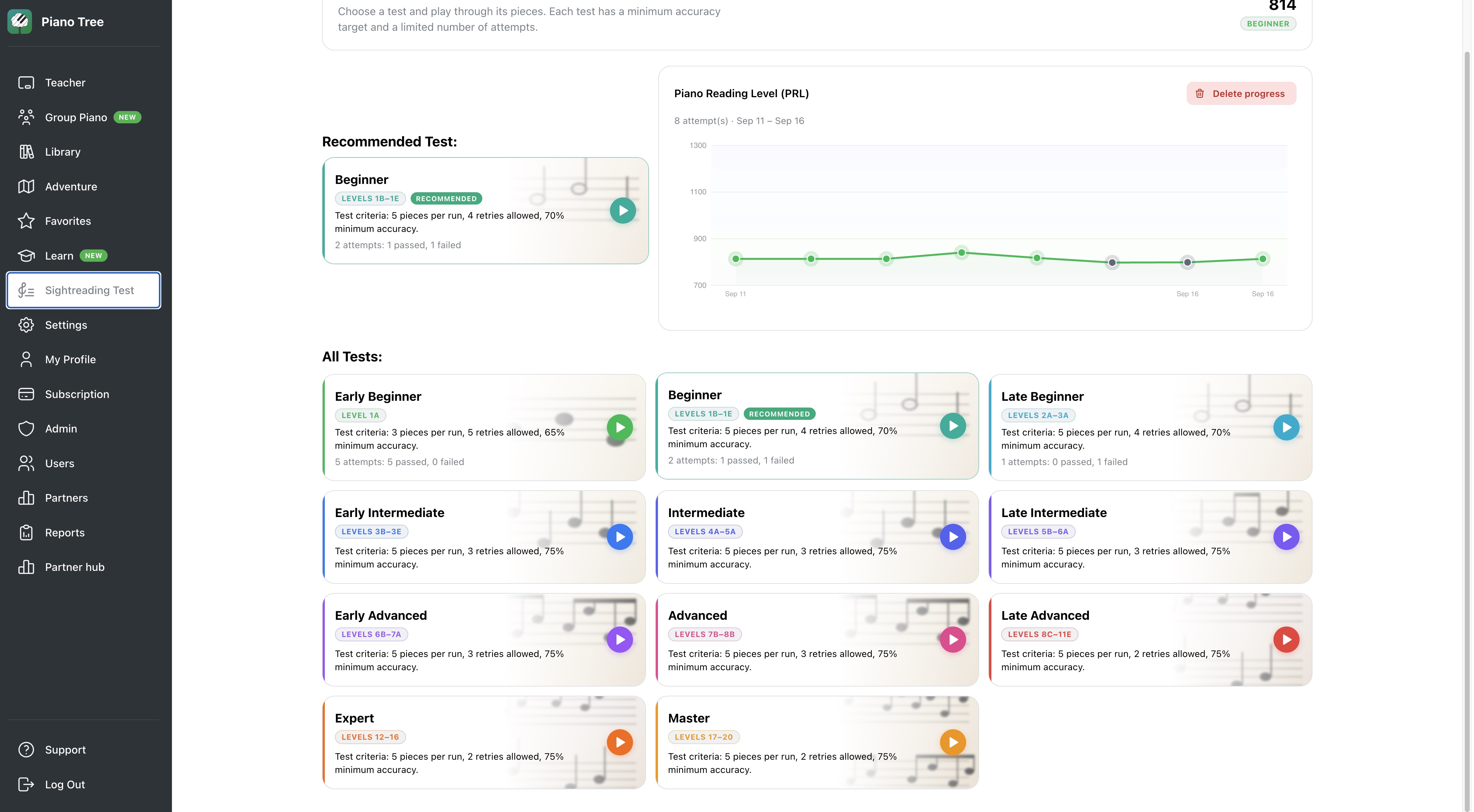
To place yourself on the ladder, the sight reading test runs all of it in eleven graded tests, from Early Beginner up to Master, and returns a Piano Reading Level score you can retest as you climb.
Find your level with the Piano Reading Level test on Piano TreeCommon Questions
Why is the exam sight reading test easier than my pieces?
Because it tests a different skill. Your pieces show the ceiling of what you can prepare; the sight reading test samples what is automatic. Boards pitch it below the repertoire deliberately, and your practice should respect the same gap.
Do Trinity and other boards use the same ladder?
The details differ, but the shape is remarkably stable everywhere: separate hands before together, fixed positions before travel, simple time before compound, single notes before chords. Learn the ladder and you are prepared for any board's version of it.
Can I skip stages?
You can skip test dates, not vocabulary. Because the elements are cumulative, an unabsorbed stage becomes a permanent leak upstream. If you are advanced with a low-level gap, the fix is fast and cheap: a few days of very easy material aimed exactly at the missing rung.
My repertoire is Grade 6 but I read like Grade 2. Is that normal?
So common it is close to the default, not only in self-taught players and quick memorisers, and completely repairable. You are not starting over: your musicianship is intact, and the reading rebuilds underneath it far faster than it built the first time. Start at the level where the pulse survives, and climb.
The Short Version
Sight reading levels are a vocabulary ladder: positions, then coordination, then travel and chords, then remote keys and syncopation, then the full surface of real music. Your reading lives well below your pieces, usually further below than the boards assume; gaps climb the ladder with you until they are fixed, and the fastest way up is the least glamorous: find your true level, read daily just below it, and let the rungs come to you.
Part of the Piano Tree sight reading series. Continue with How to Practice Piano Sight Reading, ABRSM Sight Reading: What Examiners Are Listening For and 10 Reasons Your Piano Sight Reading Is Not Improving.