
At least one to two beats ahead of the note you are playing, and further as you improve. Classic eye-movement research found that skilled sight readers are holding four to seven notes in the gap between their eyes and their hands, while weak readers hold one or two. That gap, not finger speed, is what separates fluent reading from constant stumbling, and it can be trained deliberately.
Here is what the gap actually is, why you cannot simply decide to look further ahead, and the exercises that widen it.
This post is part of our sight reading series. The full method is in How to Practice Piano Sight Reading.
What Does Reading Ahead Actually Mean?
When a fluent reader plays the second beat of a bar, their eyes are not on the second beat. They are somewhere near the end of the bar, or across the barline into the next one. The notes in between sit in a short-term buffer, already decoded, queued up for the hands.This is the same thing you are doing right now with this sentence. Your eyes are several words ahead of the word your inner voice is saying. Nobody reads text one letter at a time, and nobody reads music fluently one note at a time.
The distance between where the eyes are and where the hands are is called the eye-hand span. It is the single clearest difference between someone who reads music and someone who decodes it.
How Far Ahead Do Good Readers Look?
Eye-tracking studies of pianists go back decades, and the finding has stayed stable: skilled sight readers hold roughly four to seven notes in the span, and weak readers hold one or two. In musical terms, that is usually one to two beats for a student in their first years, and up to a full bar for an advanced reader in simpler textures. Two details from that research matter for practice. First, the span is not fixed: the same reader looks further ahead in easy music and hugs the playing position in hard music. Second, good readers move their eyes in chunks, landing on a beat or a chord shape, not on individual noteheads. Reading ahead and reading in patterns are the same skill seen from two angles.So the practical answer to the title is not a fixed number. It is: far enough ahead that your hands never have to wait for your eyes. For most students that means training at one to two beats and letting the span grow.
Your hands can only play what your eyes have already read. If the eyes are on the note being played, the next note is always a surprise.
Why Can't You Just Decide to Look Ahead?
Every student tries this after being told about it, and it collapses within two bars. There are two honest reasons.The buffer has to hold something. Looking ahead only works if what you see can be stored compactly. A reader who sees "G major triad, root position" stores one item. A reader who sees three unrelated dots stores three, and the buffer overflows. This is why reading ahead improves with harmony knowledge, not just with eye discipline: chords, scale fragments and familiar rhythms compress into single items.
The eyes flee to the hands. The most common leak is not looking behind, it is looking down. Every glance at the keyboard throws away your place in the span and forces a costly re-find. Students who read vertically, note by note, and glance down at every leap are spending their entire attention budget on recovery.
Both problems shrink with the same medicine: material easy enough that patterns are recognisable at a glance, played slowly enough that the buffer never overflows.
How Do You Train It?
Four exercises, in the order I give them to students.1. Drop the level, keep the pulse. Work two or three levels below your performance repertoire, at a tempo where you feel slightly bored. Boredom is the sign that attention is free to move ahead. If you cannot keep a steady pulse without stopping, the material is too hard for this exercise, whatever your ego says.
2. The card trick. Have someone slide a card, or your own free hand in single-hand work, over the bar you are playing, so it disappears as you reach it. You are forced to have already read it. Start by hiding half a beat, grow to a full bar. Uncomfortable, then transformative.
3. Flash reading. Look at one bar for two seconds, look away, play it. Then two bars. This trains the buffer directly: you are practising holding decoded music in memory, which is exactly what the span is.
4. Eyes on the page for a full line. Choose music with small intervals, place the hands, and forbid yourself the keyboard glance for one line. Leaps by feel, misses allowed. The habit of finding keys by touch is what makes a wide span affordable.
Ten focused minutes a day of this beats an hour once a week, and it belongs at the start of practice, not the exhausted end.
Where Piano Tree Fits
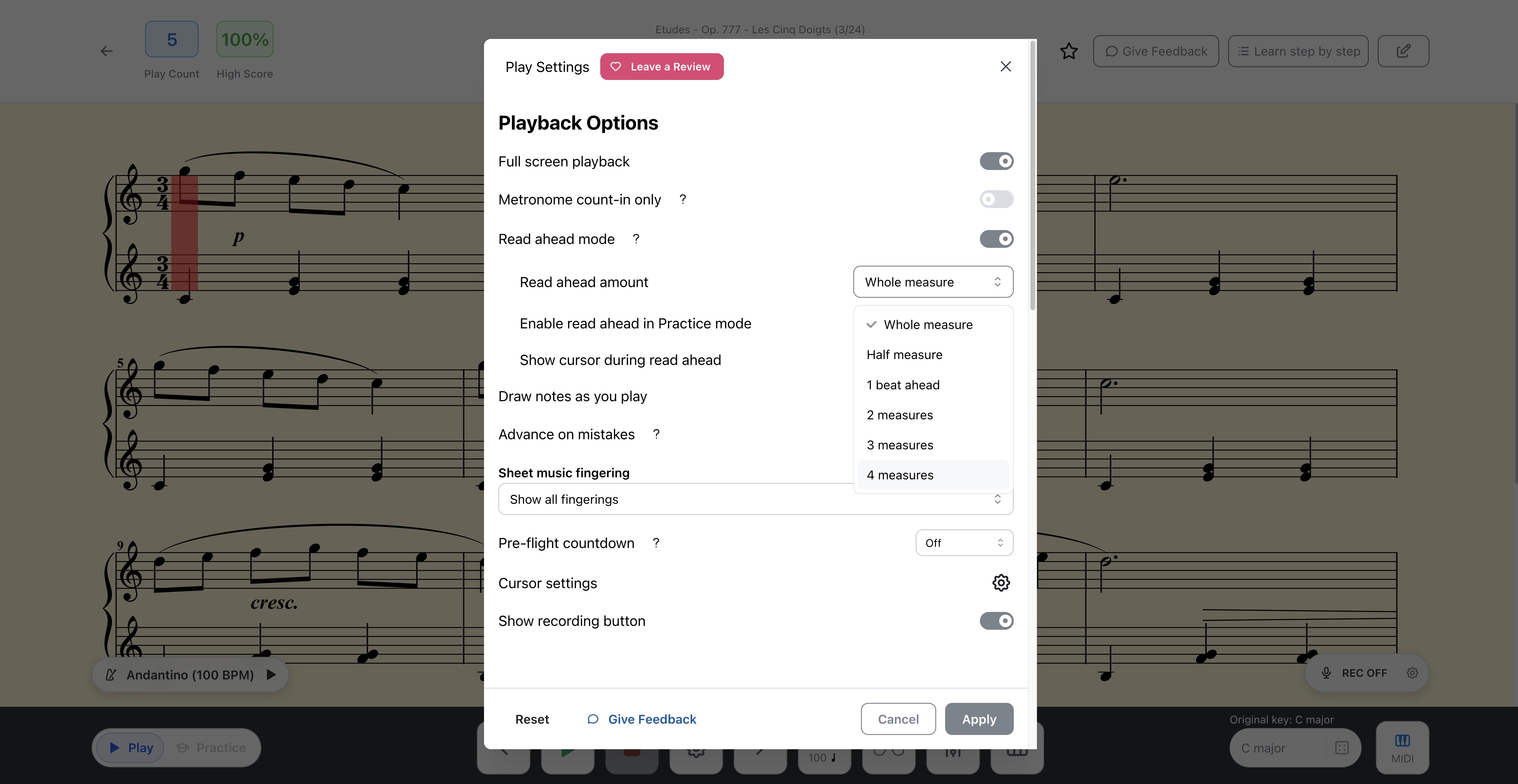
The card trick is built into the app. Read-ahead mode hides the beats you are playing as you reach them, in both Practice and Play mode, and you choose the distance: one beat, half a bar, a full bar, two bars or four. If you are new to this, one beat is enough, and half a bar is the next step once that feels natural. Save the full bar for music well below your level; that is where it teaches instead of punishing. Because the library is graded finely, finding that genuinely easy material takes one tap instead of a hunt through your shelf, and the music keeps moving when you slip, which is the pulse discipline this whole skill depends on.One more benefit, and I discovered it in my own practice: after a few days of this, you catch yourself reading ahead even in music you have practised before, without deciding to. Like any habit, it takes days to build. Then it follows you everywhere.
Train reading ahead with adjustable read-ahead mode on Piano TreeCommon Questions
How far ahead should a beginner look?
Half a beat to one beat is a realistic first target. The goal at the start is simply that the eyes leave a note before the hands play it.
Does reading ahead work in both hands at once?
You read one span, not two. Fluent readers see the grand staff vertically, a beat as a single object across both staves, which is another reason chord and interval recognition matter so much.
Should I use a metronome for these exercises?
For the card trick and easy-level reading, yes, or use a slow backing track. The pulse is what forces the eyes forward. For flash reading, no pulse is needed.
My teacher says I read note by note. Is that fixable as an adult?
Yes. The span is trainable at any age because it is a habit and a knowledge problem, not a reflex you needed to acquire as a child. Adults often progress faster once they understand why the exercises work.
The Short Version
Aim to keep your eyes at least one to two beats ahead, let the distance grow with your level, and accept that in hard music the span shrinks for everyone. Train it with easy material at a steady pulse, hide the bar you are playing, practise flash reading, and keep your eyes off your hands. The span is not a talent. It is a buffer, and buffers can be built.
Part of the Piano Tree sight reading series. Continue with How to Practice Piano Sight Reading, The Ideal Piano Training (Part 2) and Why Most Piano Apps Don't Teach Sight Reading.