
You stop looking at your hands by making the glance unnecessary: learn the keyboard by touch, keep position changes under your fingers, and read music that does not force leaps you cannot yet feel. Looking down is not a discipline problem. It is a security problem, and security can be trained in a few minutes a day.
Here is why the eyes drop in the first place, when a glance is actually fine, and the exercises that build the touch security that makes your eyes free.
This post is part of our sight reading series. The full method is in How to Practice Piano Sight Reading.
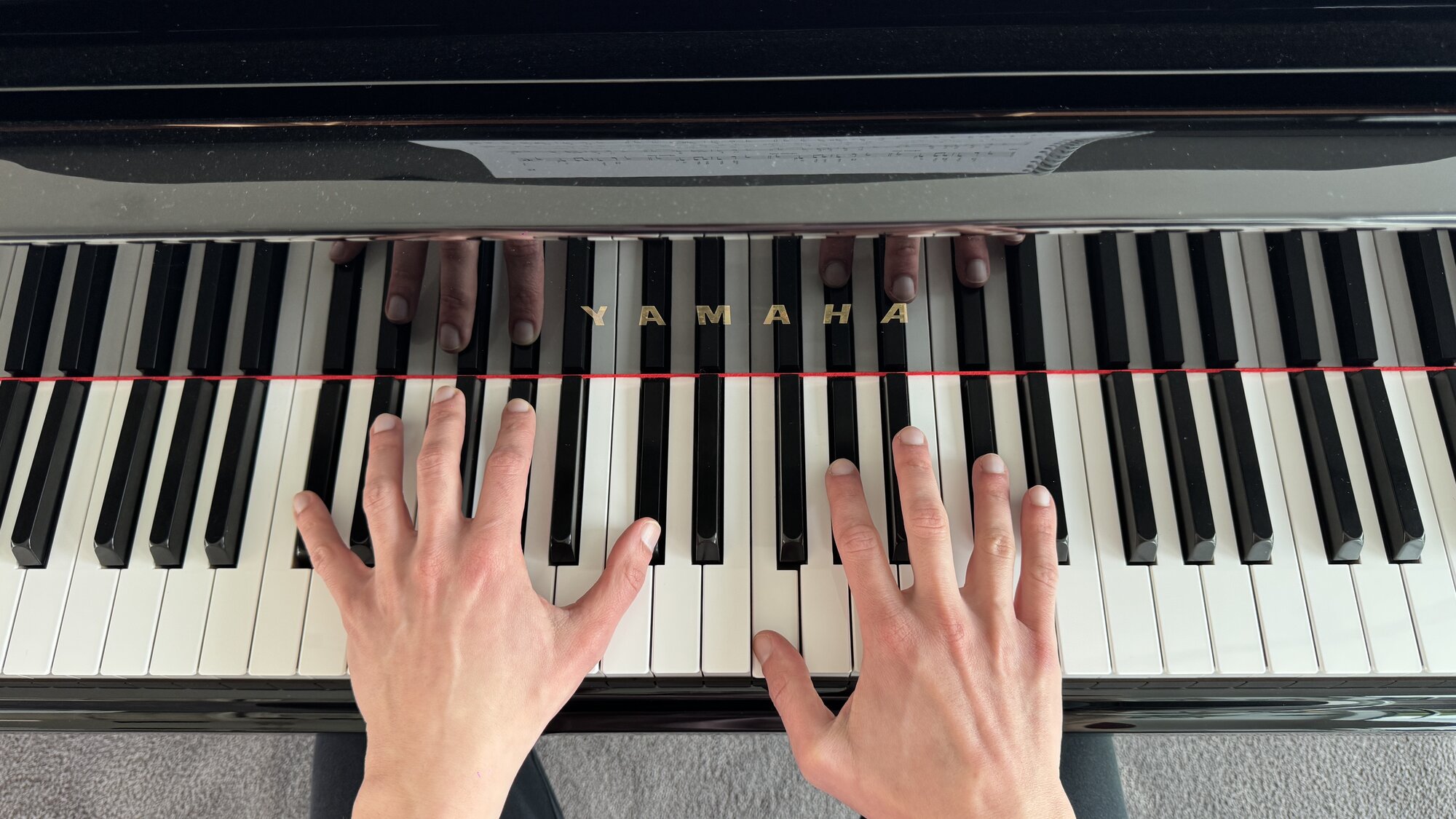
Why Do Pianists Look at Their Hands?
Because the eyes go where the uncertainty is. If you are not sure your hand will land on the right key, your eyes will go and supervise, whatever you have decided about keeping them on the page. That is why telling yourself to stop looking never works on its own: the glance is a symptom, and the disease is not trusting your hands. Each glance is expensive. You lose your place on the page, your eye-hand span collapses to zero, and finding your spot again costs a beat you did not have. Worse, the habit feeds itself: while your eyes are supervising the keys, your hands never get the chance to learn the geography on their own, so the uncertainty that caused the glance never goes away.The eyes go where the uncertainty is. Remove the uncertainty from the keys and the eyes are free to stay on the music.
Is It Ever Fine to Look Down?
Yes, and pretending otherwise just makes students feel like failures. Professional accompanists glance at the keys for large leaps all the time. The difference is that they glance on purpose: one targeted look, taken early, during a long note or a rest, with the landing spot on the page already chosen so the eyes snap straight back to it. The goal of this whole practice is not "never look down". It is "look down by choice, never by reflex".The head position for all of this is in the most famous portrait of Beethoven, and I show it to every one of my students. His chin points down toward the keyboard while his eyes look up. That is the sight reading posture: from there, either the keys or the music is one very quick glance away, with almost no head movement. Do not overdo the glancing, but sit like Beethoven and the option is always there when you need it.
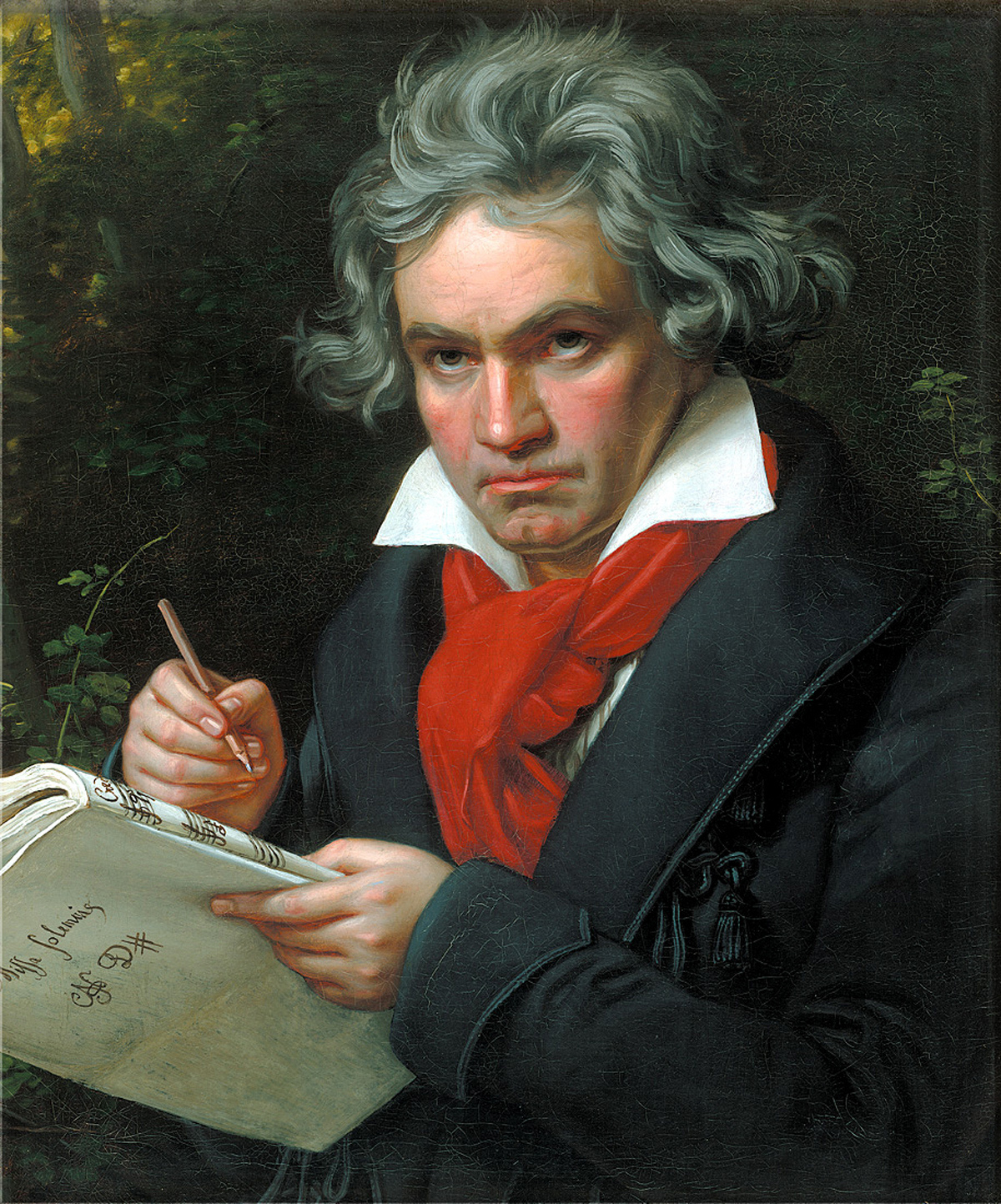 Chin toward the keys, eyes up. The sight reading head position, painted in 1820.
Peripheral vision does more work than most students realise, too. With the score at a normal height, your hands sit blurrily at the bottom of your field of view. That blur is enough to confirm a position without ever actually leaving the page. You are aiming for geography plus periphery, not blindness.
How Does Touch Replace Sight?
The keyboard was accidentally designed for blind navigation. The alternating groups of two and three black keys are a texture your fingertips can read, and in my studio they have names: the group of two is the chopsticks, the group of three is the fork. Touch a chopsticks group and you know where C and D are without any help from your eyes. Every white key has an address relative to the nearest chopsticks or fork, and your hand can learn every address.The other half is distance. An octave is a fixed width, and your hand can learn it as a shape the way it knows the width of a doorframe in the dark. Fifths, sixths and octaves become reaches you feel rather than distances you measure by sight. Once the addresses and the reaches are in your hands, the supervision job the eyes were doing simply disappears.
Which Exercises Break the Habit?
1. Chopsticks and fork, two minutes a day. Eyes shut, hands on the keyboard, find the groups by touch and say them out loud as you go: chopsticks, fork, chopsticks, fork, up and down the instrument. Then, still blind, land on middle C, the white key just left of the chopsticks, and on F, just left of the fork: right-hand thumb for both, the same thumb that lands on C and F in a C major scale, and left-hand fifth finger for both. From there, grow it: five-finger positions in C, G and D, then octaves, fifths and sixths from any starting note, checking by ear. This is the foundation everything else stands on, and students find it oddly enjoyable.2. Scales and arpeggios blind. You already know the notes, so the eyes are contributing nothing anyway. Doing daily technique with eyes closed converts practice you were doing anyway into touch training for free.
3. The one-line rule. Take an easy, mostly stepwise piece and forbid the glance for one full line. Leaps by feel, misses allowed and expected. Extend to two lines, then a page. Misses are the tuition here: each one teaches your hand a distance.
4. Block the view. If the reflex is strong, make it impossible for a while: a thin folder held in the music rack's clip so it shades the keys, or simply raising the score. When looking down stops paying, the reflex starts dying.
5. Train the planned glance. Scan the line for the one genuine leap before you play. Decide where you will look down, do it during the note before, and pick the landmark on the page your eyes will return to. This is the professional version of the habit, and it deserves deliberate practice too.
A warning about material, because some styles are leap machines. Stride, waltz accompaniment and the marcato patterns of tango all run on a left hand that jumps between a low bass note and a mid-range chord on every beat, which makes them the graduate school of eyes-up playing. Do not start there. Start stepwise, and treat those styles as the exam you take later.
They are also the reason chord work is not optional. In all three, the hand is leaping onto chords, and a chord your hand knows as a shape can be caught blind, while a chord you have to assemble needs the eyes every single time. Piano is a harmonic instrument.
Studying piano means studying chords. If chord practice is not in your training, you are not fully training.
How Long Does It Take?
With a few minutes daily, most students feel the change within two to three weeks on stepwise material, and within a couple of months the glance is reserved for real leaps. It compounds with everything else in this series: every glance you no longer take is span you keep, and every beat of span makes the next rescue easier. Like reading ahead, it is a habit, so frequency beats heroics.Where Piano Tree Fits
The early Path levels are deliberately stepwise, which makes them ideal one-line-rule material: hundreds of easy pieces where your hands barely need to travel, so your eyes can practice staying up. The music keeps moving whatever happens, which removes the pause you would otherwise use to sneak a look, and read-ahead mode pairs naturally with this skill, since eyes that are a bar ahead have even less reason to visit the keys. For one hand at a time, single-hand practice plays the other hand for you, so you can do eyes-up work without losing the music. And because catching leaps blind depends on chord shapes, the Chords and Scales Training sets feed this skill directly: triads, open left-hand voicings and four-note chords, drilled until your hand grabs them as single shapes. Practice eyes-up reading on graded stepwise material with Piano TreeCommon Questions
Should beginners avoid looking at their hands from day one?
Build touch from day one, dogma from never. A beginner should do the eyes-closed geography games early, because touch learned first never has to displace a looking habit later. But beginners also need to watch their hands sometimes to build technique, and that is fine. The rule to establish early is smaller: eyes on the page while reading, eyes anywhere you like while doing everything else.
I play well, but only when watching my hands. Where do I start?
This is the classic self-taught pattern, and it is very fixable: the playing skill is real, and the reading skill gets rebuilt underneath it with genuinely easy material and the one-line rule. Adults do this rebuild well, usually faster than they expect, because the musicianship is already there.What about big leaps in real repertoire?
Planned glances, exactly as professionals do them: early, targeted, with a return landmark chosen in advance. For repeated leaps in a piece you are learning, practice the leap itself blind a few times and it usually stops needing the glance at all.
Is this easier on a digital piano than an acoustic?
The geography is identical, so the training transfers completely. The one difference worth knowing: unweighted keyboards make distances feel slightly different under the fingers, so if you practice on one and perform on another, give your hands a minute of eyes-closed calibration on the new instrument.
The Short Version
Looking down is uncertainty, not weakness, so train the uncertainty away: learn the chopsticks and the fork with your eyes closed, do your scales blind, hold the one-line rule on easy music, and turn the remaining glances into planned ones with a chosen return point. A few minutes a day, a few weeks of patience, and your eyes stay where the music is. Sit like Beethoven: chin toward the keys, eyes up.
Part of the Piano Tree sight reading series. Continue with How to Practice Piano Sight Reading, How Far Ahead Should You Look When Sight Reading Piano? and Can You Learn Music as an Adult?