
The cruise ship pianist is one of the most complete working musicians you will find anywhere in the industry. Not because the music is the most complex. Because the demands are the most varied, the stakes are high every single night, and there is almost never time to prepare.
I do this job. I know what it requires.
This post is part of the Piano Tree path series. For related paths, see The Jazz Piano Path, The Tango Piano Path, and How to Become a Piano Teacher.
The Different Roles on a Cruise Ship
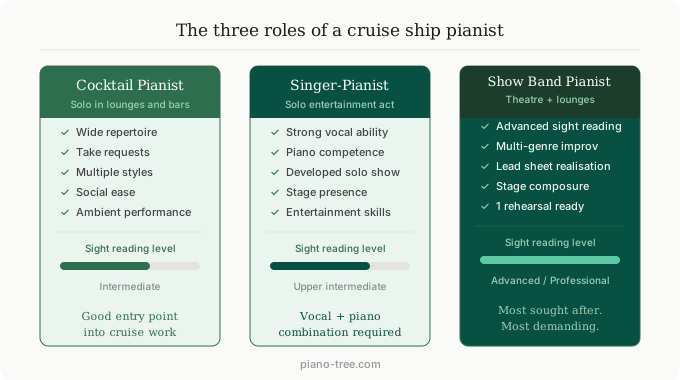
There is no single job called "cruise ship pianist." There are several distinct positions, each with its own demands and its own musical character.
The cocktail pianist plays solo in the ship's lounges and bars. The repertoire is typically easy listening, jazz standards, light classical arrangements, and popular songs. The job requires a wide repertoire, the ability to read requests, and the social ease to perform in an ambient setting where the audience is conversational rather than focused.
The singer-pianist performs as a solo entertainment act, accompanying their own singing. This role requires strong vocal ability alongside pianistic competence, solid performance skills, and a well-developed solo show.
The show band pianist plays as part of the ship's full band or orchestra, typically based in the main theatre. This is the most sought-after and arguably the most challenging and interesting of the three roles. It is also the one that demands the most from a pianist technically and musically.
Many show band pianists also play solo sets in the ship's lounges and smaller venues, which means they are effectively combining the demands of the show band role with those of the cocktail pianist. No two days on a cruise ship are musically identical.
The Show Band Pianist: The Most Demanding Role
The show band pianist plays in the theatre for two types of productions: the shows performed by the ship's permanent entertainment cast, and the performances by guest entertainers who board the ship for a short period, typically one or two nights.
The cast shows are manageable. The music is rehearsed over time, the arrangements become familiar, and the production develops its own consistency. The pianist learns the book and plays it night after night with growing confidence.
The guest entertainers are a different matter entirely.
Guest entertainers arrive on the ship, hand the band their music, and expect a professional performance. Sometimes there is a single rehearsal. Sometimes there is no rehearsal at all and the band reads the arrangement cold in the actual show.
These guest acts can be anything: a comedian who sings one song, a classical crossover singer with a full orchestral reduction, a jazz vocalist with a custom big band chart, a magician who needs specific musical cues at precise moments, a specialty dancer with a medley of themes from different periods and styles. The music arrives and the pianist is expected to play it.
This is where the real demands of the job become clear.
One Rehearsal, Then Straight to the Stage
If there is a rehearsal, it typically lasts one afternoon. The band receives the music, runs through it once, addresses the most critical problems, and that is the preparation.
That evening, in front of an audience of several hundred people, they perform it.
This is not a worst-case scenario. This is standard operating procedure on cruise ships worldwide. The expectation is not that the band will play the music perfectly after one rehearsal. The expectation is that the band will play it professionally: in time, in tune, following the conductor, responding to the soloist, making musical decisions in real time that serve the performance.
A pianist who cannot sight read at a high level cannot function in this environment. There is no alternative. There is no time to prepare at home, no opportunity to practice the difficult passage fifty times before the show. You receive the music and you play it.
The cruise ship theatre is the most honest test of sight reading ability I know. The music does not wait for you. The audience does not know you are reading it for the first time. You have to play it as if you have always known it.
I have played shows with guest acts I had never heard of, in styles I had limited experience with, from charts I had never seen, with less than two hours between receiving the music and walking onto the stage. This is the job.
Solo Playing in the Ship Lounges
Outside the theatre, the show band pianist often plays solo sets in the ship's various lounges and bars, or in small ensemble formats: duo with a vocalist, trio with bass and drums, or quartet.
These sets require a different set of skills from the theatre work. The repertoire must be broad and genuinely varied, because the audience changes from night to night and the entertainment director expects different programmes across the week. Jazz standards, Latin rhythms, pop songs, light classical arrangements, film themes, songs from different decades and different countries depending on the nationality of the passengers.
The lounge pianist must be able to take requests gracefully, move between styles without jarring transitions, and maintain a musical atmosphere that serves the space. This is not background music in the dismissive sense. It is ambient performance: aware, responsive, and musically considered.
The Skills the Job Actually Requires
Based on my experience doing this work, the cruise ship pianist needs to have genuinely mastered three areas before arriving on the ship.
Sight reading, both of fully notated arrangements and of lead sheets in chord symbol and melody format.
Improvisation across multiple genres, with enough fluency in each to sound convincing to an audience that knows those styles.
Stage composure, the ability to solve unexpected problems in public without showing the audience that anything is wrong.
These three areas are not equal in how they can be developed. Sight reading is the foundation. Without it, the other two cannot function under real working conditions.
Why Sight Reading Is Non-Negotiable
A pianist who improvises beautifully but cannot read a chart is useless in a theatre show. A pianist who plays jazz fluently but freezes when the guest act's arrangement arrives is a liability to the band. The ship does not stop. The show does not stop. The music must happen.
Every other skill in this job depends on sight reading as its foundation. Improvisation in a show context often happens between written sections, or in sections marked ad lib on the chart. You need to read everything around the improvisation to know where you are, what is coming, and when to stop. Stage composure is only possible when you are confident enough in your reading that your mental bandwidth is free to focus on listening, responding, and performing rather than decoding notation.
The sight reading demands of the cruise ship theatre are among the highest of any professional musical context. The closest comparison is probably orchestral pit work, where musicians sight read complex scores in live performance conditions. The difference is that pit musicians typically have more rehearsal time. On a cruise ship, sometimes you have none.
Improvisation Across Multiple Genres
The cruise ship pianist must be convincing in multiple styles. Not expert in all of them, but convincing enough that an audience familiar with each style does not notice the gaps.
Jazz is essential. Latin rhythms, particularly salsa, bossa nova, and rumba, are expected in many fleet contexts. Popular music from multiple decades is required for lounge work. Some ships, particularly those with themed voyages or classical crossover entertainment, require classical repertoire and accompaniment. Knowing the basic vocabulary of each style and being able to produce it on demand is a core professional competency.
The jazz training path described in the jazz pianist post is directly relevant here. The tango and Latin vocabulary described in the tango pianist post is equally applicable. A cruise ship pianist who has developed solid foundations in both will be significantly better equipped than one who has focused only on classical or only on jazz.Stage Composure: Solving Problems in Public
Every professional musician who has worked in live performance has a collection of stories about things going wrong. On a cruise ship, these stories accumulate quickly.
The chart has a page turn at the worst possible moment. The guest act changes the key at the last minute. The tempo is completely different from the rehearsal. A page is missing. The arrangement is for a different instrumentation than the band on the ship. The soloist takes a repeat that is not marked in the chart.
The professional response to all of these situations is the same: keep playing, keep listening, keep the music moving. Solve the problem without stopping, without signalling panic to the audience, without losing the pulse.
Stage composure is not a personality trait. It is a skill that develops through experience. The more you play in real conditions, the more your default response to unexpected problems becomes calmness rather than panic.
This is not something that can be practised in isolation at home. It develops through playing with other musicians in real situations, taking jobs that push you beyond your comfort zone, and accumulating the experience of having solved problems under pressure and survived.
How to Prepare for This Career
The path to working as a cruise ship show band pianist requires building all three skill areas to a professional standard before auditioning.
- Foundation: Sight reading to a high level across both notated scores and lead sheets in multiple styles and keys
- Harmony: Functional harmony, chord extensions, and lead sheet realisation from the jazz training sequence
- Jazz: Jazz standards, ii-V-I progressions in all keys, improvisation, big band piano vocabulary
- Latin and popular styles: Basic rhythmic vocabulary of salsa, bossa nova, rumba, and popular music from multiple decades
- Ensemble experience: Real playing experience with other musicians: bands, combos, pit work, anything that develops ensemble listening
- Stage experience: Regular performance in live settings, ideally with audiences, building composure under real conditions
Auditions for cruise ship positions typically involve a sight reading test, an improvisation demonstration, and a performance of prepared repertoire. The sight reading test is frequently the most demanding component. Preparing for it through structured daily practice is not optional.
How Piano Tree Supports Cruise Ship Preparation
The connection between Piano Tree and the cruise ship pianist's development is direct.The daily sight reading practice builds the automatic processing speed that theatre sight reading demands. The lead sheet formats develop the lounge and ensemble realisation skills. The seven-level progression provides systematic development from beginner reading through to complex multi-voice textures. The real-time rhythmic feedback trains the pulse stability that ensemble playing requires.
For a pianist preparing for this career, fifteen minutes of structured sight reading practice every day is one of the most efficient investments of practice time available. The skill it builds is the one that makes everything else in this job possible.
The cruise ship is not a comfortable environment for a musician who is not prepared. The music does not wait, the audience does not know you are struggling, and the band depends on you. But for a pianist who has done the training, who reads fluently, improvises confidently, and has learned to stay calm under pressure, it is one of the most exhilarating and musically rich careers available.
Build the sight reading foundation that professional cruise ship work demands with Piano TreeThis post is part of the Piano Tree path series. Explore the other professional directions: The Jazz Piano Path, The Tango Piano Path, The Church Pianist Path, and How to Become a Piano Teacher.