
No. When you are sight reading, you do not stop for mistakes. You protect the pulse, drop whatever you must to stay in time, and play to the end. Stopping is the correct response when you are learning repertoire, and exactly the wrong one when you are reading, and confusing the two is the most common reason sight reading never improves.
Here is why the rule has no exceptions while the pulse is running, what to do in the half-second after a mistake, and how to unlearn a stopping habit that most of us were explicitly taught.
This post is part of our sight reading series. The full method is in How to Practice Piano Sight Reading.
Why Is Stopping So Damaging?
Because music, alone among the arts, happens on a timeline. A painter can pause mid-stroke and the painting waits patiently. A half-finished sculpture is still a sculpture. Music has duration, it has a pulse, it is alive only while it moves. Stop the pulse and you have not paused the piece. You have ended it.That is also why the exercise ends the moment you stop. Sight reading trains one thing: processing music in real time while the pulse keeps moving. Take away the moving pulse and you are no longer training that skill. You are doing repertoire practice on music too unfamiliar to polish, which is the least useful kind of practice there is.
Worse, every stop is a rehearsal of stopping. Habits are built by repetition, and the student who pauses at every blemish is drilling the pause a hundred times a week. That reflex then fires exactly where it costs the most: in an exam, in an audition, in the middle of accompanying someone. In real music, a wrong note disappears downstream within a bar. A gap in the pulse never does. The listener forgives the first without noticing it and hears the second every time.
What Should You Do Instead, in the Half-Second After a Mistake?
Have a hierarchy ready before you need it, in order of what to protect:- The pulse. Non-negotiable. If you must, play nothing for a beat, but count that beat. Silence in time is still music. Sound out of time is not.
- The leading line. When the texture is more than you can hold, drop a hand and keep whichever line carries the piece. In melodic music, keep the melody going and let the left hand fall away. In Baroque music, reading from a continuo part, do the reverse: keep the bass walking and drop the chords until you are back on the train. Playing one hand frees your eyes, so while the easy hand looks after itself you can read the other hand a few bars into the future and rejoin cleanly. Done calmly, it can even sound like it was part of the arrangement.
- The harmony. Reduce a chord you cannot grab to its root or a plain triad rather than fishing for every note while the bar burns down. And if your harmony is solid, re-voice on the fly: a different inversion of the same chord is always available and often saves an awkward jump.
- Everything else. Ornaments, inner voices and dynamics are all sacrificable. The music survives without them. It does not survive without a beat.
Silence in time is still music. Sound out of time is not.
Why Do We Stop in the First Place?
Because we were taught to. Stop, go back, fix it: that is correct piece-learning method, drilled into every student for years. The reflex is not a character flaw. It is good training applied in the wrong mode.Because the ear flinches. A wrong note registers instantly, attention snaps backwards toward it, and the eyes follow. The span collapses, and now the next note is a surprise too, so one mistake becomes three. The stop feels like the mistake's fault. It is actually the flinch's.
Because accuracy feels like the goal. Wrong notes are what we hear ourselves make, so they feel like the thing to fix. But the currency of sight reading is continuity, and examiners, bandmates and audiences all price it that way.
When Is Stopping the Right Choice?
When you are polishing repertoire for an exam or an audition. There, by all means, go extremely slow and fix every note right from the beginning: stopping, isolating and repairing is exactly what that job needs, and the two mindsets should never share a run-through. The pillar guide covers separating practice mode from reading mode as its own step. What we are talking about here is sight reading, and playing with other people, where the rule is enforced from the outside anyway: the band will not stop for you.There is one more honest case: if a piece is forcing you to stop constantly, the problem is not your discipline, it is the level. The fix is not to grit your teeth through it but to drop two levels and read something you can keep alive. Constant stopping is a level signal, and the right response is easier material, never a tolerated pause.
How Do You Break the Habit?
Make the rule before you play, out loud if needed. "I finish this piece no matter what." The decision has to exist before the mistake does, because in the half-second after a wrong note you will not be making policy. You will be executing whatever policy you already had.Put an external pulse under yourself. A metronome works. A backing track works better, because an accompaniment that keeps going makes stopping feel immediately, physically wrong, the way it would with real musicians in the room.
Read in volume, at a level that feels almost insulting. A habit this deep is not broken by understanding it. It is broken by repetition: hundreds of pieces, eventually thousands, read at a level where not stopping is actually achievable. Way too easy is exactly right. You are not building repertoire here. You are building a reflex.
Give the fixing urge an appointment. After the piece ends, note where it broke, allow yourself one more pass, then move to the next piece. Knowing the correction is coming makes it far easier to defer.
Track your recoveries, not your mistakes. A useful reframe for perfectionists: the skill being scored is how invisibly you continue, so a session with five mistakes and five clean recoveries was a better session than one with two mistakes and two collapses.
The Hidden Lesson in Not Stopping
There is a second lesson hiding inside this rule, and it took me years to notice it: not caring too much about mistakes. Every time I slip while sight reading, something in me automatically says "all good!" and keeps going. It is a tiny positive affirmation, short and simple, and you should invent your own. C'est la vie. Whatever. Onwards. Make it a joke if you like, and do not take yourself too seriously.Be serious with your practice, not with the results.
The funny part is how far this has travelled beyond the piano. When I say the wrong thing in a conversation, or drop something in front of people, or nearly trip in the street, I shrug, maybe smile, and continue, exactly the way I do on the bench. Thousands of small, well-recovered mistakes teach you that a mistake is an event, not a verdict. It might be the most useful thing sight reading has taught me, and I never found it in a method book.
Where Piano Tree Fits
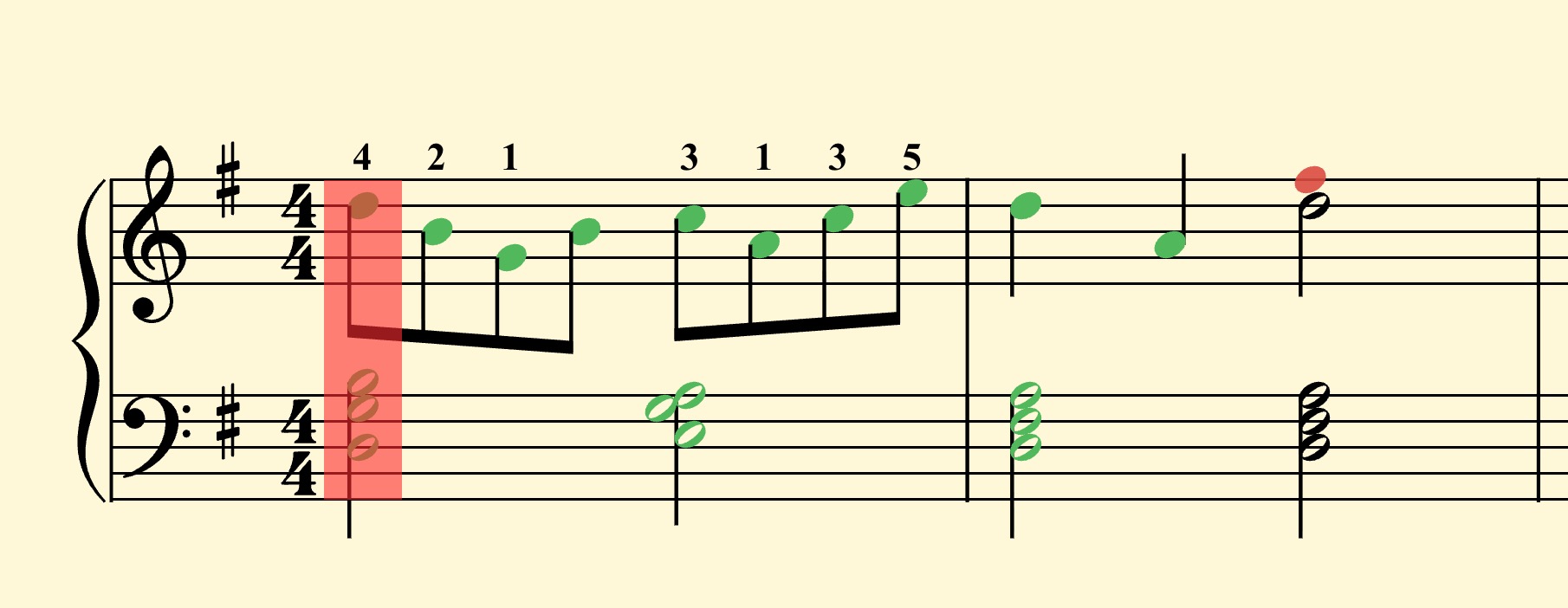
Play mode is built on this exact rule: the music keeps moving whatever you play, and the backing track keeps the floor moving under you, so a pause feels as unnatural as it should. The volume this habit needs is there too: the library holds thousands of genuinely easy pieces across every style, so you can read new material at a habit-building level for months without repeating yourself. Mistakes are never litigated mid-piece. With a MIDI keyboard, wrong notes are marked as you pass them without the music ever waiting for you; on an acoustic piano through the microphone, only the notes you got right light up while you play. Either way the detailed recap arrives when the piece ends, which is exactly when the fixing urge is supposed to get its turn. Build the no-stopping habit with backing tracks on Piano TreeCommon Questions
Do examiners penalise wrong notes in sight reading?
Far less than they penalise broken continuity. A steady, shaped reading with a few blemishes outscores an accurate one full of hesitations at every board. We wrote a full post on what ABRSM examiners are actually listening for.Should I go back and fix the mistake after I finish?
Note where it broke and why, allow one second pass if you want it, then move on to new material. A third pass is repertoire practice wearing a sight reading costume.
What if I lose my place completely?
Jump forward, never back: find the next barline or downbeat, count, and enter there. In ensemble situations, listen for the harmony and re-enter on a chord you recognise. Nobody remembers a bar you dropped. Everybody remembers a stop.
Doesn't letting mistakes go teach sloppiness?
No, because you are not ignoring them, you are deferring them. Hearing an error, logging it and continuing is itself a professional skill. Sloppiness is not noticing at all, and this practice trains the opposite: you become extremely aware of your mistakes, just no longer governed by them.
The Short Version
While the pulse runs, you do not stop. Protect the beat first, the bass and melody second, the harmony third, and sacrifice everything else without guilt. Re-enter forward at the next barline, never backwards. Save the fixing for the second pass or for repertoire practice, where stopping belongs, and decide all of this before you play, because you will not decide it well after the wrong note. Fix mistakes only once the piece is over; that is the core of the whole practice. And when one lands mid-piece, borrow my mantra until you invent your own: all good. Keep going.
Part of the Piano Tree sight reading series. Continue with How to Practice Piano Sight Reading, How Far Ahead Should You Look When Sight Reading Piano? and ABRSM Sight Reading: What Examiners Are Listening For.