
At ABRSM Grade 2, the piano sight reading test is where the hands first play together. What ABRSM, Trinity and AMEB ask, and how to get ready.
Grade 2 is the threshold. Until now the hands took turns. From Grade 2 they play together, and reading two staves at once is the real skill of piano reading. New keys, dotted rhythms and ties arrive too, but they are small next to the coordination leap. The test is still short and still easier than your pieces, so if you read a little every day, you'll get over the wall.
This post is part of our sight reading series. For the whole ladder, from first notes to Grade 8, see Piano Sight Reading Levels Explained.
Grade 2 Sight Reading at a Glance
| Board | Is it compulsory? | Preparation time | Marks |
|---|---|---|---|
| ABRSM Practical Grades | Yes | 30 seconds, and you may try any of it out | 21 of 150 |
| ABRSM Performance Grades | No sight reading test. You film four pieces and submit the video | None | None |
| Trinity College London | No. Up to Grade 5 you choose two supporting tests from sight reading, aural, improvisation and musical knowledge | 30 seconds, and you may try any of it out | 10 of 100 |
| AMEB | Yes in Comprehensive exams. Piano for Leisure lets you choose aural or sight reading. Repertoire exams have none | Not stated in the syllabus | Not listed separately in the syllabus |
ABRSM's Performance Grades have no sight reading test: you film four pieces and send in the video. So the rest of this page is about Practical Grades. Even if you choose Performance Grades, keep reading every day. Sight reading is what lets you learn new music quickly for the rest of your life, exam or no exam. At my school we keep a tradition: students taking Performance Grades still do a sight reading test, on a piece chosen by another teacher. I want to keep it alive, because music is a language. You learn to read it, write it and speak it, and then you learn its dialects and accents: the different styles.
Trinity sets its test at about two grades below the exam you are taking. AMEB sets its test within the technical standard of the grade. Either way, the test is easier than your pieces, and that changes how you should practise.
Other Exam Boards
| Board | Nearest level | Length | Keys | Preparation | Marks |
|---|---|---|---|---|---|
| LCM (London College of Music) | Grade 2 | Up to 8 bars, hands together | C, G and F major | 1 minute | 10 of 100 |
| RCM (Royal Conservatory, Canada and USA) | Level 2 | 4 bars, a melody shared between the hands | C, G and F major, and A and D minor | Not stated in the syllabus | 10 of 100 |
LCM's 2026 syllabus lets you choose a keyboard harmony test instead of sight reading, for the same 10 marks. At RCM, sight reading is part of every level, and for remote exams the passage is sent 22 hours in advance. RCM levels and ABRSM grades don't match exactly, so the table gives the nearest level. RCM also tests rhythm reading on its own, within the same 10 marks. MTAC's Certificate of Merit, in California, includes sight reading at every level, but its syllabus is sold only to member teachers, so ask your teacher for the details.
What's New at Grade 2
ABRSM publishes the clearest parameters, and they build up: everything from Initial and Grade 1 can still appear. Grade 2 adds:- Hands: playing together
- New keys: D major, and E and G minor
- Rhythm: semibreves, dotted crotchet and quaver patterns, and tied notes
- Dynamics: pp joins p, mp, mf and f
Put together, a Grade 2 ABRSM test can be in C, G, D or F major, or in A, D, E or G minor, in 2/4, 3/4 or 4/4. These requirements are the same in ABRSM's 2025 & 2026 and 2027 & 2028 syllabuses.
Trinity's Grade 2 test is gentler, because it is set about two grades below the exam. It can be in C or G major, or in A minor, now including G sharp, in 2/4, 3/4 or 4/4, and Grade 2 adds dotted minims, ties and allegretto. AMEB sets its test within the technical standard of the grade; its Piano Sight-reading book (2018) has practice examples.
How the Examiner Marks It
For a top ABRSM mark, the performance is fluent and rhythmically accurate, with the right notes and key and the musical details in place. A pass needs continuity, with note values mostly right, even if some notes are wrong. Trinity's examiners look at three things: fluency and control of pulse, rhythm and tonality; accuracy of notes; and musical detail. AMEB looks for accuracy of notes, time and rhythm, and fluency.What I See in My Studio
Grade 2 is where many students feel sight reading hit a wall, and the reason is always the same: they read one hand, then the other, and try to glue them together. It doesn't work at tempo. The fix is to read vertically, both staves as one picture per beat, and that only comes from reading a lot of easy music with both hands.Students who learn their pieces from memory hide this problem for a while, because they never have to read both hands at once. Then the sight reading test arrives and exposes it. Reading easy two-handed music every day solves it faster than any trick.
Six Things to Practise for Grade 2
1. Read below your level, and read a lot
The test is easier than your pieces, so your daily reading should be too. Easy music read fluently builds the habit the examiner is listening for. To move up a reading level, a student needs to read many pieces at the level they are on, something closer to two hundred than four. Quantity is what does it. Sight reading should always feel on the easier side, the same as reading a book. Imagine a story where every word came from a thesaurus and you had to look each one up: it would take forever. A few new words here and there are fine, and actually fun.
2. Use your 30 seconds the same way every time
A fixed routine stops you panicking. In this order:
- Key signature, then any accidentals in the music
- Time signature, then count one bar in your head
- Where do both hands start?
- Find the dotted rhythms and the ties
- Try the hardest bar out loud, hands together
- Choose a tempo you can keep all the way to the end
3. Read both staves as one picture
Read down before you read across. On each beat, look at what both hands play together, then move to the next beat. If one hand holds a long note, notice it once and let your eyes move on with the other hand.
4. Feel the dotted crotchet and quaver
A dotted crotchet followed by a quaver is long, short. Count it as "one, and two and", with the quaver on the last "and". Tap it on its own until it's automatic, then it will look after itself in the test.
5. Hold the ties
A tie joins two notes into one: play the first, hold through the second. A slur looks similar but joins different notes. Check which is which during the 30 seconds.
6. Keep going, always
Practise with a metronome or a backing track, so the music won't wait for you. If you miss something, jump back in on the next beat. I've written more about this in should you stop when you make a mistake?Using the 30 Seconds on a Real Piece
Here's how I'd prepare The Old King, a Level 4A piece in Piano Tree, in the 30 seconds.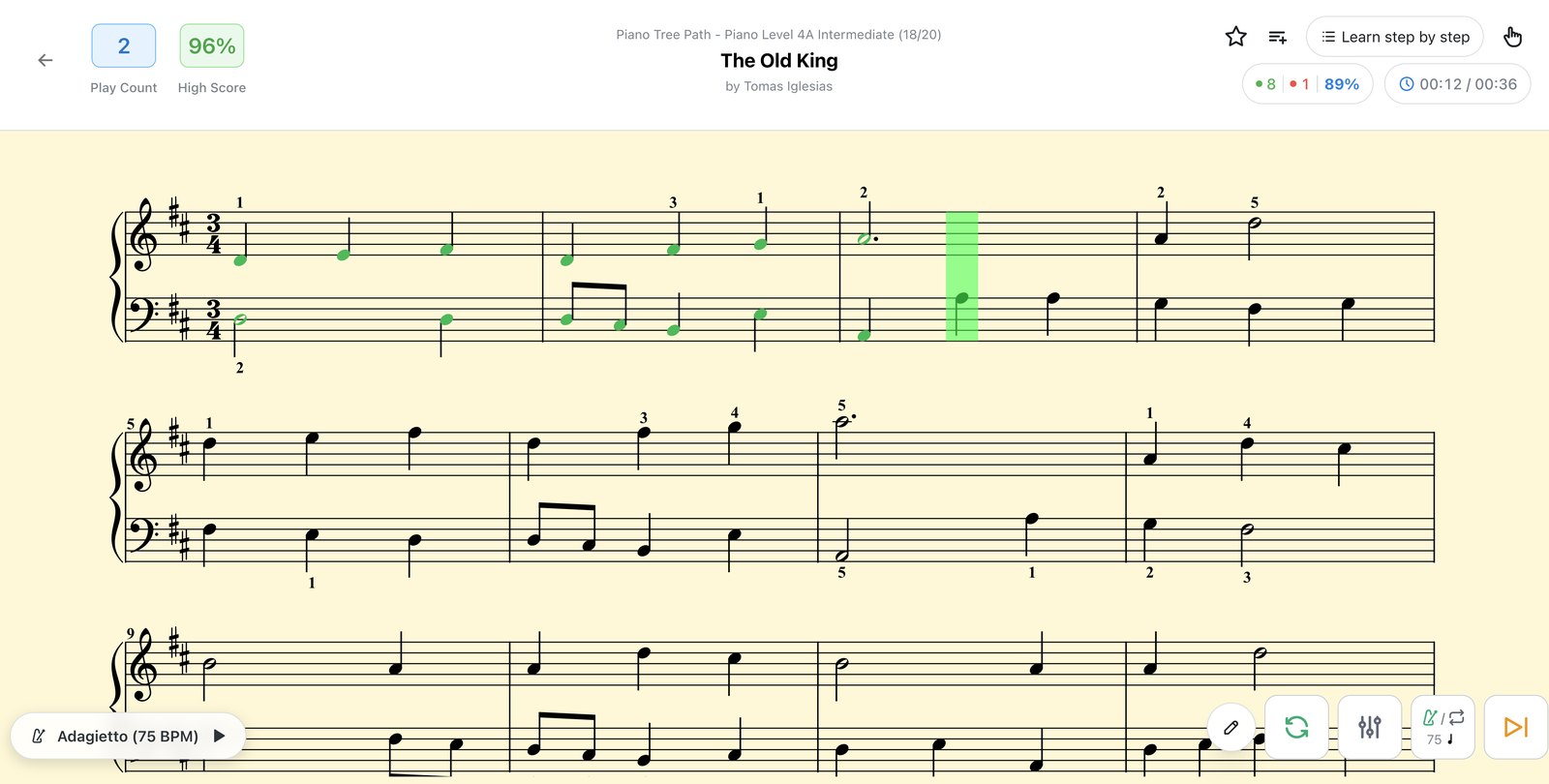
The Old King, Level 4A: D major and 3/4, hands together. Green notes show what you played correctly.
- Key: two sharps, F sharp and C sharp, so D major, one of the new Grade 2 keys.
- Time: 3/4. I count three crotchets in my head before I play a note.
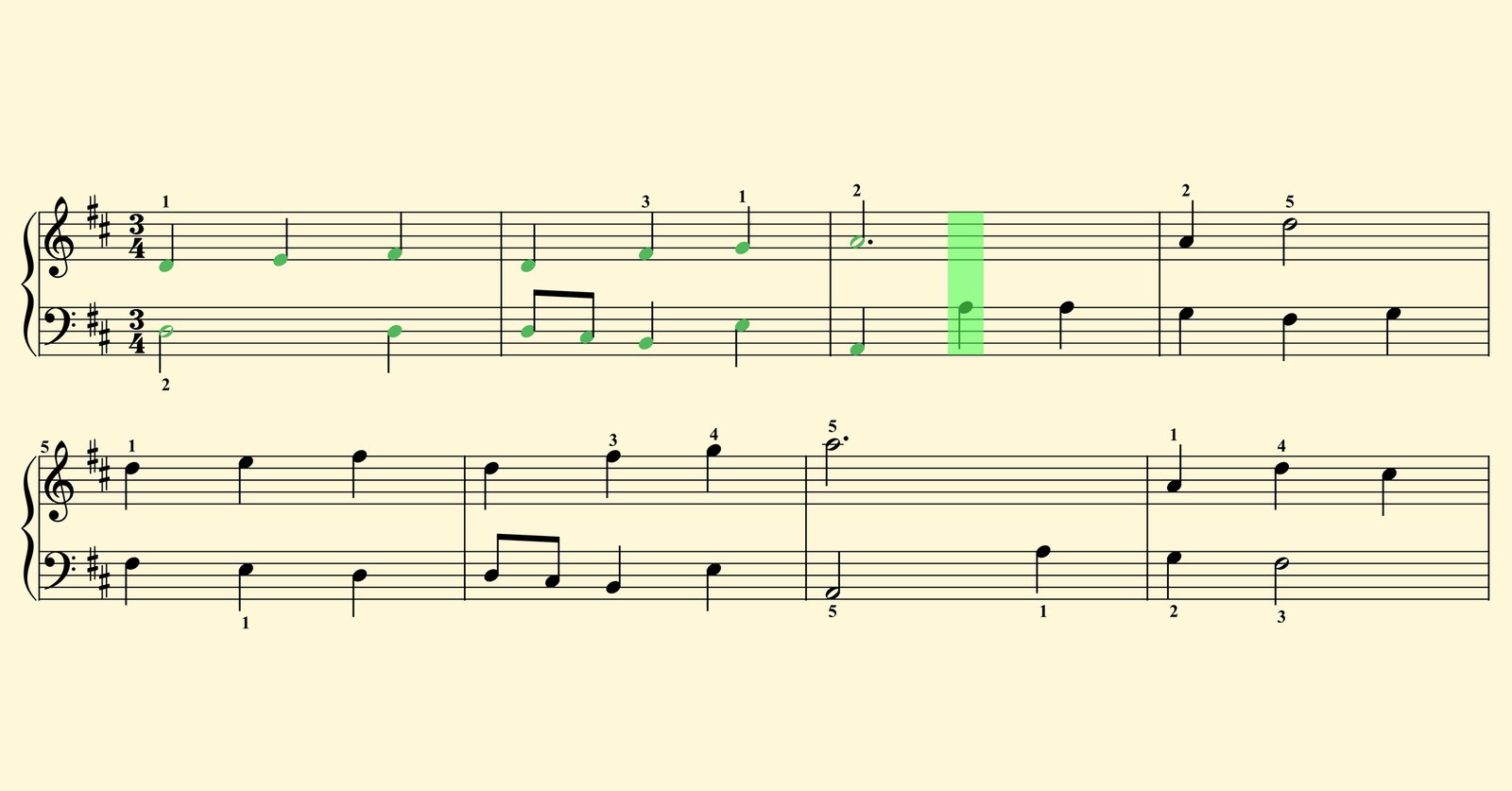
- Harmony: bar 1 is D, the tonic, and the melody simply climbs D, E, F sharp. In bar 2 the bass steps down D, C sharp, B and then jumps to E, under a melody of D, F sharp, G: tonic, then B minor, then E minor, the chord before the dominant. Bar 3 arrives on A, the dominant, held for the whole bar. In bar 4 the bass has a G under an A in the melody. That G is the seventh of the dominant chord sitting in the bass: a 4-2 chord in figured bass. A seventh has to fall, and it does, straight to F sharp: D major in first inversion, a 6-3 chord.
- The shape: look at the arch of the melody, not the single notes. Bars 1 to 3 climb a scale, D, E, F sharp, G, up to the A held in bar 3. Then bars 5 to 7 do exactly the same thing an octave higher. Read the first line well and you've already read most of the second.
- The hard part: bar 2, where the left hand plays two quavers, D and C sharp, under the right hand's crotchets. It's the first moment the hands really move differently. That's the bar I'd try out loud, hands together.
- Tempo: I pick a speed where bar 2 feels comfortable, not the speed of the first bar.
The phrase is a question and an answer. The bass goes down and lands on A, the dominant, in bar 3: that's the question, and the long note asks you to let it ring. The 4-2 chord in bar 4 starts the answer back towards D. When you read the phrase that way, you play the dominant a little stronger and let the resolution settle, and you're making music, not just playing two staves at once.
A 15-Minute Daily Routine for Grade 2
- 2 minutes: Scale and broken chord in one of the Grade 2 keys, hands together. Rotate the key each day.
- 3 minutes: Rhythm: tap a few short rhythms with dotted crotchets, quavers and ties.
- 8 minutes: Read four to six short new pieces, hands together. Prepare each one for 30 seconds, then play it once without stopping.
- 2 minutes: Look back at the piece that went worst. Was it the key, the rhythm or the coordination? That's tomorrow's focus.
How to Prepare for Grade 2 Sight Reading in Piano Tree
Master Levels 2, 3 and 4
If you've mastered Path Levels 2, 3 and 4, you're ready for the Grade 2 sight reading test. Music isn't an exact science, so let the levels overlap a little and go over: reading some of the next level as well will give you more confidence. Here is where the new Grade 2 elements start in the Path:
- Hands together: Level 2
- D major and G minor: Level 1
- E minor: Level 3
- Dotted crotchet and quaver: Level 3
- Tied notes: Level 1
Not sure where you are? The free Sight Reading Test gives you a Piano Reading Level and tells you which level to start from. For Grade 2, the tests to aim for are Early Intermediate (Levels 3B to 3E) and Intermediate (Levels 4A to 5A).
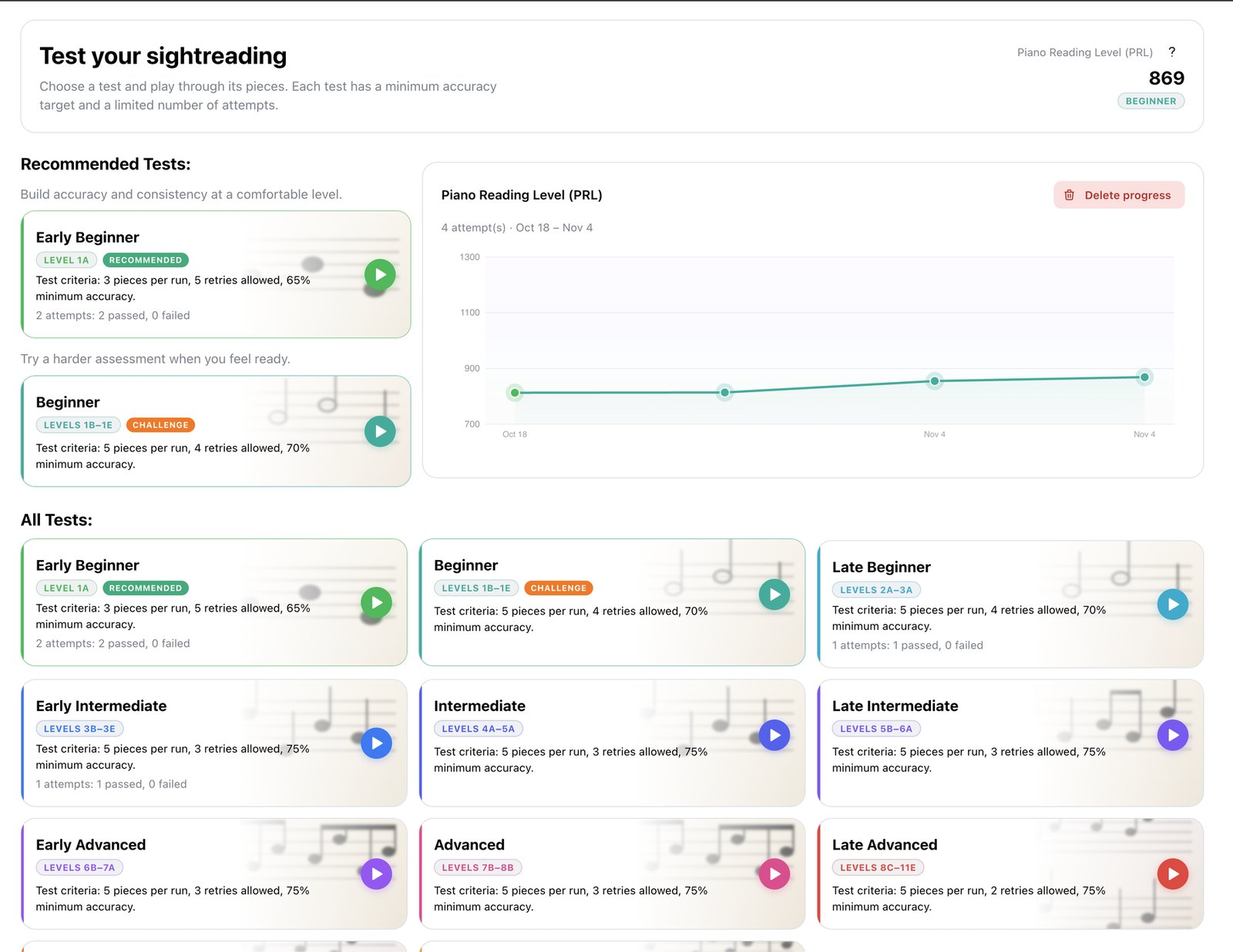
The free Sight Reading Test. Each test covers a band of Path levels and gives you a Piano Reading Level.
Read enough pieces at each level
Each Path level holds around 100 pieces, but I believe a student needs about 200 per level, sub-levels included. That's why we added the Supplementary Pieces: another 100 pieces at each level. For even more reading at this standard, explore the Christmas and Halloween collections and Hymns Levels 1 and 2. Between them there are thousands of pieces.
Use the Paul Harris books
Paul Harris's Improve your sight-reading! series is in the library, as published, along with his A Piece a Week books. Improve your sight-reading! Piano Grade 2 gives you short tests at exactly this level.
Know your chords and scales
For real mastery, students should know their chords and scales. Piano Tree has a chords and scales category in the library, and chord drills in the Learn tab.
The tools that help most
- Read ahead: set it from one beat up to several bars, so you are always looking past the note you are playing.
- Transposition: move any piece into another key to give your weakest Grade 2 key extra practice.
- The Rhythm book: part of the Sight Reading Focus Pack, it isolates rhythm on its own.
Piano Tree is a piano sight reading app built by piano teachers: 25,000+ graded pieces, real-time feedback by MIDI or microphone, from first notes to diploma level. The free plan includes hundreds of pieces and unlimited sight reading tests, with no credit card.
Start reading today: try Piano Tree freePieces at Grade 2 Standard
Sight reading is only one part of the exam. If you're learning Grade 2 pieces, you'll find music at that standard at Levels 5 and 6, in the Path itself and in the Supplementary Pieces for those levels, with a mix of Baroque, Classical and Romantic pieces at each sub-level. These levels describe pieces you prepare, not reading: as a sight reading level, Level 5 is already around Grade 3. That gap is the whole point of reading below your level, and I explain it in piano sight reading levels explained. A few examples:| Piece | Level |
|---|---|
| J. S. Bach: Menuet in D minor, BWV Anh. 132 | 5A |
| Burgmüller: Inquietude, Op. 100 No. 18 | 5A |
| Mozart: Minuet in G, K. 1e | 5B |
| Petzold: Minuets in G and G minor, BWV Anh. 114 and 115 | 5D |
| Beethoven: Sonatina in G, Anh. 5/1, Moderato | 5D |
| Haydn: Sonata in G, Hob. XVI/8, Allegro | 6A |
| Clarke: The Prince of Denmark's March | 6C |
| Clementi: Sonatina in C, Op. 36 No. 1, Allegro | 6E |
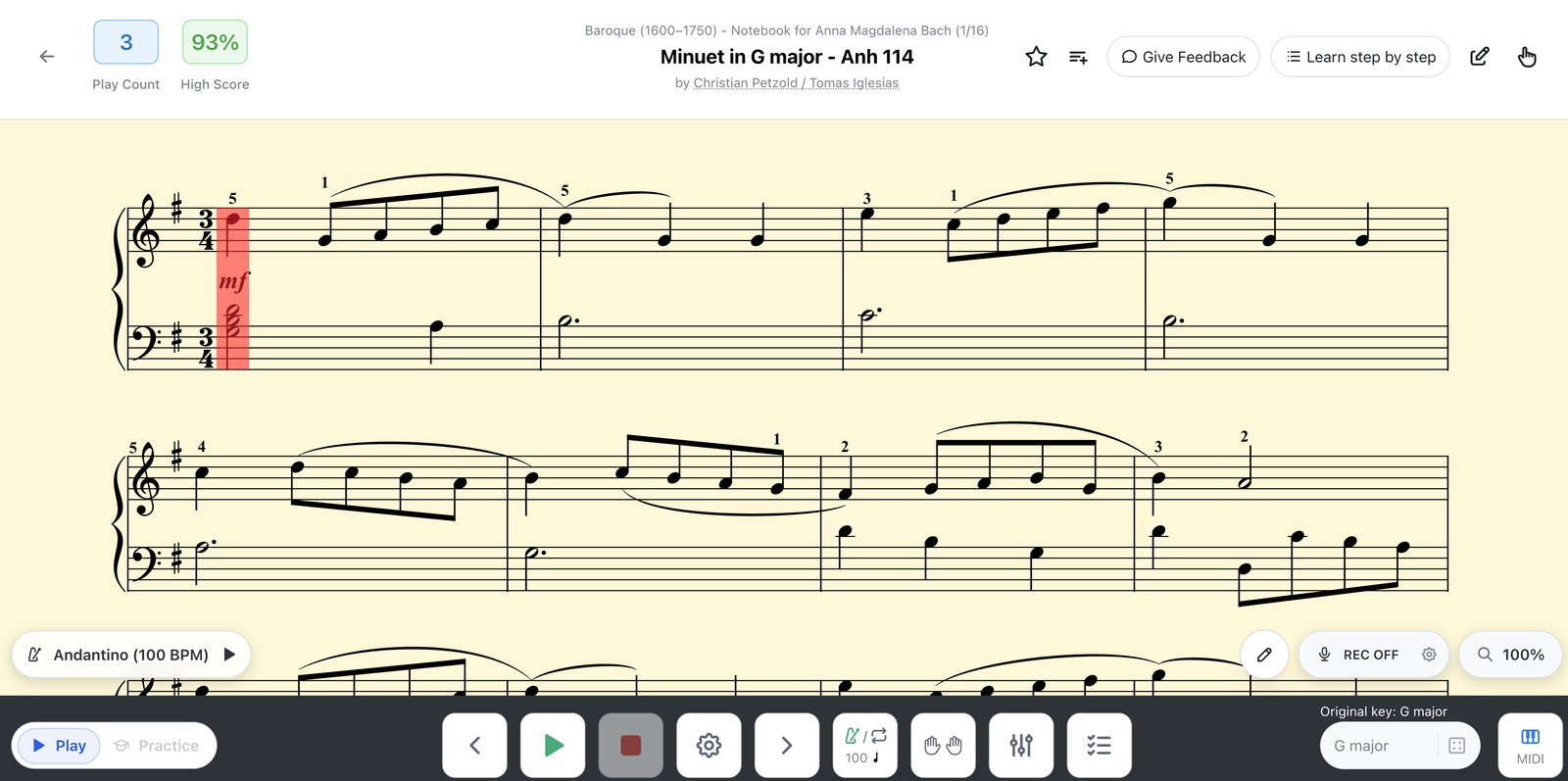
Petzold, Minuet in G, BWV Anh. 114, from the Notebook for Anna Magdalena Bach, open in Piano Tree: a piece at Grade 2 standard.
Common Mistakes at Grade 2
- Reading one hand at a time. Read each beat as one picture.
- Starting too fast. Choose the tempo of the hardest bar, not the first bar.
- Playing ties twice. A tie means hold, not play again.
- Stopping to correct. It costs more marks than the wrong note did.
- Looking down at the hands. Keep your eyes on the music and feel the keyboard.
Common Questions
Is sight reading compulsory at Grade 2?
For ABRSM Practical Grades, yes. ABRSM Performance Grades have no sight reading test, only four filmed pieces. For Trinity, no: up to Grade 5 you choose two supporting tests from four, and sight reading becomes compulsory from Grade 6. For AMEB, it is part of Comprehensive exams, optional in Piano for Leisure, and not part of Repertoire exams.
How long is the Grade 2 sight reading test?
ABRSM gives no new length for Grade 2. The first change comes at Grade 3, when tests go up to 8 bars. Expect a short piece, played hands together.
How much time do I get to prepare?
ABRSM and Trinity both give you 30 seconds, and you may try out any part of the test before you play it for the examiner.
What keys can come up at ABRSM Grade 2?
C, G, D and F major, and A, D, E and G minor.
How many marks is sight reading worth?
21 out of 150 at ABRSM, and 10 out of 100 at Trinity if you choose it.
Which Piano Tree levels prepare me for Grade 2?
For the sight reading test, master Path Levels 2, 3 and 4, with the Supplementary Pieces for extra reading. For Grade 2 exam pieces, look at Levels 5 and 6.
How long does it take to get ready?
With 15 minutes a day, most students see a clear change in about three months. Starting a term before the exam is ideal.
Sources and How We Checked
- ABRSM, Practical Music Grades: Piano Syllabus 2027 & 2028, Qualification Specification: sight reading parameters, preparation time, mark allocation and marking criteria. ABRSM states that the sight reading requirements are unchanged from the 2025 & 2026 syllabus, which remains valid until 31 December 2027.
- Trinity College London, Piano Syllabus, face-to-face graded exams: supporting tests, sight reading parameters, 30 seconds' preparation, tests set about two grades below the exam, and marking.
- AMEB, Piano Syllabus 2026: exam structure for Comprehensive, Piano for Leisure and Repertoire exams, and sight reading requirements.
- London College of Music Examinations, Piano Syllabus 2026 and Piano Sight Reading Tests, Grades 1 to 8: exam options, parameters and preparation time.
- The Royal Conservatory, Piano Syllabus, 2022 Edition: sight reading requirements and marks for each level.
- All checked in November 2026. Piano Tree is not affiliated with ABRSM, Trinity College London, AMEB, LCM, RCM or MTAC.
Part of the Piano Tree sight reading series. Continue with Grade 1 Piano Sight Reading, Grade 3 Piano Sight Reading, Piano Sight Reading Levels Explained and ABRSM Sight Reading: What Examiners Are Listening For.