

Initial Grade piano sight reading: 4 bars, one hand at a time, in C major or D minor. What ABRSM and Trinity ask, and how to prepare from the first lesson.
Initial Grade is the first step on the exam ladder, and for many students it's their first time reading music they've never seen, in front of someone they've never met. The test is tiny: four bars, one hand at a time, five fingers on five notes. But what a student learns here decides how every grade after it goes. A child who learns to keep the beat and keep their eyes on the page at Initial has already done the hardest part of becoming a reader.
This post is part of our sight reading series. For the whole ladder, from first notes to Grade 8, see Piano Sight Reading Levels Explained.
Initial Grade Sight Reading at a Glance
| Board | Is it compulsory? | Preparation time | Marks |
|---|---|---|---|
| ABRSM Practical Grades | Yes | 30 seconds, and you may try any of it out | 21 of 150 |
| ABRSM Performance Grades | No sight reading test. You film four pieces and submit the video | None | None |
| Trinity College London | No. Up to Grade 5 you choose two supporting tests from sight reading, aural, improvisation and musical knowledge | 30 seconds, and you may try any of it out | 10 of 100 |
| AMEB Preliminary | No. AMEB sight reading tests start at Grade 1 | None | None |
ABRSM's Performance Grades have no sight reading test: you film four pieces and send in the video. So the rest of this page is about Practical Grades. Even if you choose Performance Grades, keep reading every day. Sight reading is what lets you learn new music quickly for the rest of your life, exam or no exam. At my school we keep a tradition: students taking Performance Grades still do a sight reading test, on a piece chosen by another teacher. I want to keep it alive, because music is a language. You learn to read it, write it and speak it, and then you learn its dialects and accents: the different styles.
AMEB's first exam, Preliminary, has no sight reading test, and neither does a Trinity Initial exam if you choose aural, improvisation or musical knowledge instead. Read anyway. AMEB sight reading starts at Grade 1, and a student who has read every day since their first lesson walks into that test already fluent.
Other Exam Boards
| Board | Nearest level | Length | Keys | Preparation | Marks |
|---|---|---|---|---|---|
| RCM (Royal Conservatory, Canada and USA) | Preparatory B | About 2 bars, a short melody shared between the hands | Set five-finger positions | Not stated in the syllabus | 10 of 100 |
RCM tests rhythm reading and playing separately, within the same 10 marks, and RCM levels and ABRSM grades don't match exactly, so the table gives the nearest level. LCM's introductory Step exams have no sight reading test: LCM sight reading starts at Grade 1, where you can choose it or a keyboard harmony test. MTAC's Certificate of Merit, in California, includes sight reading at every level, but its syllabus is sold only to member teachers, so ask your teacher for the details.
What's in the Initial Grade Test
ABRSM publishes the clearest parameters. Every later grade builds on these:- Length: 4 bars in 4/4, or 6 bars in 2/4
- Keys: C major and D minor
- Hands: each hand plays separately, in a five-finger position from the tonic to the dominant
- Rhythm: minims, crotchets and pairs of quavers
- Musical details: legato phrases, staccato, f and p
In practice, that means the right hand or the left hand sits on C, D, E, F, G or on D, E, F, G, A, and the music never asks it to move. These requirements are the same in ABRSM's 2025 & 2026 and 2027 & 2028 syllabuses.
Trinity's Initial test is in C major and 2/4, with crotchets and minims, p and f, a moderate tempo and simple phrasing. AMEB has no sight reading at Preliminary; its tests start at Grade 1, within the technical standard of the grade.
How the Examiner Marks It
For a top ABRSM mark, the performance is fluent and rhythmically accurate, with the right notes and key and the musical details in place. A pass needs continuity, with note values mostly right, even if some notes are wrong. Trinity's examiners look at three things: fluency and control of pulse, rhythm and tonality; accuracy of notes; and musical detail.What I See in My Studio
The students who struggle with reading at Grade 5 are almost always the ones who learned their first pieces by copying: watching the teacher's hands, a video, or coloured notes on a screen. It feels fast at the start, because the first songs come quickly. Then the pieces get longer, the copying stops working, and reading has to start from zero.So from the very first lesson, my students read. Not many notes, not fast, but always from the page, with their eyes on the music and their hands finding the keys by feel. They also accompany from Level 1 in Piano Tree: the orchestra plays the tune and the student plays a simple piano part underneath it. Music is a language, and children learn a language by using it, long before they understand its grammar.
Six Things to Practise for Initial Grade
1. Read below your level, and read a lot
The test is easier than your pieces, so your daily reading should be too. Easy music read fluently builds the habit the examiner is listening for. To move up a reading level, a student needs to read many pieces at the level they are on, something closer to two hundred than four. At Initial, that sounds like a lot, but these pieces are only a few bars long: five or six a day adds up fast. Sight reading should always feel on the easier side, the same as reading a book. Imagine a story where every word came from a thesaurus and you had to look each one up: it would take forever. A few new words here and there are fine, and actually fun.
2. Use your 30 seconds the same way every time
A fixed routine stops you panicking. In this order:
- Which hand plays, and which clef is it in?
- Key signature: none means C major, one flat means D minor
- Time signature, then count one bar in your head
- Put your thumb or your fifth finger on the first note, and the other fingers on the next four notes
- Spot the rests and the long notes
- Choose a tempo you can keep all the way to the end
3. Find the five-finger position before you start
At Initial the hand never moves. In C major it covers C to G, and in D minor D to A. If the first note is the tonic, your thumb goes there in the right hand and your fifth finger in the left. Put the hand in place during the 30 seconds, and the rest of the test is just steps and skips inside those five notes.
4. Read steps and skips, not letter names
Don't name every note. Read the first note, then read the shape: a step moves to the next finger, a skip jumps over one finger, a repeated note stays where it is. This is how fluent readers read, and Initial is the best time to learn it, while there are only five notes to choose from.
5. Count through the minims and rests
A minim is two full beats, and a rest is silence you still count. Beginners often cut long notes short and rush the rests. Count aloud while you play, "1 2 3 4", and let the long notes and the silences take their full time.
6. Keep going, always
Practise with a metronome or a backing track, so the music won't wait for you. If you miss something, jump back in on the next beat. I've written more about this in should you stop when you make a mistake?Using the 30 Seconds on a Real Piece
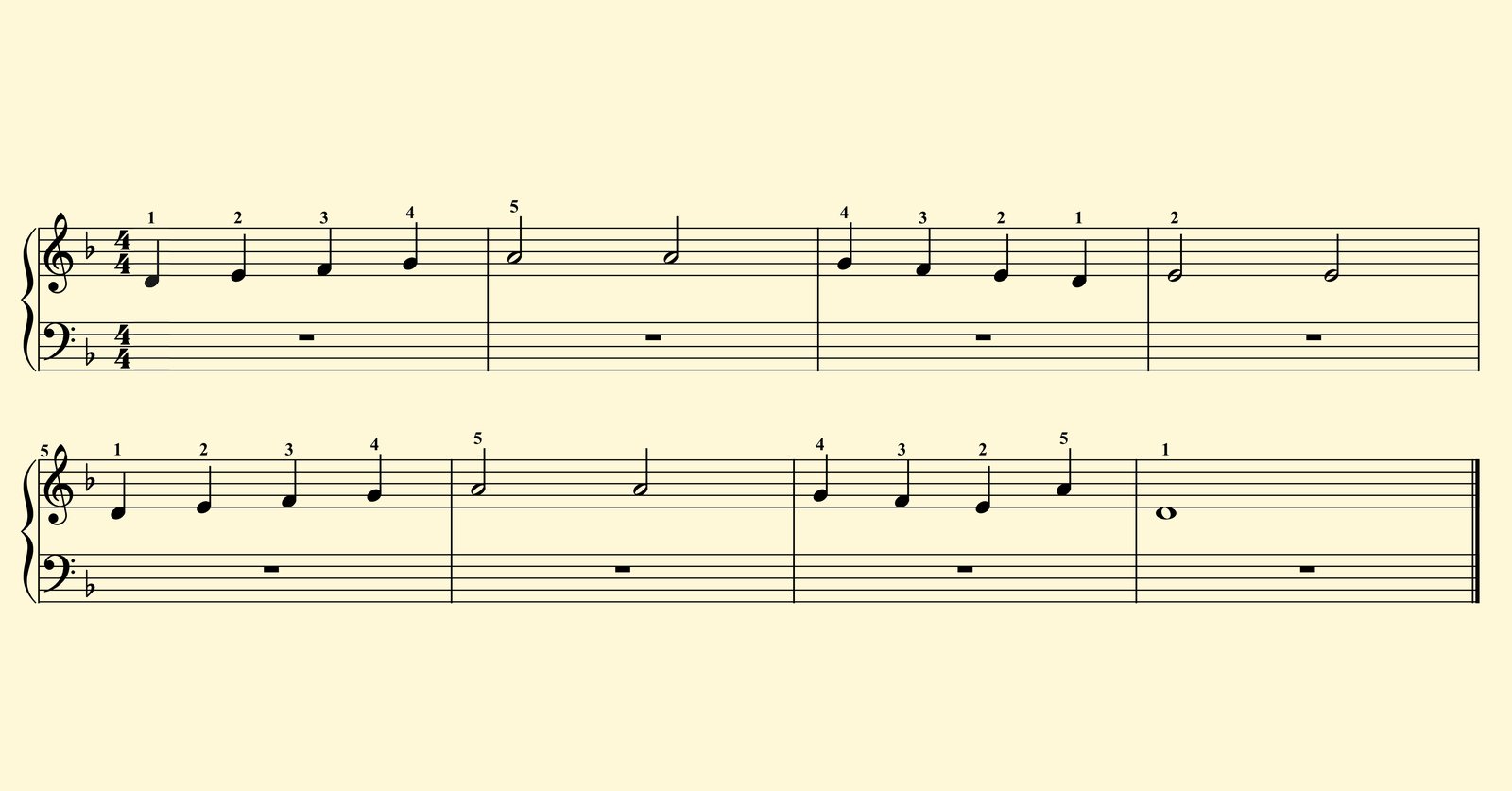
Here's how I'd prepare Five Little Stars in D minor, a Level 1E piece in Piano Tree, in the 30 seconds.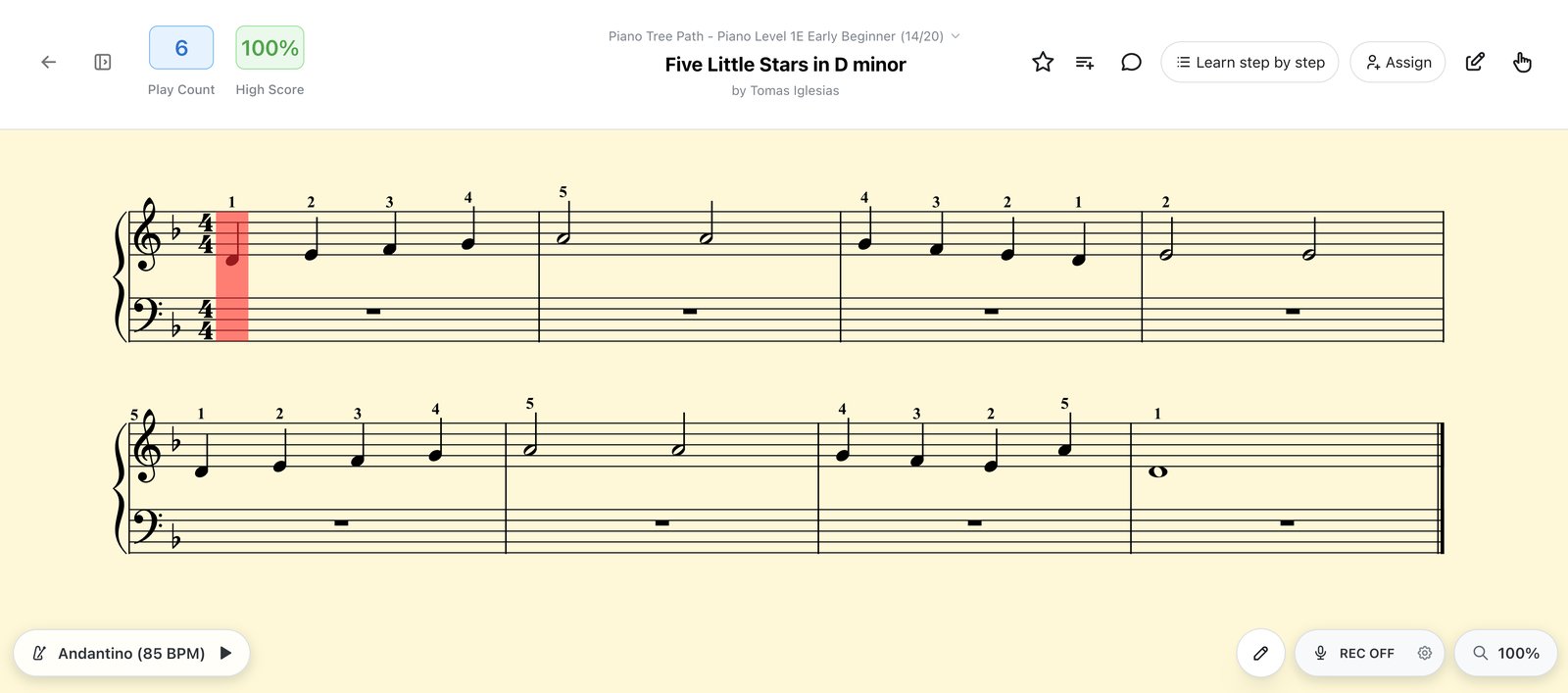
Five Little Stars in D minor, Level 1E: eight bars for the right hand alone, in one five-finger position from D to A.
- Hand and clef: the right hand plays, in the treble clef. The left hand rests for the whole piece, so I can forget about it.
- Key: one flat, and the first note is D: D minor. My thumb goes on D and the other fingers on E, F, G and A. The B flat in the key signature never comes up, because the hand never reaches B.
- Time: 4/4 at 85 crotchets a minute. I count one bar in my head, "1 2 3 4", before I start.
- Shape: bar 1 steps up from D to G, bar 2 holds two minims on A, bar 3 steps back down to D, and bar 4 rests on two minims on E. Each finger plays its own note, so I read the direction, not the letter names.
- The easy part: bars 5 and 6 are the same as bars 1 and 2. Read two bars, play four.
- The hard part: bar 7. It steps down G, F, E, then jumps up to A with the fifth finger, and the last bar drops back to D. That's the only skip in the piece, so it's the bar I'd try out loud.
- Tempo: I keep it at 85. The minims get two full beats and the last note gets four.
Read like this, the piece is two four-bar phrases: a question that stops on E, and an answer that comes home to D. Play it legato, let the line grow a little towards the minims on A, and hold the last D for its full length.
A 10-Minute Daily Routine for Initial Grade
- 2 minutes: Five-finger scale in C major and D minor, each hand. Say the note names as you play.
- 2 minutes: Rhythm: clap a few short rhythms in 2/4 and 4/4, with minims, crotchets, pairs of quavers and rests.
- 5 minutes: Read four to six very short new pieces. Prepare each one for 30 seconds, then play it once without stopping.
- 1 minute: Pick the piece that went worst. Was it the hand position, the rhythm or stopping? That's tomorrow's focus.
How to Prepare for Initial Grade Sight Reading in Piano Tree
Master Levels 1 and 2, and start Level 3
If you've mastered Path Levels 1 and 2, and reached 3A, where quavers come in, you're ready for the Initial Grade sight reading test. Music isn't an exact science, so let the levels overlap a little and go over: reading some of the next level as well will give you more confidence. Here is where the Initial Grade elements start in the Path:
- 4/4 time: Starts at Level 1A
- D minor: Starts at Level 1E
- Quavers: Starts at Level 3A
Not sure where you are? The free Sight Reading Test gives you a Piano Reading Level and tells you which level to start from. For Initial Grade, the tests to aim for are Beginner (Levels 1B to 1E) and Late Beginner (Levels 2A to 3A).
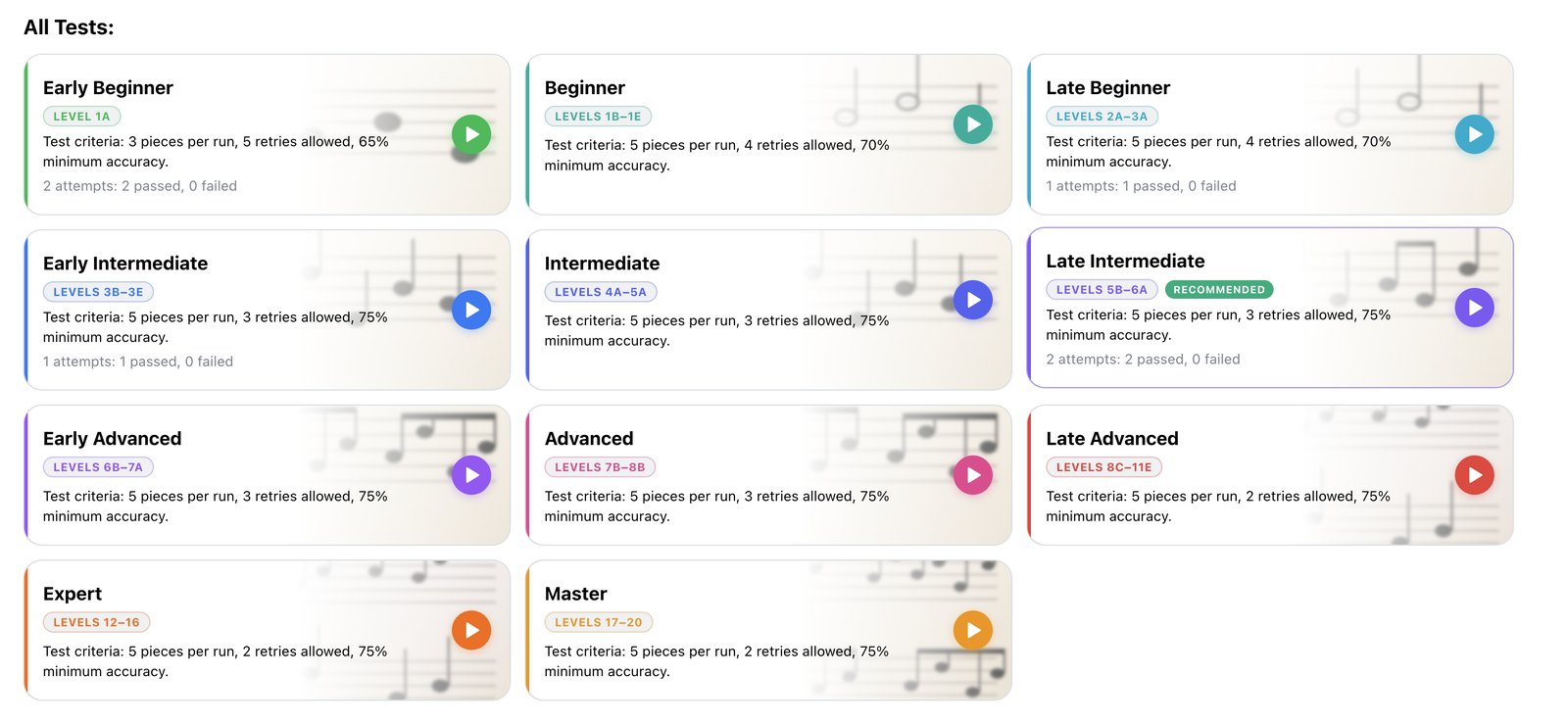
The free Sight Reading Test. Each of the eleven tests covers a band of Path levels and gives you a Piano Reading Level.
Read enough pieces at each level
Each Path level holds around 100 pieces, but I believe a student needs about 200 per level, sub-levels included. That's why we added the Supplementary Pieces: another 100 pieces at each level. For even more reading at this standard, explore the Christmas and Halloween collections and Hymns Level 1. Between them there are thousands of pieces.
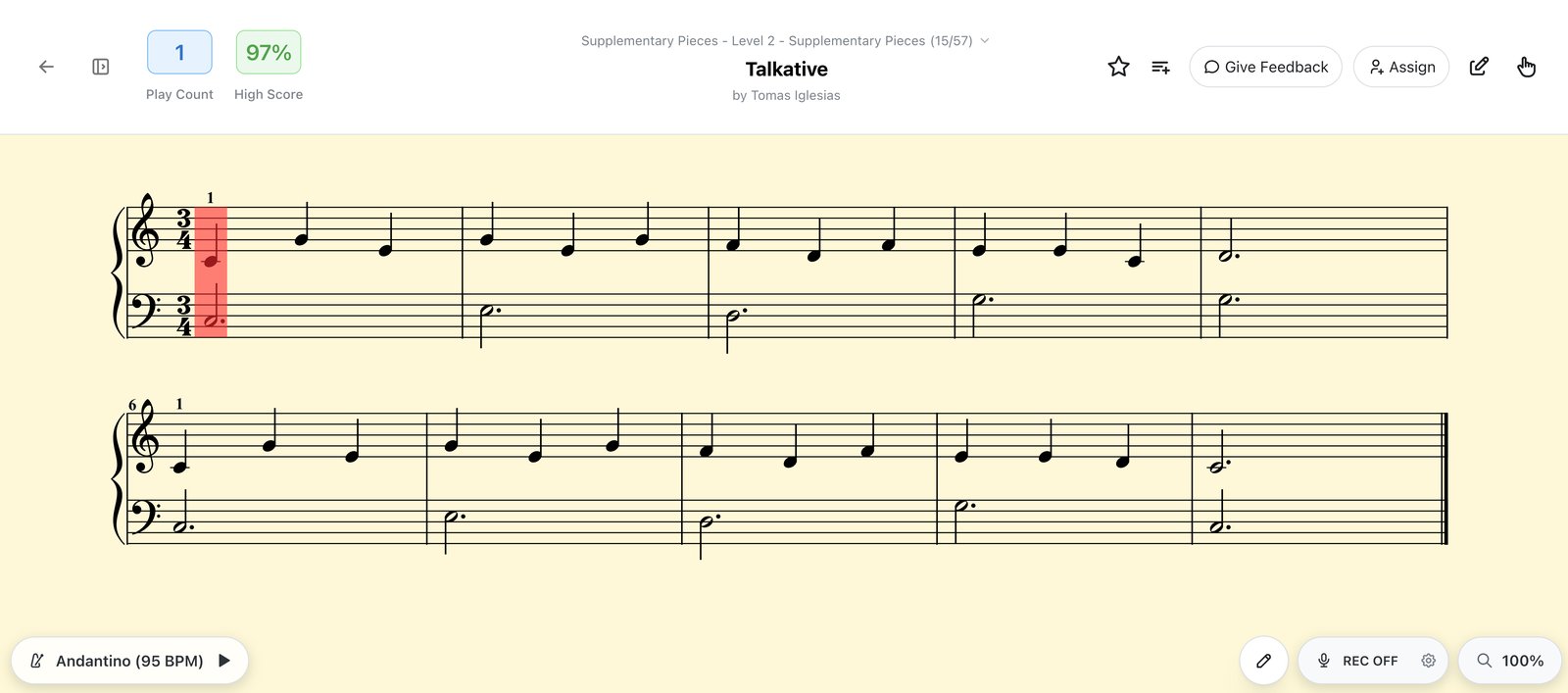
Talkative, one of the Level 2 Supplementary Pieces: a right-hand tune over long notes in the left hand.
Use the Paul Harris books
Paul Harris's Improve your sight-reading! series is in the library, as published, along with his A Piece a Week books and his sight reading duets. Improve your sight-reading! Piano Pre-Grade 1 gives you short tests at exactly this level, and the duets let a teacher or parent play along, which is the best way to learn that the music doesn't wait.
Know your five-finger positions
For real mastery, students should know their chords and scales, and at Initial that starts with five-finger positions. Piano Tree has a chords and scales category in the library, and chord drills in the Learn tab.
The tools that help most
- Read ahead: set it to one beat, then two, so your eyes start to look past the note you are playing.
- Accompanying: play the piano part while the backing track plays the tune. It keeps you in time, and it's the most fun way to learn that the music doesn't wait.
- The Rhythm book: part of the Sight Reading Focus Pack, it isolates rhythm on its own.
Piano Tree is a piano sight reading app built by piano teachers: 25,000+ graded pieces, real-time feedback by MIDI or microphone, from first notes to diploma level. The free plan includes hundreds of pieces and unlimited sight reading tests, with no credit card.
Start reading today: try Piano Tree freePieces at Initial Grade Standard
Sight reading is only one part of the exam. A student who has finished Level 3B in Piano Tree is ready to tackle the Initial Grade exam pieces with confidence. At this stage your reading and your pieces are close together. The gap between them grows with every grade, and I explain why in piano sight reading levels explained. A few examples from the Path:| Piece | Level |
|---|---|
| Five Little Stars in D minor | 1E |
| Talkative (Supplementary Pieces) | 2 |
| Türk: Second March | 3B |
ABRSM's Initial lists also draw on the classic teaching composers: Beyer, Diabelli, Gurlitt and Reinagle all appear in the 2025 & 2026 syllabus, next to new pieces and pop arrangements.
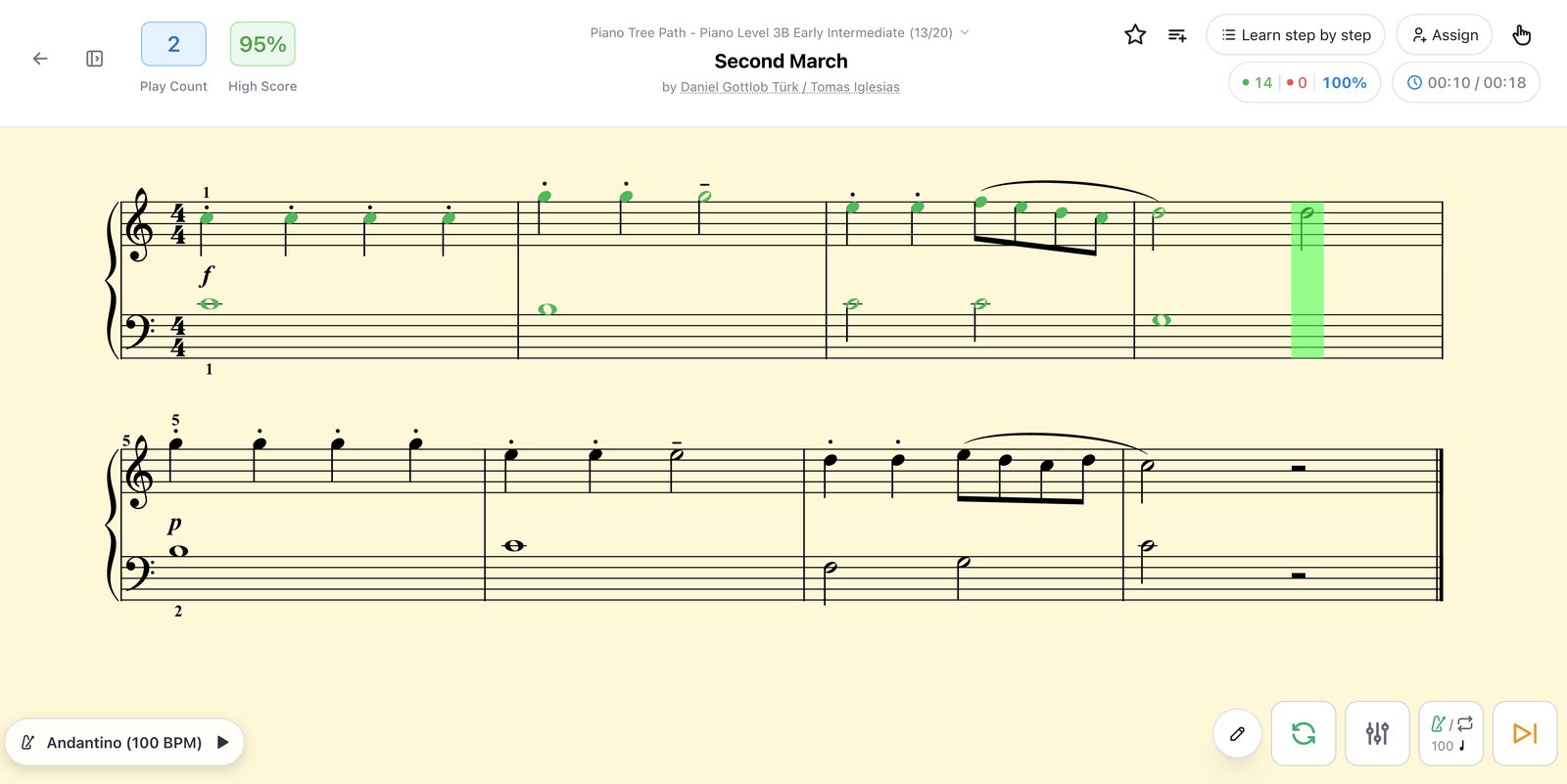
Türk, Second March, open in Piano Tree at Level 3B: a piece at Initial Grade standard, with staccato, f and p, and a run of quavers in bar 3.
Common Mistakes at Initial Grade
- Putting the hand in the wrong place. Check the first note against the stave, and the clef, before you play.
- Starting too fast. Choose the tempo of the hardest bar, not the first bar.
- Cutting the minims short. A minim is two beats. Count them.
- Looking down at the hands. In a five-finger position, you don't need to. Keep your eyes on the music.
- Stopping to correct. It costs more marks than the wrong note did.
Common Questions
Is sight reading compulsory at Initial Grade?
For ABRSM Practical Grades, yes. ABRSM Performance Grades have no sight reading test, only four filmed pieces. For Trinity, no: up to Grade 5 you choose two supporting tests from four. AMEB's Preliminary exam has no sight reading test; AMEB sight reading starts at Grade 1.
How long is the Initial Grade sight reading test?
At ABRSM, 4 bars in 4/4 or 6 bars in 2/4, with one hand playing at a time.
How much time do I get to prepare?
ABRSM and Trinity both give you 30 seconds, and you may try out any part of the test before you play it for the examiner.
What keys can come up at ABRSM Initial Grade?
C major and D minor. At Trinity, C major only.
How many marks is sight reading worth?
21 out of 150 at ABRSM, and 10 out of 100 at Trinity if you choose it.
Which Piano Tree levels prepare me for Initial Grade?
For the sight reading test, master Path Levels 1 and 2 and reach 3A, with the Supplementary Pieces for extra reading. For the Initial Grade exam pieces, finish Level 3B.
How long does it take to get ready?
With 10 minutes a day, most students see a clear change in about three months. Starting a term before the exam is ideal.
Sources and How We Checked
- ABRSM, Practical Music Grades: Piano Syllabus 2027 & 2028, Qualification Specification: sight reading parameters, preparation time, mark allocation and marking criteria. ABRSM states that the sight reading requirements are unchanged from the 2025 & 2026 syllabus, which remains valid until 31 December 2027.
- ABRSM, Piano Practical Grades 2025 & 2026 syllabus: the Initial Grade lists.
- Trinity College London, Piano Syllabus, face-to-face graded exams: supporting tests, sight reading parameters, 30 seconds' preparation and marking.
- AMEB, Piano Syllabus 2026: sight reading tests apply to Grades 1 to 8, so there is no sight reading test at Preliminary.
- London College of Music Examinations, Piano Syllabus 2026: Step exams and the sight reading option from Grade 1.
- The Royal Conservatory, Piano Syllabus, 2022 Edition: sight reading requirements and marks for Preparatory B.
- All checked in November 2026. Piano Tree is not affiliated with ABRSM, Trinity College London, AMEB, LCM, RCM or MTAC.
Part of the Piano Tree sight reading series. Continue with Grade 1 Piano Sight Reading, Piano Sight Reading Levels Explained and ABRSM Sight Reading: What Examiners Are Listening For.