

Piano Tree now has Paul Harris's best-selling sight reading series, licensed from Faber Music: Improve your sight-reading! from Initial Grade to Grade 8, A Piece a Week, the duets, and You can read music. That is more than 1,400 pieces, each placed on the Piano Tree Path, with a metronome, a count-in and live feedback.
New in Piano Tree. For how Piano Tree compares with other sight reading apps, see Best Piano Sight Reading Apps for 2027.
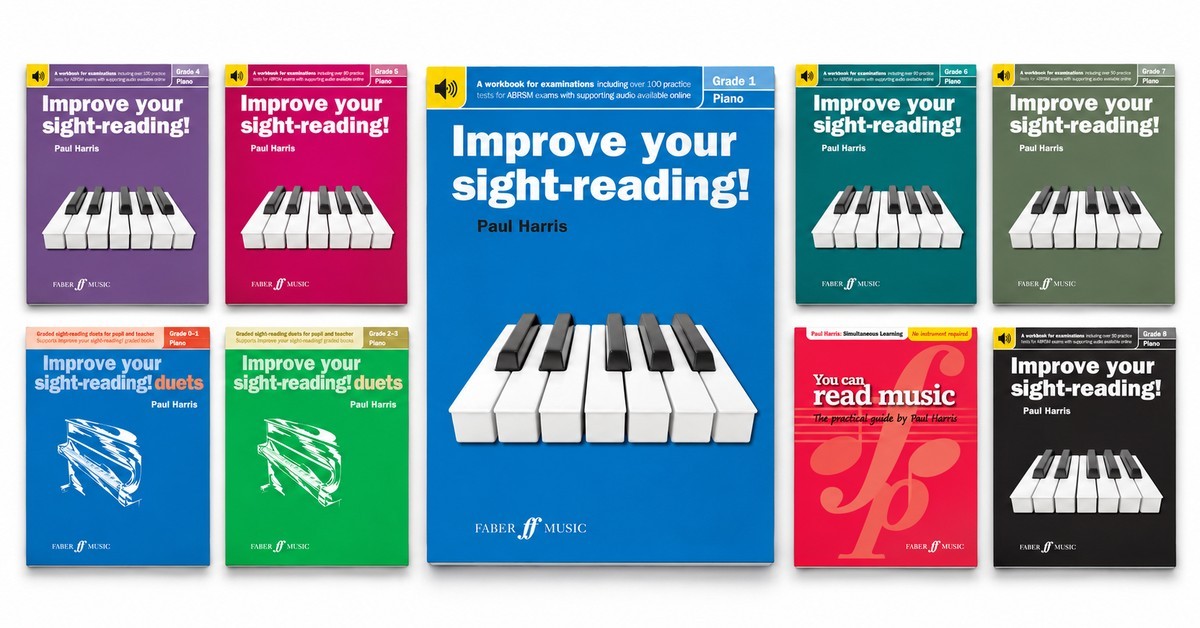
For many piano teachers, Paul Harris's books are where sight reading practice starts, especially before ABRSM exams. Now the whole series is inside Piano Tree, in partnership with Faber Music, so students can play every exercise with a metronome and live feedback instead of on their own.
Who is Paul Harris?
Paul Harris is one of the UK's leading music educators. He studied at the Royal Academy of Music and the University of London, and has more than 600 publications to his name, including the Improve your sight-reading! series and How to Sight-Read, which won Best Educational Publication at the Art of Piano Education Awards. He writes for magazines such as Music Teacher, BBC Music Magazine and ABRSM's Libretto, works as an examiner and adjudicator, including for BBC Young Musician of the Year, and leads workshops for teachers around the world.
He also created Simultaneous Learning, an approach to instrumental and singing teaching that connects every part of musicianship in each lesson, now used by teachers all over the world. You can read his full biography on his website, and find his books at Faber Music.Why are Paul Harris's books so good for sight reading?
His books are built around two Golden Rules. Golden Rule 1 is "Always count". Golden Rule 2 is "Never stop". Before students read a single note, the books ask them to feel the pulse, like a heartbeat, and keep it going. That is exactly how we built Piano Tree: every piece has a metronome and a count-in, and you can choose to keep going through mistakes instead of stopping.
Always count. Never stop. Paul Harris's two Golden Rules are built into every piece.
Which Paul Harris books are in Piano Tree?
Every book is in the app, with its own place on the Path, so you can see which Piano Tree level each one matches. All of them are part of Piano Tree Premium.
| Book | Pieces | Piano Tree level |
|---|---|---|
| Improve your sight-reading! Initial Grade | 119 | Level 1 |
| Improve your sight-reading! Grade 1 | 187 | Level 1 |
| Improve your sight-reading! Grade 2 | 180 | Level 3 |
| Improve your sight-reading! Grade 3 | 159 | Level 4 |
| Improve your sight-reading! Grade 4 | 127 | Level 5 |
| Improve your sight-reading! Grade 5 | 112 | Level 6 |
| Improve your sight-reading! Grade 6 | 104 | Level 7 |
| Improve your sight-reading! Grade 7 | 92 | Level 9 |
| Improve your sight-reading! Grade 8 | 80 | Level 12 |
| A Piece a Week Initial Grade | 29 | Level 3 |
| A Piece a Week Grade 1 | 26 | Level 3 |
| A Piece a Week Grade 2 | 26 | Level 3 |
| A Piece a Week Grade 3 | 27 | Level 4 |
| A Piece a Week Grade 4 | 27 | Level 4 |
| A Piece a Week Grade 5 | 27 | Level 5 |
| A Piece a Week Grade 6 | 28 | Level 6 |
| A Piece a Week Grades 7-8 | 32 | Level 8 |
| Improve your sight-reading! Duets, Grades 0-1 | 45 | Levels 1 to 4 |
| Improve your sight-reading! Duets, Grades 2-3 | 45 | Levels 5 to 8 |
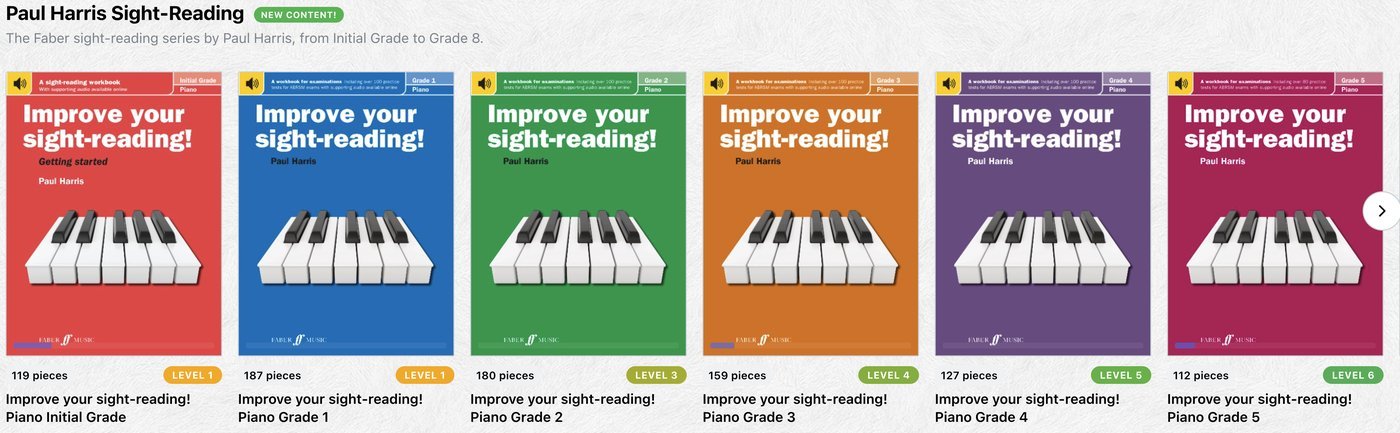
Improve your sight-reading! Initial Grade to Grade 5, each with its Piano Tree level.
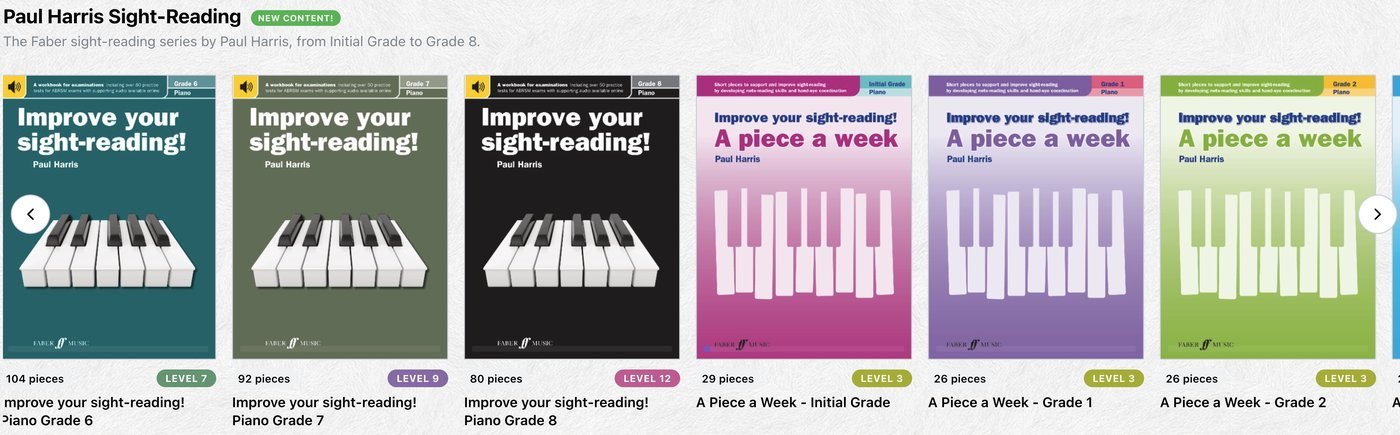
Grades 6 to 8, and the first A Piece a Week books.
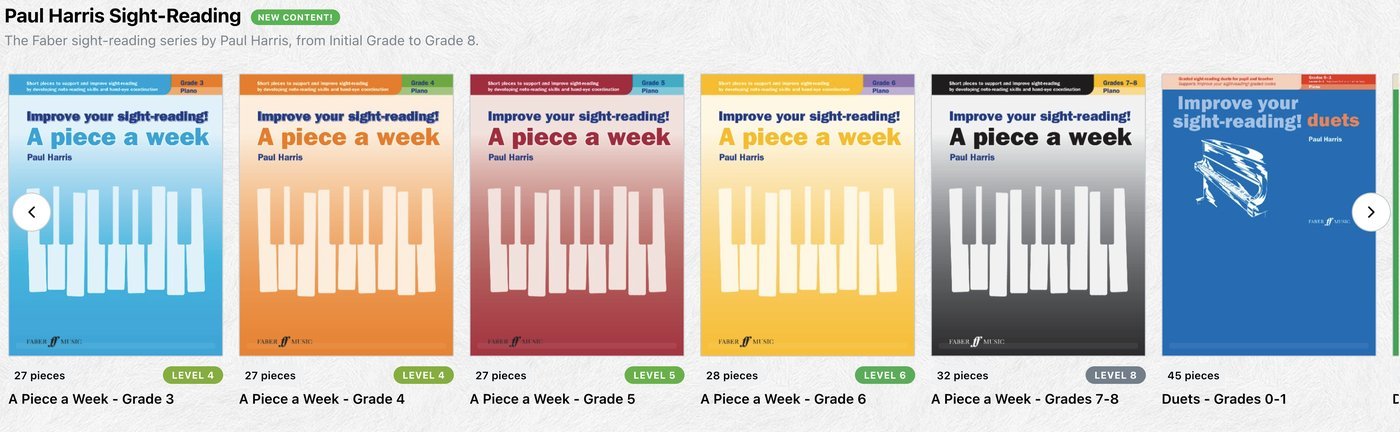
A Piece a Week Grades 3 to 8, and the duets.
What is the difference between Improve your sight-reading! and A Piece a Week?
Improve your sight-reading! is a workbook for each grade. It works step by step through the skills a reader needs, from rhythm and pulse to keys and patterns, and from Grade 1 up it includes dozens of practice tests in the style of the ABRSM sight reading test.
A Piece a Week is a set of short pieces, written to be learned one a week. They build note reading and hand-eye coordination by giving students a steady supply of new music at their level, which is exactly what fluent reading needs.
The two series are made to be used together: the workbook for the daily sight reading, and A Piece a Week for the slightly longer pieces you get to know over a few days.
What is You can read music?
You can read music is Paul Harris's practical guide to reading notation, built on his Simultaneous Learning approach. It needs no instrument, so it suits complete beginners, adults coming back to music, and anyone who wants to read faster before they play. It is in Piano Tree alongside the sight reading books.
Are the rhythm exercises included?
Paul Harris starts with rhythm, because playing the right notes is rarely what goes wrong when we sight read. Playing them in time is. The rhythm exercises from the books are in Piano Tree too, so students can practice counting before they add the notes, the way the books intend.
How do the duets work in Piano Tree?
The two books of Improve your sight-reading! Duets, Grades 0-1 and Grades 2-3, are graded sight reading duets for pupil and teacher. Reading with another player is the real test of sight reading: the music keeps going whether you are ready or not. In Piano Tree you choose your part and the app plays the other one, so you get that real duet pressure even when you practice alone. Or play them with your teacher.
How should you combine Paul Harris with the Piano Tree Path?
As much as I respect Paul's work, I recommend blending his books with the Piano Tree Path. His books move one exam grade at a time. The Path is more gradual: 20 levels, each split into five sub-levels, so 100 small steps, and each step adds only one new thing. Between two Paul Harris grades there are several Path levels of new music to read.
A good plan is to finish the matching Path levels while you work through each book. If you are on Improve your sight-reading! Grade 3, which sits at Level 4, read through Levels 4A to 4E of the Path at the same time. By the time you finish the book, you will have sight read a lot of new music at exactly the right level, which is what makes reading fluent.
Pair both with two more parts of Piano Tree:
- The rhythm books, with rhythms for one hand or two hands, to keep the pulse steady. You can also use them to improvise, or simply play a C in each hand.
- The chord trainers, from intervals and triads in every inversion to seventh chords, so you recognize harmony at a glance instead of reading note by note.
A simple week could look like this: a few exercises from the Paul Harris workbook each day, one piece from A Piece a Week across the week, two or three new pieces from your Path level every day, and five minutes of rhythm or chords to finish.
Paul Harris for the method, the Path for the mileage: the more new music you read at the right level, the faster you read.
How should you practice the Paul Harris books in Piano Tree?
- Start at the right level. Take the free Sight Reading Test. Your Piano Reading Level tells you which book to open, using the table above.
- Turn on the count-in. Listen to one or two measures of the beat before you play, and keep counting.
- Do not stop. Set practice mode to show mistakes in red and carry on. That is Golden Rule 2.
- Read a little every day. A few exercises from the workbook, plus new pieces from your Path level, and one piece from A Piece a Week across the week.
- Move up when it feels easy. When you can read a page in time without stopping, go to the next book.
Teachers can assign any book or exercise to their students and see how they did.
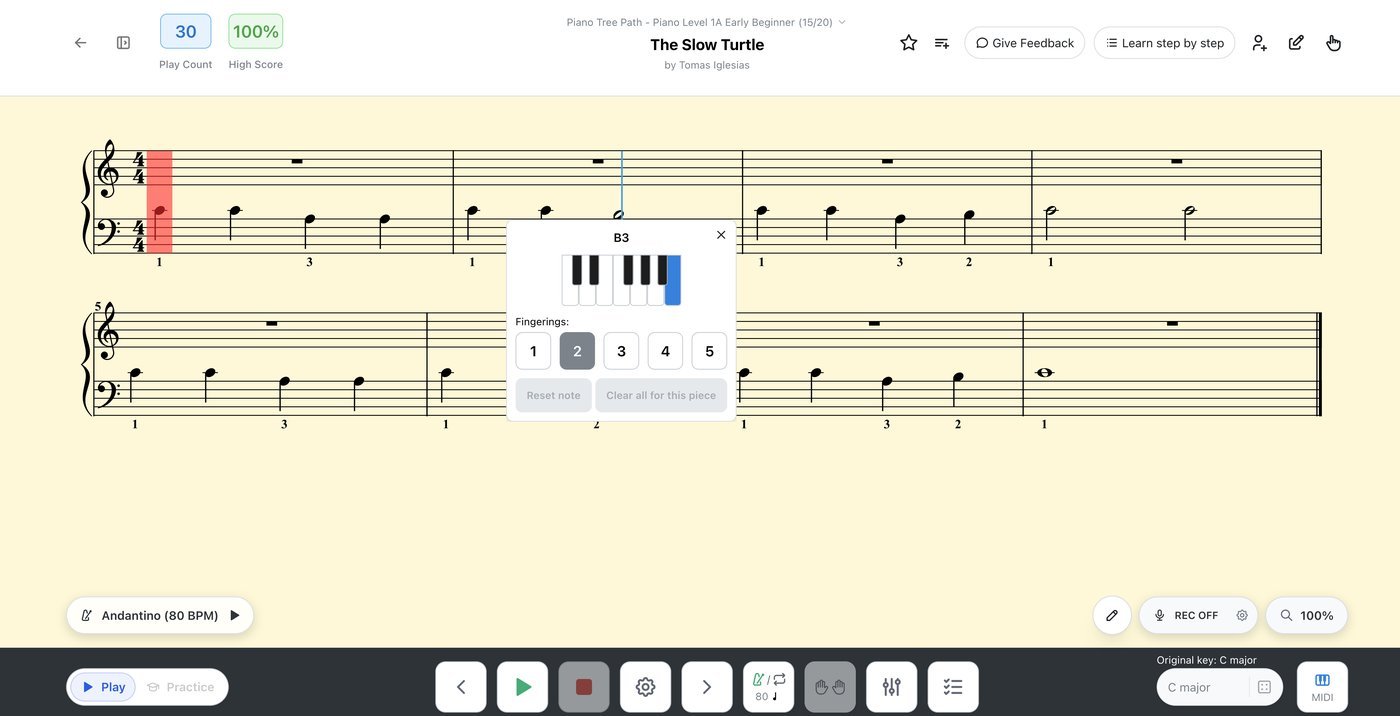
Every piece in Piano Tree, shown here with one of my own, has a metronome and count-in, Play and Practice modes, and fingering you can change.
Which book should you start with?
If you are preparing for an exam, start with the book for your grade, then go one grade down if it feels hard. If you are not sure, take the Sight Reading Test and use your Piano Reading Level. Our grade guides, from Initial Grade to diploma, show which Path levels match each ABRSM grade. Find your reading level in a few minutes. Take the free Sight Reading Test, then open the Paul Harris book that matches it.Paul Harris in Piano Tree: questions
Is there an app for Improve your sight-reading!?
Yes. Piano Tree has the complete Paul Harris piano sight reading series, licensed from Faber Music: Improve your sight-reading! from Initial Grade to Grade 8, A Piece a Week, the duets, and You can read music. You play every exercise with a metronome, a count-in and live feedback, on a digital piano with MIDI or on an acoustic piano with the microphone.
Are these the real Faber books?
Yes. They are the published Faber Music editions, licensed for Piano Tree, with the music exactly as Paul Harris wrote it.
Do I need to buy the printed books?
No. Every piece is included in Piano Tree Premium. Many teachers still like to have the printed books on the music stand, and you can buy them from Faber Music.
Can I use them to prepare for my ABRSM sight reading test?
Yes. From Grade 1 up, each Improve your sight-reading! workbook includes dozens of practice tests in the style of the ABRSM sight reading test, and the books are useful for Trinity, AMEB, RCM and LCM exams too.
What is the difference between Improve your sight-reading! and A Piece a Week?
Improve your sight-reading! is a step-by-step workbook with short exercises and practice tests for each grade. A Piece a Week is a set of short pieces to learn one a week, to build note reading and hand-eye coordination. They work best together.
Should I use the Paul Harris books or the Piano Tree Path?
Both. The Paul Harris books move one exam grade at a time, and the Path breaks the same ground into 100 smaller steps with far more new music. Work through the Path levels that match your Paul Harris book at the same time, and add the rhythm books and chord trainers.
Can teachers assign the Paul Harris books to students?
Yes. Teachers can assign any book or exercise in Piano Tree and follow each student's results.
Why use Piano Tree for sight reading?
Piano Tree is a piano sight reading app built by piano teachers: 25,000+ graded pieces, real-time feedback by MIDI or microphone, from first notes to diploma level. With Paul Harris's books inside the Path, you can work through the series teachers already trust, with a metronome, a count-in and live feedback on every page. That is a big part of why we think Piano Tree is the best sight reading app for pianists. You can see how it compares in Best Piano Sight Reading Apps for 2027.The Short Version
Paul Harris's complete piano sight reading series is now in Piano Tree, licensed from Faber Music: Improve your sight-reading! from Initial Grade to Grade 8, A Piece a Week, the duets and You can read music, more than 1,400 pieces placed on the Path. Always count, never stop, and now with a metronome, a count-in and live feedback on every page.
More from Piano Tree: Best Piano Sight Reading Apps for 2027, Initial Grade Piano Sight Reading, Grade 3 Piano Sight Reading, How to practice the 371 Bach chorales