
The exam is a controlled sample: one short solo piece, half a minute to prepare, nobody else in the room. Real-world sight reading is longer, messier and social: whole services and sets, other musicians, incomplete notation, and a pulse that belongs to everyone but you. The core skill is identical. The surrounding skills are not, and the exam trains only some of them.
I say this as someone who trains students for exams and has spent a working life reading music for singers, churches, shows and bands: pass the test, by all means, and then understand what the test could not measure. Here is the full difference, and how to train across it.
This post is part of our sight reading series. The full method is in How to Practice Piano Sight Reading.
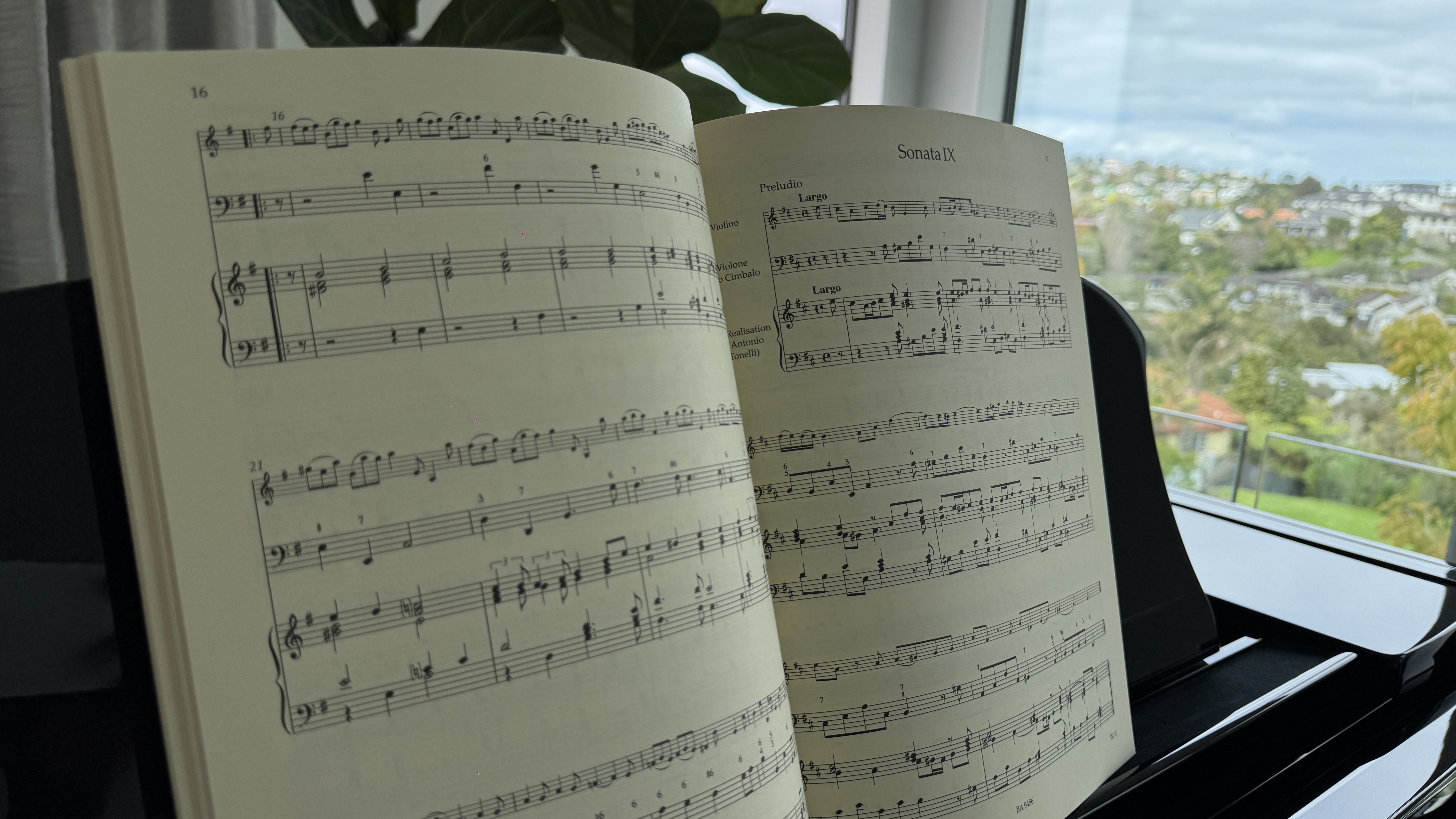
What Does the Exam Actually Test?
A carefully bounded thing, and it is worth respecting the design. An ABRSM candidate gets a short unseen solo piece pitched below their repertoire level, thirty seconds to scan it and try things out, and 21 of the exam's 150 marks for the outcome, judged above all on continuity and pulse. The room is silent, the piano is alone, the piece fits on a page, and nothing depends on the result except the mark. As a measurement of the core reading mechanism, it is well built: the examiners' priorities are the right priorities, and the graded ladder underneath it is a genuine map of the skill's vocabulary.But notice what the design excludes: length, other people, bad copies, surprises and consequences. Those are not flaws in the exam. They are the entire second half of the skill.
What Does Real Life Ask For Instead?
Stamina. The exam is one page. A church service, a rehearsal, a show or a wedding is one to three hours of reading, much of it music you first see when it lands on the stand. Reading is concentration, and concentration is a muscle with a fuel tank the exam never tests.Someone else's pulse. In the exam you set the tempo. In real life the tempo belongs to the singer's breath, the conductor's hand, the drummer, or a congregation that will keep singing whether you are with them or not. You do not just keep time, you follow it, and re-entry after a slip means finding a moving train, not restarting your own. And the pulse you follow is not always good. Some players simply rush or drag; others have fine time that turns free the moment the performance carries them away. Your job is not to correct them from the piano bench. Your job is to adapt in real time, which is the true art of accompaniment: accompanying.
Accompaniment, not solo. Almost all piano training is solo piano, and almost all real-life piano is accompaniment. You take solos here and there, but the working pianist's default state is under someone: a singer, a violinist, a congregation, a room. Accompaniment is chords, voicings and rhythm delivered in service of somebody else's line, which is one more reason I keep saying that training chords is training piano. If chords are not in your practice in one way or another, you are not fully practicing the instrument.
A master sight reader is a master of chords.Incomplete and imperfect notation. Real music arrives as lead sheets and chord charts, hymnals with four voices on two staves, orchestral reductions with cues in small print, photocopies cut off at the margin, and handwritten parts. Reading the notes is often the easy part; supplying what the page leaves out is the job.
The roadmap. Repeats, first and second endings, dal segno, coda, a vamp until the singer nods, and a cut announced ten seconds before downbeat. In working charts, more trainwrecks come from losing the map than from misreading a note, and sometimes the map is not even written: repeat this part until I tell you, vamp here, the singer starts talking to the audience and expects background music to appear underneath her until she is done. The exam has no roadmap at all.
Style as a requirement. Whole layers of the performance are never printed. Swing is written as even eighth notes, but you are expected to play them long-short, close to a triplet of a quarter plus an eighth, with the accents falling on the off-beat eighths, and if the bass is walking in four, the accents move to beats two and four. Tango is stricter still: a group of four written eighth notes may be phrased as an eighth, a quarter, then two sixteenths, and nothing on the page tells you so. These conventions come from knowledge and from reading many, many charts in the style. The notes were the easy part. The feel is the job, and the feel is not written down.
No thirty seconds. Sometimes you get a day with the music. Sometimes a singer hands it to you as they walk on. The preparation scan the exam allows becomes a luxury you learn to compress into the length of a count-in.
In the exam, the pulse is yours. In real life, the pulse belongs to everyone else.
What Stays Exactly the Same?
The core, entirely. A steady pulse over accuracy, eyes ahead of hands, patterns over single notes, recoveries over corrections, and material easy relative to your level so attention stays free. Every rule in the mistake protocol transfers without amendment, except that real life enforces it for you: the band will not stop, so the habit the exam merely rewards becomes the habit the gig requires. If you trained honestly for the test, you own the engine. What real life adds is the vehicle around it.How Do You Train Past the Exam?
Read long. Once a week, read for thirty or forty minutes straight through a book of easy material, not eight-bar tests. You are training the fuel tank, and the level should be low enough that the only challenge is staying awake at the wheel.Borrow a pulse. Backing tracks, then people. Accompany a singer, join a choir rehearsal, play duets. Duets are the most underrated sight reading training that exists: a partner is a metronome with consequences and a sense of humour.
Read the incomplete. Lead sheets and hymn books, one of each per week. Both teach you to supply what is missing, from opposite directions: the lead sheet gives melody and asks for everything else, the hymnal gives everything and asks your hands to redistribute it.
Practice the map. Choose pieces with repeats, endings and codas and read them without stopping, navigating in real time. Then simulate the working version: decide mid-piece to take a cut, and land it.
Say yes early. The fastest teacher is a low-stakes gig: accompanying a student recital, a hymn at a family event, a friend's rehearsal. One hour of reading with consequences teaches what a month of solitary practice cannot, and the church piano bench has trained more real readers than any syllabus.Where Piano Tree Fits
The app trains both halves. The exam half is the obvious part: the graded Path, the Focus Packs and the sight reading tests that return a Piano Reading Level. The real-world half is quieter but built in: backing tracks put someone else's pulse under everything you read, the library carries the textures working pianists actually meet, chorales and hymns, lead sheets, jazz phrases, tango accompanying patterns, and there is enough easy material to read long without repeating yourself. The unwritten layer is trainable too: in the swing material, play the eighths straight and the app marks them wrong, with a timing tolerance you can adjust, forgiving by default. My favourite setting for this work is metronome off, backing track on, tolerance down. With no click to lean on and a band that will not wait, your timing has to come from listening, which is exactly where the gig will ask you to get it from. And since the piano at the venue is never yours, the microphone mode means the practice tool travels: any upright in any hall, no cable required. Train exam reading and gig reading on the same graded libraryCommon Questions
Is Grade 8 sight reading enough to work as a pianist?
It is the entry ticket, not the job. Grade 8 reading plus roadmap fluency, lead sheet skills and an hour of stamina is employable; Grade 8 reading alone is a very promising beginning. The good news is that the additions train faster than the core did, and working pianists largely learn them on the bench.Do the examiners' priorities transfer to real playing?
Almost perfectly. Continuity and pulse are exactly what bandmates, singers and congregations value, which is why honest exam preparation is real preparation. The exam is not wrong about the skill. It is just silent about the rest of it.
I read fine alone but fall apart with people listening. What do I do?
Repetitions with witnesses, starting cheap: record yourself, then read for one friendly person, then accompany someone at practice tempo. The freeze is not a reading problem, it is an exposure problem, and it responds to dosage. Keep the material easy while the audience is the challenge.
Should exam students bother with real-world reading before Grade 8?
Yes, in small doses, because it feeds straight back: duets appear on the syllabus from the earliest grades, accompanying builds the following skill, and students who have read with others stop treating the exam as the scariest room they know.
The Short Version
The exam measures the engine: pulse, continuity, eyes ahead, on one quiet page. Real life supplies the vehicle: hours instead of minutes, other people's tempo, incomplete pages, roadmaps and style. Train the engine honestly, then add the vehicle deliberately, read long, borrow a pulse, read the incomplete, practice the map, and say yes to the small gig. The exam is where the skill is certified. The world is where it is used.
Part of the Piano Tree sight reading series. Continue with ABRSM Sight Reading: What Examiners Are Listening For, How to Read a Lead Sheet at the Piano and More Bass, Please: What the Church Pianist Job Actually Demands.