
Bach chorales are the most efficient sight reading material a pianist can own. They are short, they are built entirely from complete four-voice harmony, and the rhythm mostly stays out of the way, so your eyes learn to read chords and voice leading instead of one note at a time. Ten minutes a day will change how you see a page.
This is part of the Piano Tree sight reading series. The pillar post is How to Practice Piano Sight Reading: The Complete Method.
What is a Bach chorale?
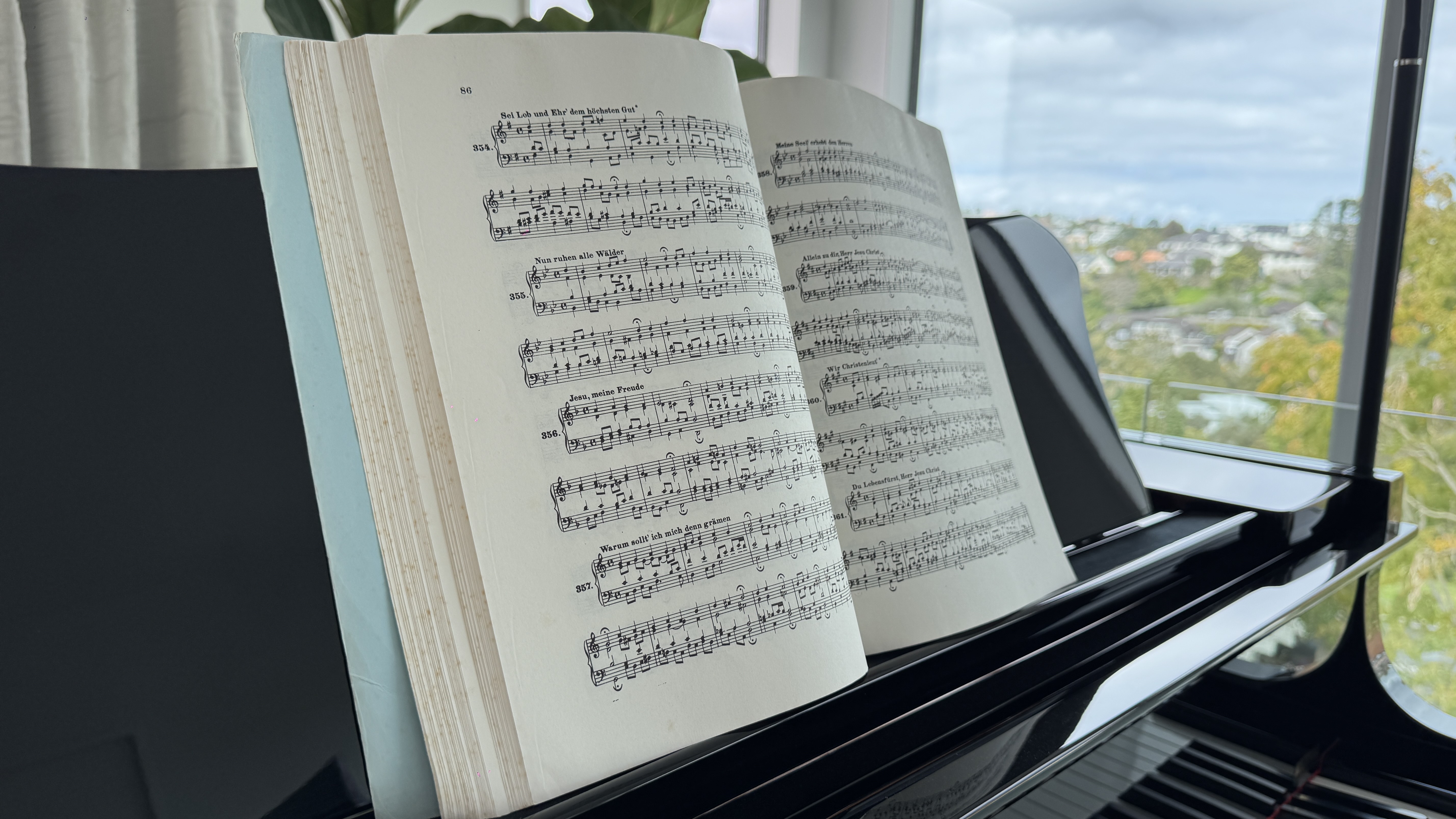
A chorale is a hymn tune harmonized in four voices: soprano, alto, tenor and bass. Bach did not write the tunes. They were the melodies his congregation already sang. What he wrote is everything underneath them, and the traditional collection of 371 harmonizations is what pianists, organists and harmony students have been living off ever since.A word about that number, because it gets repeated carelessly. The Bach-Archiv in Leipzig says nearly 400 chorales survive. The famous 371 comes from a publishing tradition rather than from Bach sitting down and writing exactly that many, so the honest phrasing is the traditional collection of 371, not Bach composed 371 chorales.
On the page a chorale looks modest. Eight to sixteen bars, mostly quarter notes and half notes, no virtuosity anywhere. That modesty is exactly why it works. Nothing is competing for your attention except the harmony, and the harmony is the hardest thing to read.
Why has this collection stayed in pianists' hands for 300 years?
Partly because someone made it convenient for us very early. After Bach died, his son Carl Philipp Emanuel published his father's four-part chorales in two batches, 100 in 1765 and 100 more in 1769, and in those editions the four vocal parts were already laid out on two staves: the upper voices on the right-hand staff, the bass on the left. That is a keyboard layout. Breitkopf then issued the big complete eighteenth-century collection between 1784 and 1787. Reading chorales at a piano is not a modern teaching invention, it is close to the original format.
Bach did teach with chorales, mostly in composition and thoroughbass. It is worth knowing that his own method was more hands-on than the paper harmony exercises that later became standard: manuscripts from his circle show students working from chorale melodies, outer voices and figured basslines at the keyboard, filling in the inner voices themselves before writing their own basslines. So when you sit down and read one, you are doing something closer to his classroom than a written harmony assignment is.
Why are chorales such good sight reading practice?
Four reasons, in the order I would give them to a student sitting next to me.They are short. A chorale is one page or less. You can read three of them in the time it takes to stumble through one movement of a sonatina, and repetition across many short pieces is what builds reading, not one long piece practiced to death. Sight reading only improves when you read new material.
The rhythm is honest. Most chorales move in steady quarter notes with the occasional passing eighth. That does not mean rhythm is absent, it means rhythm is not the obstacle. So the difficulty lands where you actually need training: on reading several notes at once and keeping four lines moving.
Every chord is complete. In most piano music you get a fragment of the harmony: a bass note, a broken figure, a third floating in the middle. In a chorale you get the whole chord, spelled out, every time, with each note belonging to a voice that has somewhere to go. There is no better place to learn what chords actually look like on a stave.
Nothing is decoration. There is no filler in this music. If you misread a note, the harmony tells you immediately, because it stops making sense. A chorale corrects you faster than a teacher can.
Studying piano means studying chords. A master sight reader is a master of chords, and chorales are where chords live.
What do chorales train that ordinary pieces do not?
Reading vertically and horizontally at the same time
This is the real skill, and it is why chorales are hard even though they look easy. You have to see the chord (vertical) and follow four independent lines through it (horizontal). Most students can do one or the other. A reader who has spent a year with chorales does both without thinking, and that is the moment their reading of everything else jumps.
Recognizing shapes instead of spelling notes
An experienced reader does not name the notes. They see a shape and their hand knows what it means. This is not just teacherly opinion, it is the single finding the research is clearest about: of everything that has been measured, fast recognition of chord patterns tracks sight reading ability most closely. Chorales teach those shapes faster than anything else, because the same handful keep returning in every key.
Take one example. The alto sits a third below the soprano and the two move up together in parallel: on the page that is two noteheads keeping a fixed gap, sliding up the stave like a ladder. You do not read four notes there, you read one shape and one direction. Or take the most common event in the whole collection: a voice holds a note over a change of chord, it rubs, then it steps down. Once you recognize a suspension by its look, you stop reading it and start hearing it coming, which is a completely different way to sit at a piano.
Hearing the inner voices
Alto and tenor are where students go deaf. The tune is easy to follow and the bass is easy to feel, but the middle is where the music actually moves. Practicing chorales makes the inner voices audible to you, and once you can hear an alto line you will start noticing them everywhere: in Chopin, in a jazz voicing, in a tango bandoneon part.
Steady pulse under pressure
Four voices give you four chances per beat to panic. Chorales train you to keep the pulse moving through a note you did not get. That is the single most valuable sight reading habit there is, and I wrote about the mechanics of it in should you stop when you make a mistake.What does the research say about reading chorales?
I want to be careful here, because this is a place where blogs overclaim. There is no study showing that six months of Bach chorales beats six months of something else. Nobody has run that experiment. What exists is better than nothing and worth knowing about, in two parts.First, what predicts good sight reading. Waters, Townsend and Underwood (1998) tested pianists across several abilities and found that the fastest recognition of chord patterns had the strongest relationship with sight reading skill, with the ability to hear the music internally and to predict what comes next also contributing. Gilman and Underwood (2003) restricted what pianists could see of the score and tracked their eyes, and the stronger readers were reading further ahead of their hands. Chord recognition, prediction, and reading ahead: those are the three things a chorale demands on every beat.
Second, what happens when you read this specific music. Fine, Berry and Rosner (2006) took Bach chorales and broke them on purpose, altering melodic patterns and turning the tonal harmony atonal, and accuracy fell, which tells you that readers are leaning on pattern and harmonic expectation rather than decoding note by note. Lewandowska and Schmuckler (2020) had pianists read passages taken from twelve major and twelve minor chorales, varying texture and tonality, and found that thicker two-handed textures produced more errors than one-handed ones. Read that last result as a warning about how to start: it is direct evidence against handing a beginner all four voices at once, and direct support for climbing a ladder instead.
There is even research on how the page is laid out. Stenberg and Cross (2019) had percussionists read two-voice chorale arrangements while the researchers changed how phrases and smaller units were visually spaced, and certain groupings significantly reduced errors. Engraving is not decoration. How music is spaced on a page affects how well it is read, which is something anyone building a reading app should take seriously.
And the honest limit: Mishra's 2014 meta-analysis pulled together 92 sight reading studies and found that structured practice helps, with a fairly small overall effect, and nothing in it crowns any one body of repertoire. So what I will say is this. Chorales concentrate the exact demands the research associates with strong reading, into pieces short enough to read three of before breakfast. That is a good reason to use them. It is not proof that they are magic.
Studies referenced: Waters, Townsend and Underwood (1998), British Journal of Psychology. Gilman and Underwood (2003), Visual Cognition. Fine, Berry and Rosner (2006), Psychology of Music. Mishra (2014), Psychology of Music. Stenberg and Cross (2019), Scientific Reports. Lewandowska and Schmuckler (2020), Psychological Research.
Are chorales too hard for beginners?
Four voices at once, in the first year, is too much for most people. But a chorale with fewer voices is not too hard at all, and this is where most teachers go wrong: instead of reducing the texture, they simplify the music, and a simplified Bach chorale is not a Bach chorale.The distinction matters. If you remove the alto and tenor and play only the soprano and bass, everything you play is still exactly what Bach wrote. The voice leading is authentic, the counterpoint between the two outer lines is authentic, and when you add the missing voices later, nothing you learned has to be unlearned. If instead you rewrite the harmony into something easier, you have learned a piece that does not exist.
A sensible ladder for any student: soprano alone, then soprano and bass, then three voices, then all four. Stay at each stage until it is boring. Boring is the signal to move up, and each step should be small enough that the first read of the new stage still holds a pulse.
How should you practice one?
Short version here. The full method, including how to work through the whole collection of 371 without burning out, comes next in this series.- Pick a tempo you can hold, then halve your ambition. Chorales are slow music. Play them slower than slow the first time through.
- Count out loud for the first read. Four voices will pull your attention off the beat. Your voice keeps it.
- Look at the bass before you start. Ten seconds. The bass tells you the harmony, and the harmony tells you what the other three voices are likely doing.
- Do not stop. Drop a voice rather than stop the pulse. If you must lose something, lose the alto, then the tenor. Keep soprano and bass alive.
- One read is enough. Then take a different chorale. You are training reading, not repertoire.
I had a student a while ago who could play a Chopin nocturne from memory and play it well. I put a chorale in front of him, sixteen bars, nothing faster than a quarter note, and he could not get through the second line. He kept stopping to work out the middle notes, and every time he stopped he lost the beat. He was not a weak pianist. He was a pianist who had spent years learning pieces and almost no time reading them, and a chorale is the fastest way to find that out about yourself. Six months of one chorale a day fixed it, and he told me afterwards that the surprising part was how much easier his own repertoire got to learn.
Do chorales help with real playing, or only with exams?
They help most in the places where reading actually gets tested, which is not the exam room.Play in a church and you will be handed hymns, which are chorales with different words. Accompany a choir and you will be reading four voices off an open score while the conductor watches you. Play for singers and you will be reading a vocal line plus harmony, at sight, in whatever key the singer decided on that morning. In all three, nobody stops for you. The habit chorales build, of holding the pulse and keeping the outer voices alive while the inside gets messy, is the habit that keeps you employed.
I have been handed a hymn on the way to the piano bench more than once. A photocopy of a photocopy, the bottom stave half cut off, and someone saying the number out loud while the congregation is already standing. Nobody in that room cares how you feel about it. You find the key, you find the first chord, and you start on time. The only reason that is possible is that four-part writing had stopped being a puzzle to me years earlier, so a hymn on a bad photocopy is just a shape I recognize.
If you want the full version of what that job asks of you, I wrote about my own first rehearsal as a church pianist, the one where the conductor asked me for more bass while I was hanging on with one hand, in more bass please: what the church pianist job actually demands. The short version: pulse first, bass second, inner voices last. Chorales are how you earn the right to keep all three. Exam sight reading is a narrower thing, and worth understanding on its own terms. I compared the two in exam sight reading vs real world sight reading.The band will not stop for you. Neither will a congregation. Chorales teach you how to keep going.
Where Piano Tree fits
The reason I can write this post with any confidence is that we spent a long time building the ladder I just described, and it took longer than we expected because we refused to rewrite the music.Piano Tree has the complete traditional collection in piano score, plus a graded course that gets you to it. The course is organized as a ladder, and we keep adding chorales to each rung:
- Level 1: Melody alone, rhythm simplified to mostly quarter notes. Pitch only.
- Level 2: Melody and bass, still simplified. Two lines at once.
- Level 3: Soprano and bass, and now these are the real chorales, with Bach's own rhythm.
- Level 4: Soprano, alto and bass. Three voices, still the real chorales.
- Level 5: Four voices in keyboard style, three notes in the right hand and the bass alone in the left. The layout most hymnals use.
- Level 6: Full SATB, as Bach wrote them, with the voice crossings resolved so the lines stay easy to track.
- Level 7: Open score, modern clefs. Four staves, one voice each.
- Level 8: Open score, the original clefs. Soprano, alto, tenor and bass. Not for the faint hearted.
If you are looking for these in the app: levels 1 to 5 sit under Sacred and Church Music. Levels 6, 7 and 8, which are the real chorales in full, sit under Baroque.
You do not have to work through everything on a rung before you move up. Once a level starts to feel easy, go to the next one. The collection is there to be dipped into, not completed.
The shape of that ladder is not a house style, it is what the texture research points at: add voices one at a time, because the jump in errors comes from texture.
I take liberties at three rungs and I would rather print them than bury them.
Levels 1 and 2 have the rhythm simplified. I will be straight with you: they sometimes do not sound as good as the real thing, because a chorale stripped to quarter notes loses some of what makes it a chorale. That is the price of the training, and it buys you something worth having, which is attention on pitch alone before rhythm arrives. Level 3 puts Bach's own rhythm back, and from level 3 upward you are reading the real chorales.
Level 5 is keyboard style, and there I have taken some liberties with the voice leading, because a continuo layout is more forgiving than strict four-part writing. The melody and the bass are untouched. It is the format most hymnals use and it is excellent for quick, casual reading.
Level 6 is Bach as he wrote it, except that I resolved the voice crossings. That does cost something, since crossings are part of the counterpoint, but a crossed voice is genuinely hard to follow at sight and I judged the trade worth it.
Nothing else is altered anywhere. Every note you play is a note Bach wrote.
Levels 7 and 8 are optional, and I mean that. Open score is not for everybody and I will not pretend otherwise. It suits people heading toward professional work, and anyone with an early music or university requirement to satisfy. If that is not you, stopping at level 6 is a perfectly respectable place to land.
The old clef sets exist for a specific reason. At university I had to learn to read alto clef on its own, and there is very little material for it that is also real music. Reading the alto voice of a chorale in its own clef solves that. It pays off later too: go anywhere near figured bass and you will meet the tenor clef, the C clef on the fourth line, because that part often doubles the cello, and cellists read tenor clef constantly.
Chorales are not the only ladder
Hymns, chants and psalms are graded on the same four rungs in the same section: level 1 is the melody alone, level 2 adds the bass, level 3 is three voices, level 4 is all four. The music itself is easier than Bach at every equivalent rung, with simpler harmony and simpler rhythm, so it makes a gentler first climb. There is a graded set of Christmas hymns as well, which is worth knowing about in November.
The route I would suggest is to alternate, using the easier music to precede each chorale rung. Roughly: level 1 of the chants, psalms, hymns and chorales together, then chorales level 2, then level 2 of the chants, psalms and hymns, then chorales level 3, then chorales level 4, then either level 4 of the hymns, chants and psalms or chorales level 5, then chorales level 6.
That is not an exact science and I am not going to pretend it is. The rungs do not line up perfectly between one body of music and another, so let the player feel which one is easier next rather than following a chart. The principle is what matters: each easier rung makes the next Bach rung feel like a small step rather than a wall, and you end up with several bodies of church music under your hands instead of one. That is also the practical combination, since hymns and psalms are what you will actually be handed on a Sunday and chorales are what make you able to read them at sight.
Keyboard style deserves a note of its own, since it is level 5 of the chorale ladder and the layout most hymnals actually use. Four voices taken the way a continuo player would take them, three notes in the right hand and the bass alone in the left. It reads differently from two voices per hand and it sits better under the hands for accompanying. If you are learning church piano rather than training your reading, that is the format to get comfortable in first.
The tools around the pieces matter as much as the grading. You can mute any voice individually, so if you want the soprano with Bach's original rhythm before you are ready for two hands, mute the left hand and let the backing track carry it, or remove it entirely and read the right hand alone. That is the same hands separate practice a teacher would give you, without the teacher having to be in the room.
Try Piano Tree free for 7 days, no card needed. Open a four-voice chorale, look at the stems, and decide for yourself.FAQ
How many Bach chorales are there?
The traditional collection contains 371 harmonizations, and it is the one published after Bach's death that everyone still uses. The Bach-Archiv puts the number of surviving chorales at nearly 400, so treat 371 as the name of a collection rather than a count of what Bach wrote. Some settings share a tune, which is a feature: comparing two harmonizations of one melody teaches you more about harmony than any textbook chapter.
Did Bach teach sight reading with these chorales?
Not in the way the story is usually told. He taught composition and thoroughbass with chorales, and his students worked at the keyboard from melodies, outer voices and figured basses rather than filling in SATB exercises on paper. Using the collection as reading material for pianists came later, helped along by the fact that his son published it on two staves. It is a good use of the music. It is just not something Bach assigned.
Do I need to play them in four voices to benefit?
No. Reading soprano and bass alone, with Bach's real notes, already trains most of what matters: outer voice awareness, harmonic direction and steady pulse. Add the inner voices when two feel easy.
How long does it take to see a difference in my sight reading?
In my studio, students who read one or two chorales a day notice something within a few weeks, usually described as the page feeling less crowded. That is chord recognition arriving. It is not a straight line, and it does not require long sessions.
Are chorales useful if I play pop or jazz?
Very. Four-part writing is where you learn how voices move between chords, and voice leading is exactly what separates a jazz pianist with good voicings from one who plays block shapes. The genre changes, the physics of harmony does not.
Should I analyze the harmony as I read?
Not while sight reading, at least not at first. Read, keep the pulse, and analyze afterwards. Trying to name chords in real time is the surest way to stop playing.
That answer changes once you have trained in figured bass. At that point you cannot fully separate the two anymore, and you would not want to: you are reading and hearing the harmony and the counterpoint at the same time, as one act. That is the real power of figured bass training. The same thing happens with a jazz standard. You read the lead sheet, you voice it, and while your hands are doing that you are already thinking two five one into A flat. The analysis stops being a separate task and becomes part of how you see the page. It just cannot be forced early. It arrives after the reading is fluent.
What about hymns from a hymnal instead?
Excellent material, and closer to what you will actually be handed at a church gig. Hymns are also easier, which makes them a good way in. I use both, alternating: a level of hymns, then the matching level of chorales, then up. Hymns for the job, chorales for the training.
In summary
Chorales are short, complete, and unforgiving in the most useful way. They teach chord recognition, voice leading and pulse in ten-minute doses, they scale down to a single melody without being rewritten, and they prepare you for the real reading situations that come with playing for churches, choirs and singers. If you add one thing to your practice this month, make it a chorale a day.More in this series: How to Practice Piano Sight Reading: The Complete Method (pillar) · Should you stop when you make a mistake? · Piano sight reading levels explained · Exam sight reading vs real world sight reading · More bass please: what the church pianist job actually demands