

Piano Tree is the better choice for sight reading. It is a reading course built by piano teachers, graded in 100 small steps from first notes to diploma, with drills for every reading skill and a microphone that works on acoustic pianos. It also costs less: $8.33 a month on the yearly plan, against $10.84 for Piano Marvel.
Part of our series comparing piano sight reading apps. For all 14 apps side by side, see Best Piano Sight Reading Apps for 2027.
Piano Tree is the piano sight reading app built by our team of piano teachers and software engineers, all of us pianists. Piano Marvel is a general piano course from the United States. On the surface they look alike, since both listen to you play and both have a sight reading test.
They are built for different jobs. I teach piano and run a music school, and I have used both. This page compares them on what matters if your goal is to read music well: how the levels are built, what you actually read, how each app checks your playing, and what it costs.
One thing to say up front: we make Piano Tree. I have kept every fact about Piano Marvel to what Piano Marvel publishes itself, and the sources are listed at the end.
What does Piano Tree have that Piano Marvel doesn't?
This is the first question teachers ask me. Here is the short list:
- Lead sheets. Read the melody and build your own accompaniment from the chord symbols.
- Rhythm scores you can improvise on. The app gives you a rhythm, and you invent the notes.
- Practice any voice. Not only left or right hand: pick one voice of a chorale or a fugue, or any combination of voices.
- Open score in modern and old clefs, including all 371 Bach chorales.
- Read-ahead. The music you are playing disappears, so your eyes have to stay ahead.
- Your own fingering. Change any fingering in the score, or add your own, and the app remembers it.
- Transpose any piece, then lock the whole app in that key.
- Keep going after a mistake. In practice mode you choose: the app stops you, or it marks the wrong note in red and lets you carry on.
- Piano duets.
- A microphone built for acoustic pianos, on the web, iPhone, iPad and Android. It hears chords of up to six notes and tells you if each note was wrong, early or late.
- Write on the score with a pencil, a finger or a mouse.
- Real score layout: repeats, first and second endings, da capo, dal segno, coda and fermatas, plus lyrics you can show or hide.
- Short courses on hymns, Bach chorales, tango, blues and jazz.
- British or American terms: crotchets and quavers, or quarter notes and eighth notes.
I checked Piano Marvel's website and App Store listing and used the app myself. If Piano Marvel has added any of these since, tell us and we will update this page.
How do Piano Tree and Piano Marvel compare side by side?
| Piano Tree | Piano Marvel | |
|---|---|---|
| Built for | Sight reading, from first notes to diploma | A general piano course with sight reading tools |
| Built by | Piano teachers, composers and software engineers | Piano Marvel LLC (United States) |
| Library | 25,000+ graded pieces and exercises | 25,000+ songs and exercises (website), 30,000+ (App Store) |
| Levels | 20 levels, each split into 5 sub-levels (100 steps) | 18 levels, 90 sub-levels in the SASR test |
| Sight reading test | Free Sight Reading Test that gives you a Piano Reading Level (PRL) | SASR, free with an account |
| How it listens | MIDI or microphone, on a digital or acoustic piano, on the web, iOS and Android | MIDI; microphone on iPhone and iPad only, in beta ("results may vary") |
| Reading drills | Focus Packs for rhythm, intervals, ledger lines, cadences, counterpoint, open score and more | General lesson exercises |
| Read-ahead setting | Yes: one beat, half a measure, or one to four measures | Not found |
| Lead sheets to improvise from | Yes | Not found |
| Hand practice | Each hand, and any single voice or combination of voices | Each hand |
| Open score, old clefs | Yes, modern and old clefs | Not found |
| Edit the fingering | Yes, on any note, saved per piece | Not found |
| Transpose and key lock | Yes | Not found |
| Practice mode after a mistake | Your choice: stop, or mark it red and keep going | Practice Mode waits for the right note |
| Piano duets | Yes | Not found |
| Early and late notes | Yes, with MIDI or the microphone | With MIDI; microphone in beta |
| Write on the score | Yes: Apple Pencil, finger or mouse | Not found |
| Licensed books | Paul Harris: Improve your sight-reading!, A Piece a Week and more (Faber Music) | Popular titles from Hal Leonard, Alfred and FJH |
| Backing tracks | Orchestral backing tracks written to each piece's harmony | On some songs |
| Your own music | MusicXML import, plus Scan mode for PDFs and photos | MIDI, MusicXML and audio uploads |
| Exam guides | Grade by grade guides from Initial to diploma (ABRSM, Trinity, AMEB, RCM, LCM) | Its own levels |
| Free plan | Hundreds of pieces, unlimited sight reading tests, core features | 150+ songs, 200+ lesson exercises, 25 video lessons |
| Premium price | $8.33 a month on the yearly plan, or $9.99 month to month | $10.84 a month on the yearly plan ($129.99), or $17.99 month to month |
| Free trial | 7 days of Premium, no card needed | Free account only |
| Platforms | Web, desktop app, Windows, Mac, Chromebook, iPhone, iPad, Android | iOS, Android, Windows, Mac, Chromebook |
What is each app built for?
Piano Marvel is a general piano course. Its library mixes method books, technique exercises, seasonal collections and licensed pop songs in one catalog, with hundreds of video lessons on top. Sight reading is one strand of that.
Piano Tree starts from one question: what does a student need to read, in what order, to become a fluent reader? Everything in the app hangs off that. The library is graded into one path, and each new reading skill gets its own drills before it turns up in pieces. In my studio, that is how reading improves: lots of music that is slightly easier than what the student is learning, with one new thing at a time.
The question is not which app is bigger. It is whether you want a general course that includes reading, or a reading course built by teachers.
How do the sight reading tests compare?
Piano Marvel's sight reading test is called the SASR. It pulls excerpts from 90 sub-levels, scores your note and rhythm accuracy, and keeps going until you fail three pieces at under 80% accuracy. Your score runs from 100 to 1900, and each 100 points is one of Piano Marvel's 18 levels.
Piano Tree's Sight Reading Test is free, with no subscription needed. It has 11 tests that cover the whole Path, from Level 1A (first notes) to the top levels. At the end you get your Piano Reading Level (PRL), which tells you exactly where to start in the Piano Tree Path. Retake it whenever you like to see how far you have come.
Your PRL also connects to exams. Our grade guides, from Initial Grade to diploma, show which Path levels match each ABRSM grade, with notes for Trinity, AMEB, RCM and LCM. So one test tells you where to start in the app and roughly where you stand for your next exam.The difference is what happens after the test. In Piano Tree, your PRL places you in a course built for reading, so the next piece you play is already at the right step.
How do the levels move?
The hardest part of sight reading practice is finding music at the right level. Too easy and nothing improves. Too hard and you stop reading and start learning the piece by heart.
The Piano Tree Path has 20 levels, and each one is split into five sub-levels, A to E. That gives 100 small steps from first notes to diploma, and each step adds one new thing. A few examples:
- 4/4 time from Level 1A
- Eighth notes from Level 3A
- Three-note chords in the right hand over a bass from Level 4C
- Syncopation from Level 6A, first as a simple rhythm exercise, then in pieces
- Triplets from Level 9A
Many of the early pieces were written by our team for exactly that step, so you are never reading something that jumps two steps at once.
Piano Marvel uses 18 levels. When I tried it, the method moved in bigger jumps than I would choose for a reading student, and I had to work harder to find the next right piece.
What do you actually read?
Both apps list more than 25,000 pieces and exercises, so size alone does not separate them. What is in the library does.
Piano Tree is almost all real music, graded into the Path: Baroque and Classical keyboard music, Romantic studies, hymns, folk tunes, Christmas and Halloween collections, jazz and pop styles, and original pieces written for each level. You will also find:
- Sight Reading Focus Packs: whole books that each train one part of sight reading, from intervals and ledger lines to fugue expositions and open score. There is more on these below.
- Paul Harris's sight reading books, licensed from Faber Music and in the app as published: Improve your sight-reading! (including Pre-Grade 1), A Piece a Week and the sight reading duets.
- All 371 Bach chorales, on the grand staff and in open score with both modern and old clefs. Reading four voices at once is one of the best reading workouts there is, so we also built a chorale course that leads up to it: start with the melody, add the other voices one at a time, then play four voices in keyboard style, then full four-part harmony, and finally open score in modern clefs and then in the original clefs. Move up a level as soon as one feels easy.
- Lead sheets, where you read the melody and make your own accompaniment from the chords. Start with a simple left hand. Then use the chords in the right hand too: harmonize the melody over a walking bass, try a Charleston rhythm, or any of a hundred other patterns. This is how working pianists actually play. Watch how I practice with a lead sheet below.
- Piano duets, to read with a teacher, a friend or a family member.
Everything is organized by style and period, so you can stay in Baroque counterpoint for a month, or move between Classical, Romantic, jazz, blues and tango without hunting for the next piece.
How does Piano Tree train each reading skill?
Reading pieces is the main work. But sight reading is made of many small skills, and each one improves faster when you train it on its own. That is what our Sight Reading Focus Packs are for: each book trains one specific sub-skill.
- Reading the notes: melodic intervals, harmonic intervals, ledger lines, broken chords, and alto clef reading.
- Rhythm: hundreds of rhythm scores for one hand or two. Play the rhythm on any note you like. Keep it simple and play a C in each hand, or use it to improvise: follow the written rhythm and invent your own melody. In the two-hand exercises the right hand plays from middle C up and the left hand below it. Timing is graded more strictly than in pieces, so your counting gets really solid. There are also books for polyrhythms and for hand coordination.
- Harmony at the keyboard: cadences, cadences in random keys, keyboard harmony exercises in random keys, and waltzes, so you see harmony as shapes instead of single notes.
- Counterpoint: counterpoint exercises, imitations at every interval, fugue expositions, and open score.
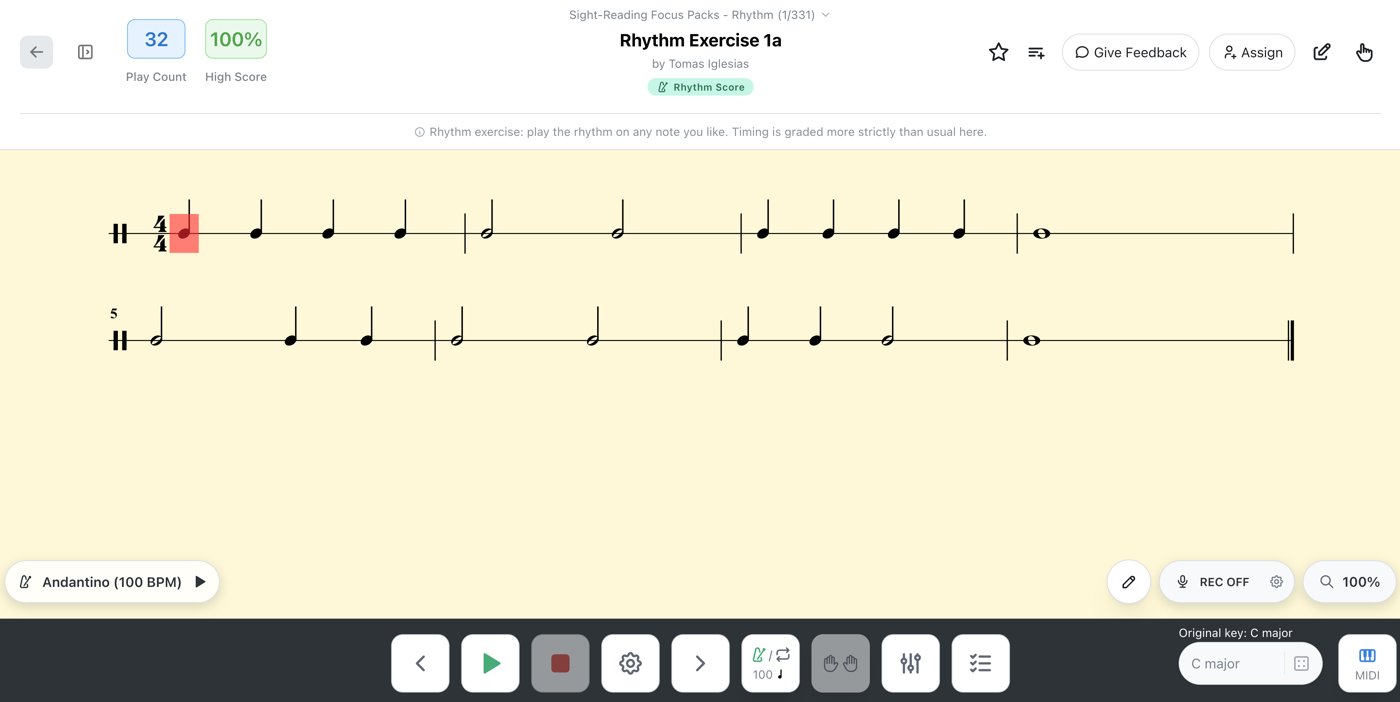
A one-hand rhythm exercise: play the rhythm on any note you like.
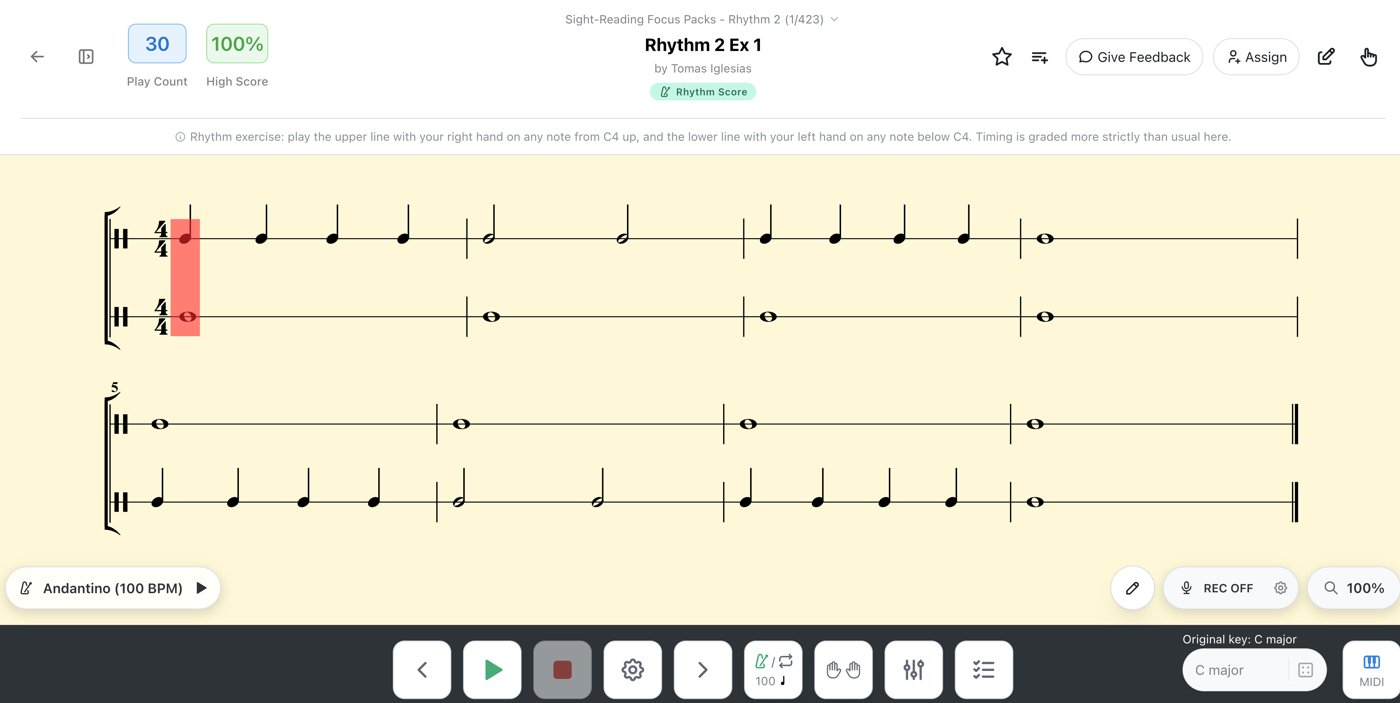
A two-hand rhythm exercise: right hand from middle C up, left hand below it.
Two more tools sit in the Learn tab:
- Chord Trainer: random notes, intervals, triads or seventh chords to play as fast as you can. Triads come in every inversion and in major, minor, diminished, augmented, sus2 and sus4, and there are 11 types of seventh chord.
- Music theory, Grades 1 to 8, following the ABRSM theory grades, plus an Initial grade we wrote to come before Grade 1. It has games, so it is fun to work through.
Polyphonic music gets special help. In a four-part chorale or a three-part fugue you can practice each voice on its own, or any combination, such as alto and bass together. That is how organists and choir directors learn to read several lines at once.
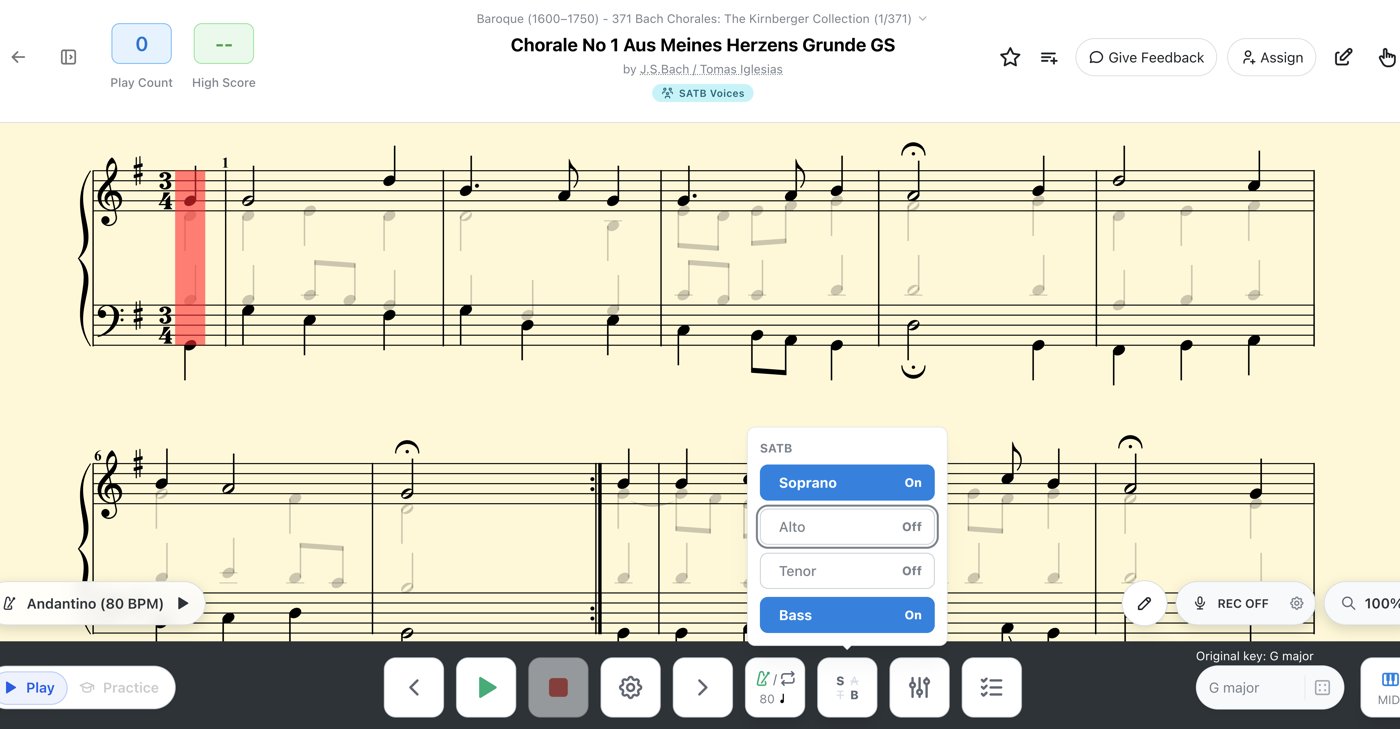
Bach Chorale No. 1 with only the soprano and bass switched on. Fermatas and repeat signs show as in the score.
When I tried Piano Marvel, I could not find open score reading, cadence drills, ledger line practice, lead sheets, or books that train one reading skill at a time like these.
Which tools change how you practice?
A few Piano Tree features exist only because teachers asked for them:
- Read-ahead: our students' favorite feature. Switch it on and the music you are playing disappears, so your eyes have to stay ahead. Choose one beat, half a measure, or one to four measures. It works in practice mode too, and you can keep the cursor visible if you like.
- Keep going or stop: in practice mode, the app can stop you at each mistake, or mark the wrong note in red and let you carry on. Keeping going is the most important sight reading habit, so you can train it from the start.
- Seamless section loops: repeat a hard measure without stopping.
- Fingering your way: tap any note to change its fingering, or add fingering where there is none. Teachers can match the fingering they use in lessons, and students can write in what works for their hands. You can also show all fingerings, only the first in each measure or in the piece, or hide them.
- Transposition and key lock: play any piece in any key. Tap the lock and the whole app stays in that key, so you can spend a week reading in A flat major.
- Count-ins your way: a countdown in seconds, a two-measure count-in, or a metronome that only counts you in.
- Metronome subdivisions: click in eighth notes instead of quarter notes for very slow music, like the opening of Beethoven's Pathétique Sonata.
- Fermatas: hold them as written, or switch them off.
- Easy on the eyes: choose a warm, paper, white, gray or custom background for the score, use the dark theme, and change the color of the cursor.
- Write on the score like a teacher marks a printed copy: chord names, phrase marks, reminders. Use an Apple Pencil or a finger on iPad, or the mouse on the web.
- Your own music: import MusicXML, or scan a PDF or photo and play it with full feedback.
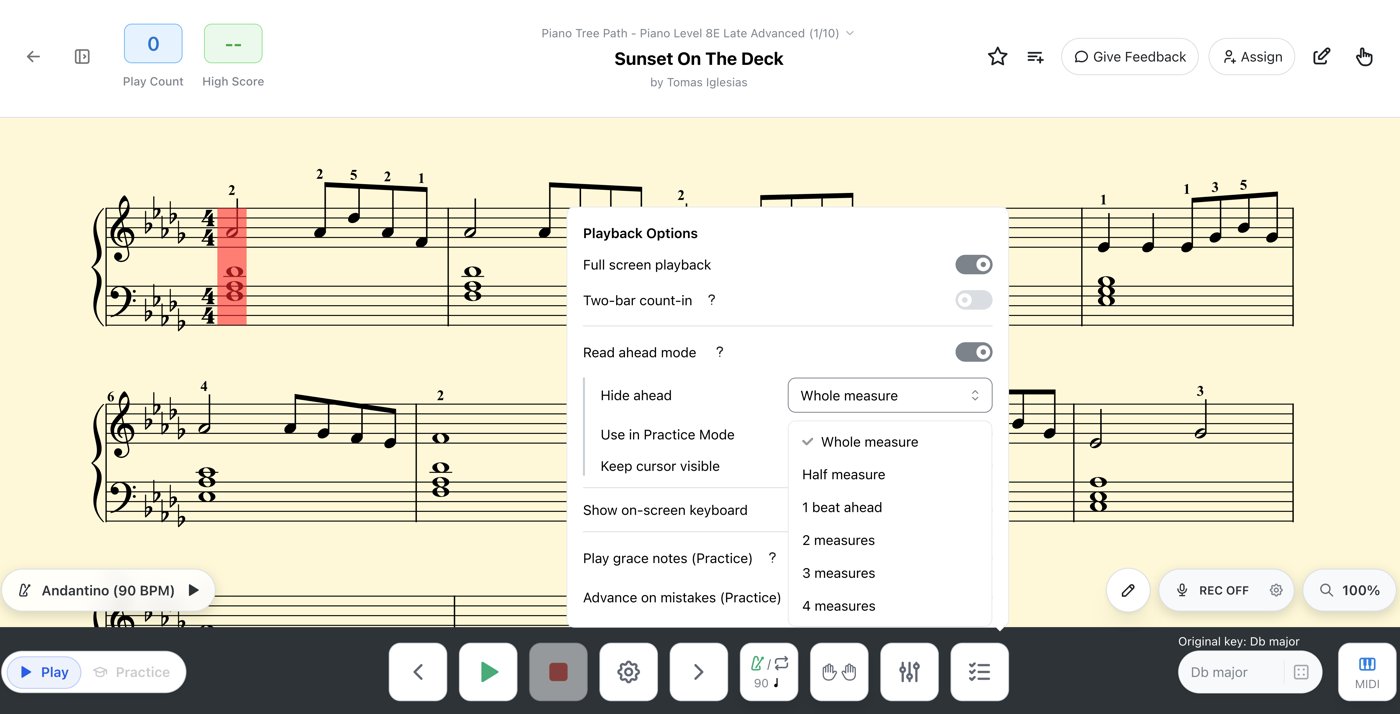
Read-ahead: choose how far ahead the music disappears, from one beat to four measures.
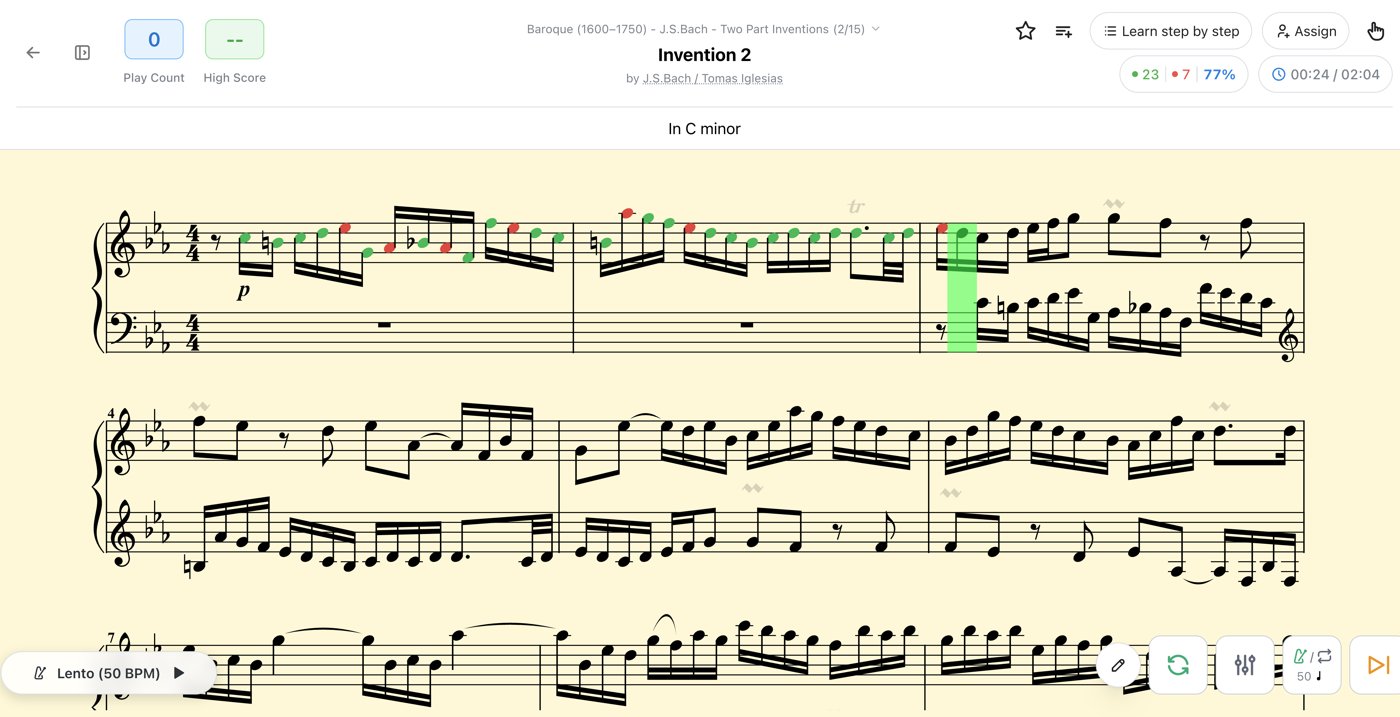
Practice mode on a Bach invention: wrong notes turn red and the music keeps going.
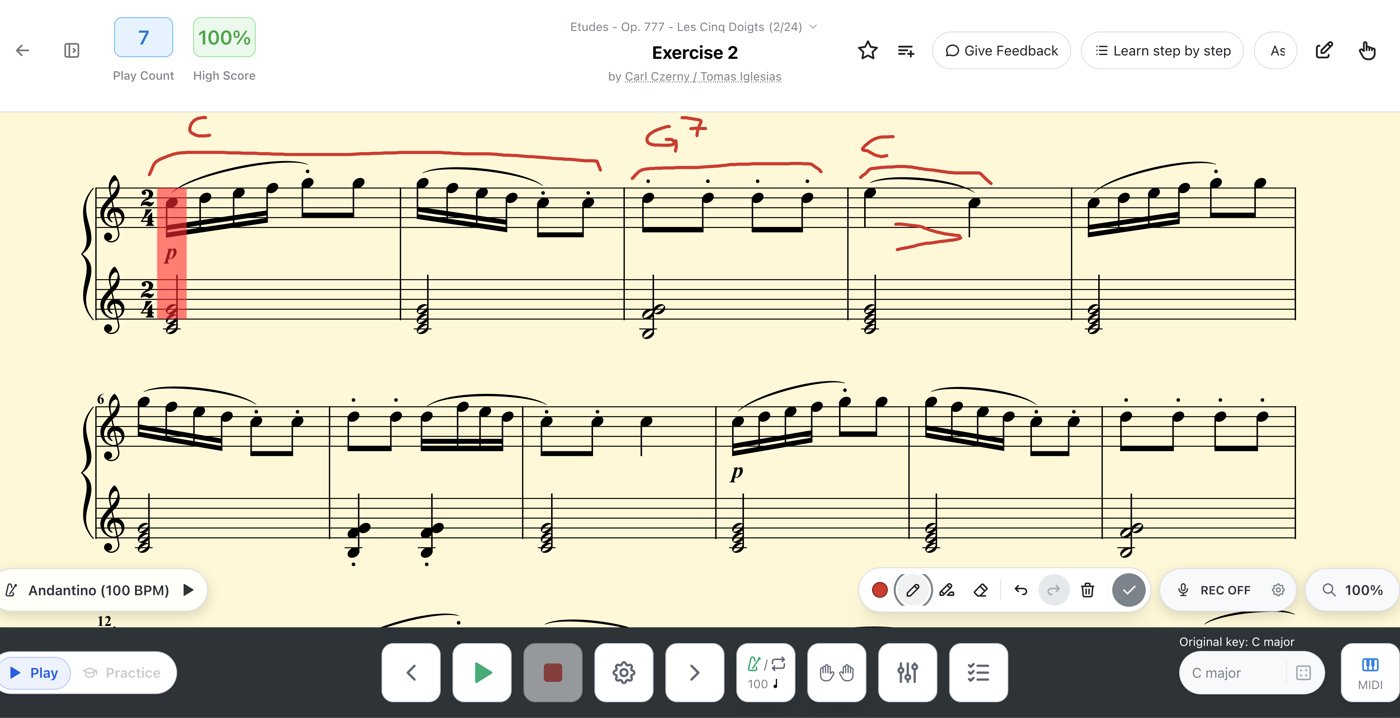
Writing on the score: chord names and phrase marks added on a Czerny study.
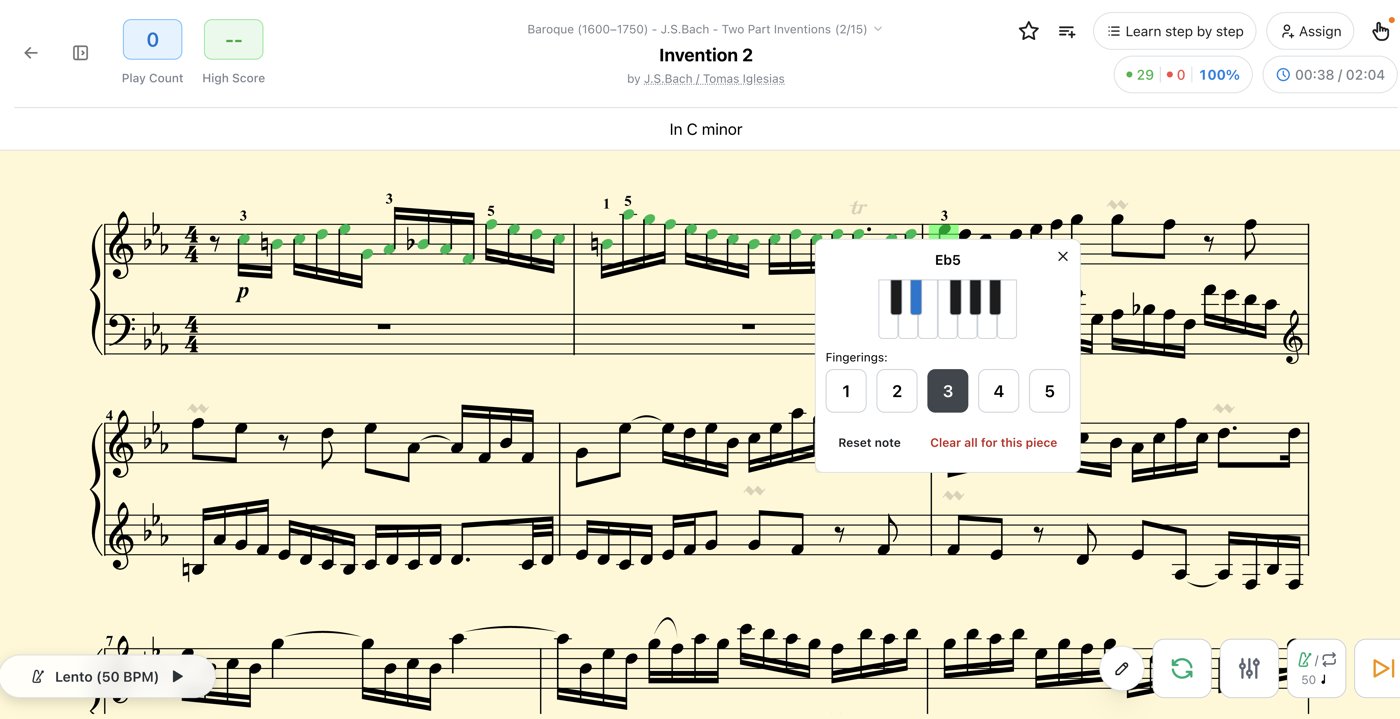
Tap any note to see its name and choose the finger you want. Reset one note, or clear all your fingerings for the piece.
Which app works on an acoustic piano?
This matters to a lot of students, because many families own an acoustic piano and no digital one.
Piano Tree works with MIDI on a digital piano, or with your device's microphone on an acoustic piano. Our latest microphone is very accurate. It hears chords of up to six notes, shows wrong notes and tells you whether each note was early or late, even in fast music. I tested it on my own acoustic piano by playing half a beat late on purpose, and it marked those notes late every time. You can see it for yourself in these two tests: a Mozart sonata played fast, and big chords.
Piano Marvel was built around MIDI, and its microphone is still catching up. Its App Store listing marks microphone grading as a beta and warns that results may vary. Its own help page says the microphone works on iPhone and iPad only, is less accurate than MIDI, and is affected by background noise. When Piano Marvel launched the feature, it said four-note chords at 99% accuracy were planned for a later phase.
Reviewers report the same thing. One 2026 review says the microphone does not always pick up the notes you actually play, and a reader commenting on another review said they could not get scores with an acoustic piano and the iPad microphone. When I tried it on my own acoustic piano in July 2026, the microphone did not pick up my playing, so I spent the session reading rather than playing.
If you play an acoustic piano, Piano Tree is the safer choice. Try our free Sight Reading Test on your own piano and hear the difference for yourself.
Do the backing tracks help?
Playing with an orchestra behind you is a great way to keep going through mistakes. Piano Tree's backing tracks are written by composers on our team for each piece, following its own harmony, and you can play with them from Level 1.
Keeping going through mistakes is the most important sight reading habit of all, and every Piano Tree feature is built to train it.
How much do Piano Tree and Piano Marvel cost?
Piano Tree Premium is $8.33 a month on the yearly plan, or $9.99 month to month. You can try all of it free for 7 days, with no card needed. The free plan stays free, with hundreds of pieces and unlimited sight reading tests.
Piano Marvel Premium is $10.84 a month on the yearly plan ($129.99 billed once a year), or $17.99 month to month. Its free account includes 150+ songs. Schools and studios get a quote.
Piano Tree is cheaper on both plans, and on the monthly plan it costs a little over half as much.
Which should you choose?
Choose Piano Tree if you want to read music fluently, you are working toward an exam or a diploma, you play an acoustic piano, or you are a teacher who wants reading material graded in small steps for every student.
Piano Marvel is only worth a look if you mainly want licensed pop songs and you already play on a MIDI keyboard.
The best test is your own. Take the free Sight Reading Test in Piano Tree, play a few pieces at your level, and see how it feels after a week.
Find your reading level in a few minutes. Take the free Sight Reading Test and start at the right step of the Path.Piano Tree vs Piano Marvel: questions
Is Piano Tree or Piano Marvel better for sight reading?
Piano Tree, if sight reading is your main goal. It is a reading course graded in 100 small steps, with drills for each reading skill and a microphone that works on acoustic pianos. Piano Marvel is a general piano course built around MIDI keyboards.
What does Piano Tree have that Piano Marvel doesn't?
Lead sheets to improvise from, rhythm scores you can improvise on, practice for any single voice or combination of voices, open score in old clefs, read-ahead, transposition with a key lock, piano duets, fingering you can change on any note, and the choice to keep playing after a mistake in practice mode.
Which is cheaper, Piano Tree or Piano Marvel?
Piano Tree. It costs $8.33 a month on the yearly plan, or $9.99 month to month. Piano Marvel costs $10.84 a month on the yearly plan, or $17.99 month to month.
Can I use Piano Tree or Piano Marvel with an acoustic piano?
Piano Tree works on an acoustic piano through your device's microphone on the web, iPhone, iPad and Android, and it shows wrong, early and late notes. Piano Marvel's microphone works on iPhone and iPad only and is still marked as a beta, so with an acoustic piano your results may vary.
Do both apps have a sight reading test?
Yes. Piano Marvel has the SASR, free with an account. Piano Tree has a free Sight Reading Test that gives you a Piano Reading Level (PRL) and places you on the right step of the Path.
Which is better for ABRSM and other piano exams?
Piano Tree publishes grade by grade guides from Initial Grade to diploma that show which Path levels match each grade, with notes for ABRSM, Trinity, AMEB, RCM and LCM. Piano Tree is not affiliated with any exam board. Piano Marvel uses its own 18 levels.
How we checked
Piano Marvel's prices, library size, levels, SASR details and microphone limits come from Piano Marvel's own website, help center and App Store listing, checked on 25 November 2026. Prices are in US dollars and can change, and Piano Marvel sometimes runs promotions. My notes on using Piano Marvel come from my own test in July 2026. If anything here is out of date, email us and we will fix it.
- Piano Marvel pricing page
- Piano Marvel homepage
- Piano Marvel SASR pages
- Piano Marvel on the App Store (microphone beta note)
- Piano Marvel help center: Microphone Assessment (iPhone and iPad guide)
- Piano Marvel: Microphone Assessment launch page
- Reviews: Top Consumer Reviews (Piano Marvel review, 2026) and Pianist's Compass (Piano Marvel review and reader comments)
The Short Version
If you want to read music fluently, choose Piano Tree. It is built by piano teachers for exactly that, it works on acoustic and digital pianos, and it costs less on every plan. Piano Marvel is a general piano course built around a MIDI keyboard, where sight reading is one part among many.
More in this series: Piano Tree vs Sight Reading Factory, Piano Tree vs SightReader, Piano Tree vs MasterPiano, Best Piano Sight Reading Apps for 2027, Initial Grade Piano Sight Reading, Grade 3 Piano Sight Reading, Diploma Piano Sight Reading