
For pianists, Piano Tree is the better choice. Sight Reading Factory makes computer-generated exercises for more than 60 instruments. Piano Tree is a piano reading course built by piano teachers: 25,000+ pieces of real music graded in 100 small steps, with live feedback as you play, by MIDI or microphone.
Part of our series comparing piano sight reading apps. For all 14 apps side by side, see Best Piano Sight Reading Apps for 2027.
I first used Sight Reading Factory in 2016. It was my first sight reading app, and it has barely changed since. Today I teach piano, run a music school and help build Piano Tree, and I would not give it to a piano student. This page explains why, and compares the two apps on what matters if your goal is to read real music at the piano.
One thing to say up front: we make Piano Tree. Every fact about Sight Reading Factory comes from what Sight Reading Factory publishes itself, and the sources are listed at the end.
What does Piano Tree have that Sight Reading Factory doesn't?
- Real music. 25,000+ pieces and exercises, from Baroque and Classical to jazz, blues and tango, plus original pieces our team wrote for each level. Sight Reading Factory generates every exercise by computer.
- A course, not a generator. The Piano Tree Path has 20 levels split into 100 small steps, from first notes to diploma, with grade guides that match each level to ABRSM and other exam boards.
- Feedback while you play. Piano Tree marks every note live, by MIDI or microphone. Sight Reading Factory records you and gives a score after you finish.
- Built only for piano. Grand staff, two hands, fingering you can edit, and practice for each hand or each voice.
- Licensed sight reading books: Paul Harris's Improve your sight-reading! and A Piece a Week, as published by Faber Music.
- Lead sheets to make your own accompaniment from the chords.
- All 371 Bach chorales, with a chorale course that builds up to them, and open score in modern and old clefs.
- Orchestral backing tracks written to each piece's own harmony.
- A practice mode where you choose: stop at each mistake, or see it in red and keep going.
- A free plan that stays free, with hundreds of pieces and unlimited sight reading tests.
I checked Sight Reading Factory's website, help pages and App Store listing. If Sight Reading Factory has added any of these since, tell us and we will update this page.
How do Piano Tree and Sight Reading Factory compare side by side?
| Piano Tree | Sight Reading Factory | |
|---|---|---|
| Built for | Piano sight reading, from first notes to diploma | Generated exercises for 60+ instruments, voices and ensembles |
| Built by | Piano teachers, composers and software engineers | Sight Reading Factory (United States) |
| The music | 25,000+ pieces of real music and exercises, graded | Computer-generated exercises only |
| Levels | 20 levels, each split into 5 sub-levels (100 steps) | Difficulty levels and custom settings |
| Piano exam guides | Grade by grade guides from Initial to diploma (ABRSM, Trinity, AMEB, RCM, LCM) | Not found |
| Feedback | Live, note by note, while you play | Score after you record (Auto Assessment) |
| How it listens | MIDI or microphone, on a digital or acoustic piano | Microphone recording |
| Practice mode | Your choice: stop at each mistake, or mark it red and keep going | Not found |
| Hand and voice practice | Each hand, and any single voice or combination of voices | Not found |
| Edit the fingering | Yes, on any note, saved per piece | Not found |
| Lead sheets | Yes | Not found |
| Licensed books | Paul Harris (Faber Music) | None |
| Backing tracks | Orchestral, written to each piece's harmony | Not found |
| Free plan | Hundreds of pieces, unlimited sight reading tests, core features | Limited free demo and a 30-day trial |
| Price | $8.33 a month on the yearly plan, or $9.99 month to month | $35 a year for individuals, $45 a year for teachers |
| Platforms | Web, desktop app, Windows, Mac, Chromebook, iPhone, iPad, Android | Web browser and an iOS app |
What is each app built for?
Sight Reading Factory is a generator. It composes a new exercise on demand every time you practice, for more than 60 instruments and voices, and for full ensembles such as concert band, choir and string orchestra. Piano is one option on that list.
Piano Tree is built only for piano, and only for one goal: reading real music fluently. The library is real music graded into one path, each new reading skill gets its own drills before it turns up in pieces, and every feature in the app is there to help a pianist read.
Can computer-generated music teach you to read real music?
This is the heart of it. In my experience, Sight Reading Factory's exercises read like random chord progressions with random rhythms: tonal, but not like anything a composer would write. Nothing in it resembles a Bach minuet, a Clementi sonatina or a jazz standard.
That matters because good readers do not read note by note. They read in patterns: a cadence, a sequence, an Alberti bass, a scale run, a four-measure phrase that answers the one before it. Their eyes recognize the shape and their hands already know what comes next. Those patterns are the language of music, and you only learn a language from the real thing.
Practicing random music is like learning a language from random words. You collect a lot of them, but you never learn to speak.
I have a friend with a 600-day streak on Duolingo who still cannot hold a conversation in French. My friend knows plenty of words, but never learned how real sentences are built. Generated sight reading works the same way. You can do it every day for years and still freeze in front of a real sonatina, because you have never practiced reading what real composers write.
The same goes for popular music. A pop or jazz pianist reads chord progressions, grooves and voicings that come from real songs. Random tonal music trains neither the classical pianist nor the popular one.
How do you get feedback?
Sight Reading Factory's Auto Assessment records you through the microphone. When you finish, it analyzes the recording and gives you a score with a list of wrong notes, early and late notes, and intonation.
Piano Tree gives you feedback live, while you play. Every note turns green or red as you go, and the app shows you whether each note came early or late. It works with MIDI on a digital piano, or with your device's microphone on an acoustic piano. Our latest microphone hears chords of up to six notes, even in fast music.
Practice mode adds one more choice. The app can stop you at every mistake, or mark the wrong note in red and let you carry on. Keeping going is the most important sight reading habit, so you can train it from the very first piece.
How do the levels move?
Sight Reading Factory's levels get harder by adding more complex rhythms, larger leaps, wider ranges and more accidentals. You can also set those options yourself.
The Piano Tree Path moves the way a piano student actually grows. There are 20 levels, each split into five sub-levels, A to E, so 100 small steps from first notes to diploma. Each step adds one new thing: 4/4 time from Level 1A, eighth notes from 3A, three-note chords over a bass from 4C, syncopation from 6A, triplets from 9A. Many of the early pieces were written by our team for exactly that step.
The free Sight Reading Test tells you where to start. It gives you a Piano Reading Level (PRL), and our grade guides, from Initial Grade to diploma, show which Path levels match each ABRSM grade. So you know where you stand for your next exam, too.Is any of Piano Tree's music computer-generated?
No. Every piece and exercise in Piano Tree was written or arranged by a musician. Take the cadences: each one was realized from figured bass, the way keyboard players have learned harmony for three hundred years. They are real voice leading, the same patterns you meet in Bach, Mozart and every hymn book.
Our popular music material is written the same way, by a person. The classic rock progressions, the 2-5-1 jazz phrases, the funky and groovy loops, the short grooves and the tango accompaniments were all written by Victor Nocelli, our popular music specialist. Victor is a pianist, composer and producer who has performed and conducted on major stages in Buenos Aires, across Europe, Asia and the Americas, and worked as a session pianist on international cruise lines. He has more than 15 years of teaching experience and co-created Tango Piano Secrets, a course platform for tango piano in Spanish and English. His pieces carry the real language of those styles: the grooves, voicings and progressions you will meet on a lead sheet or at a gig.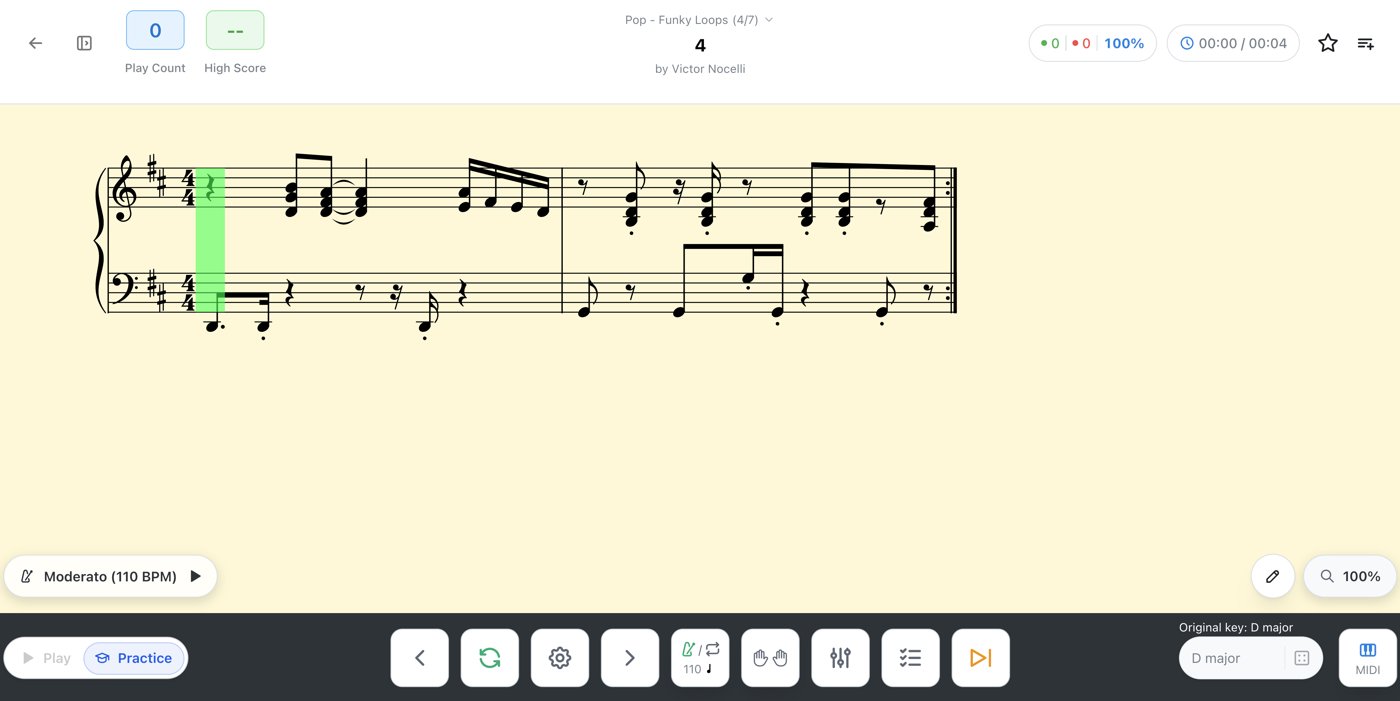
One of Victor's funky loops: syncopated chords over a bass line, written the way a working pianist plays them.
The only thing the app automates is the key. It serves those cadences, and the keyboard harmony exercises, in random keys, so the patterns become automatic everywhere and not just in C major. The Chord Trainer works the same way: it picks chords at random for you to play as fast as you can, because a chord is a shape to recognize, not a piece of music.
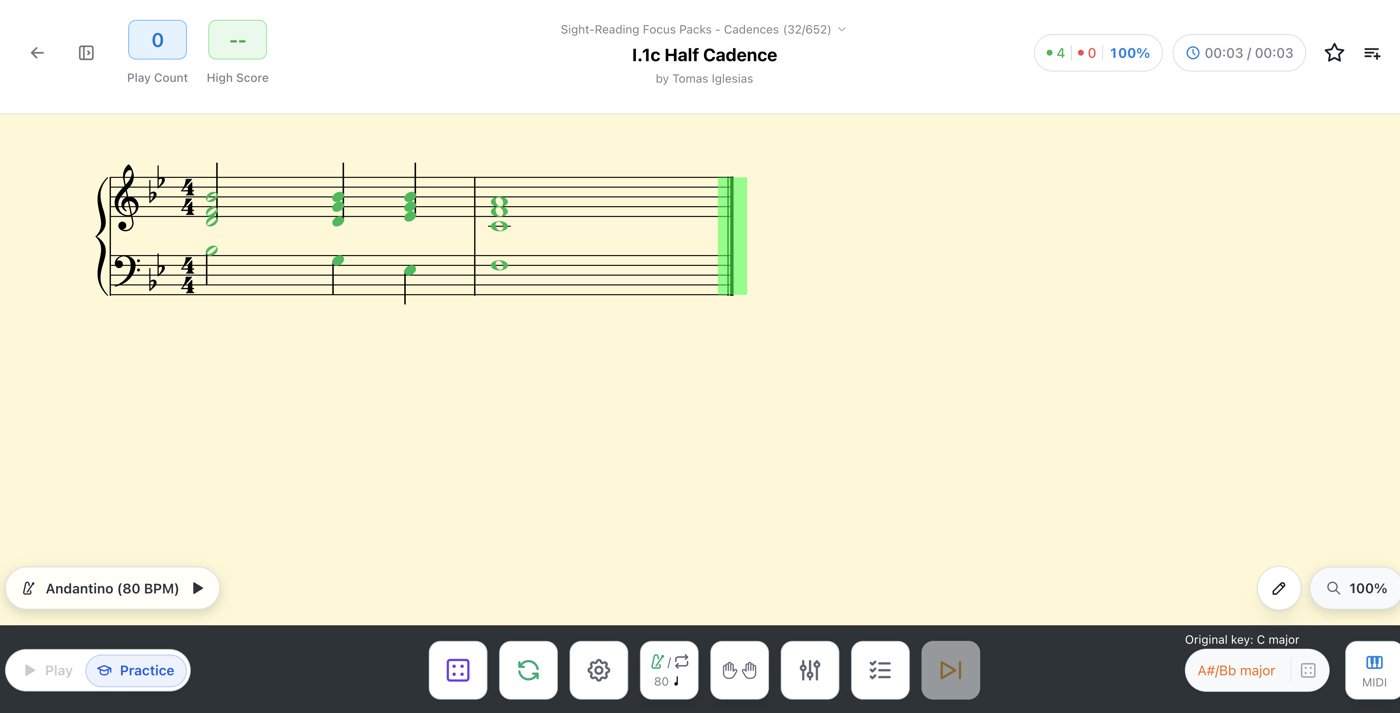
A half cadence from the Cadences Focus Pack, written in C major (bottom right) and served here in B flat major. The music is real; only the key changes.
Random keys, yes. Random music, no.
That is the difference in one line. Sight Reading Factory randomizes the music itself. Piano Tree keeps the music real and only varies where you meet it.
What do you read in Piano Tree?
Piano Tree is almost all real music, graded into the Path and organized by style and period:
- Repertoire from Baroque and Classical keyboard music to Romantic studies, hymns, folk tunes, jazz, blues, tango and pop styles, plus original pieces written for each level.
- Sight Reading Focus Packs: books that each train one sub-skill, including melodic and harmonic intervals, ledger lines, broken chords, alto clef, rhythms for one or two hands, polyrhythms, hand coordination, cadences, waltzes, imitations at every interval, fugue expositions and open score.
- Paul Harris's sight reading books, licensed from Faber Music: Improve your sight-reading! (including Pre-Grade 1), A Piece a Week and the sight reading duets.
- All 371 Bach chorales, on the grand staff and in open score with modern and old clefs, plus a chorale course that builds up to them one voice at a time.
- Lead sheets, where you read the melody and build your own accompaniment from the chords.
- Piano duets, to read with a teacher, a friend or a family member.
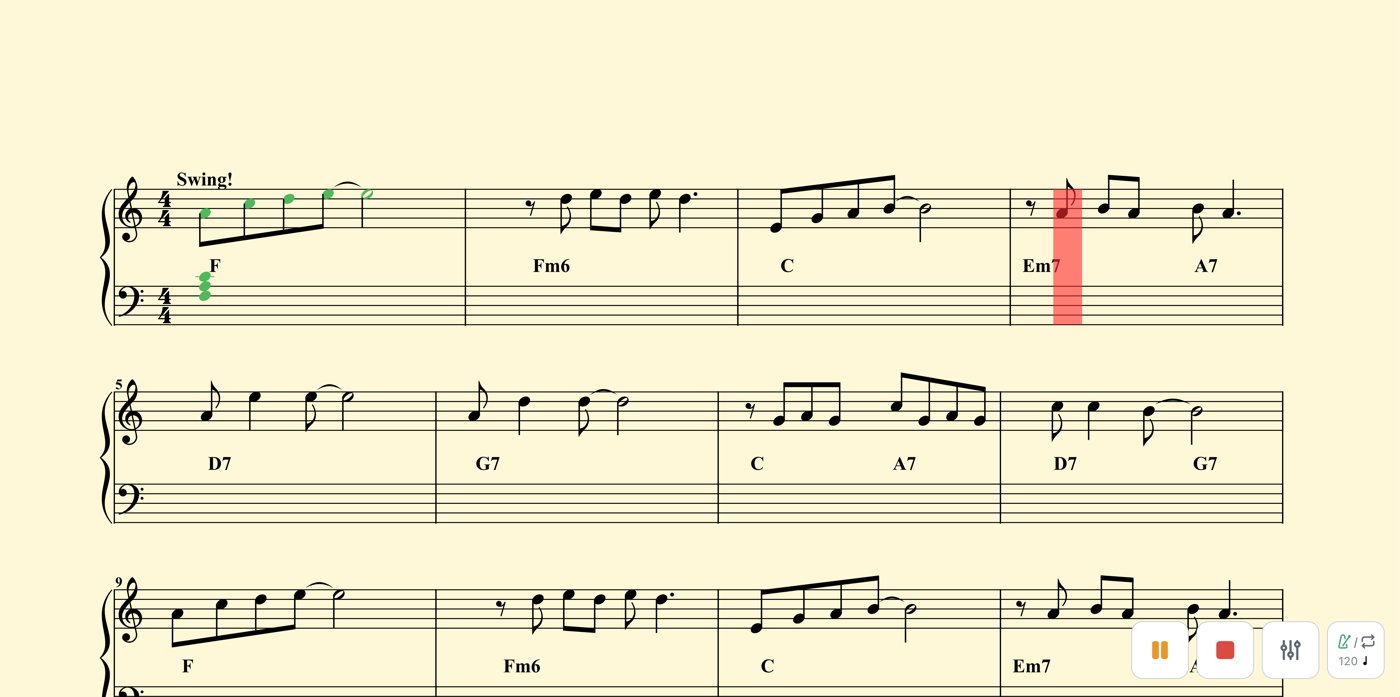
A lead sheet in Piano Tree: read the melody, follow the chord symbols, and build your own accompaniment. Here I start with an F chord in the first measure.
Polyphonic music gets special help: in a chorale or a fugue you can practice each voice on its own, or any combination of voices.
For the full list of practice tools, from read-ahead to transposition with a key lock, see our Piano Tree vs Piano Marvel comparison.How much do Piano Tree and Sight Reading Factory cost?
Piano Tree Premium is $8.33 a month on the yearly plan, or $9.99 month to month. You can try all of it free for 7 days, with no card needed, and the free plan stays free.
Sight Reading Factory costs $35 a year for individuals and $45 a year for teachers, with a limited free demo and a 30-day trial.
Sight Reading Factory costs less, and the price matches what you get: a generator of exercises. Piano Tree gives you a full reading course with 25,000+ pieces of real music, licensed books, live feedback, backing tracks and the tools teachers asked for.
Which should you choose?
Choose Piano Tree if you play the piano and want to read real music fluently: classical pieces, exam pieces, hymns, jazz or pop. It is also the choice for piano teachers who want reading material graded in small steps for every student.
Sight Reading Factory only makes sense if you direct an ensemble, such as a choir or a school band, and need a fresh unison exercise for the whole group.
Find your reading level in a few minutes. Take the free Sight Reading Test and start at the right step of the Path.Piano Tree vs Sight Reading Factory: questions
Is Piano Tree or Sight Reading Factory better for piano sight reading?
Piano Tree. It is built only for piano, with 25,000+ pieces of real music graded in 100 small steps and live feedback as you play. Sight Reading Factory makes computer-generated exercises for more than 60 instruments.
Does Sight Reading Factory use real music?
No. Sight Reading Factory generates every exercise by computer. Piano Tree is almost all real music, from Bach to jazz, plus original pieces written by piano teachers for each level.
Does Sight Reading Factory listen to you play?
Its Auto Assessment records you through the microphone and gives you a score after you finish. Piano Tree marks every note live while you play, by MIDI or microphone, and shows whether each note was early or late.
Which is cheaper, Piano Tree or Sight Reading Factory?
Sight Reading Factory costs $35 a year, and it is a generator of exercises. Piano Tree costs $8.33 a month on the yearly plan and is a full piano reading course, with a free plan that stays free.
Is any Piano Tree music computer-generated?
No. Every piece and exercise was written or arranged by musicians. The cadences were realized from figured bass, and the rock, jazz, funk and tango material was written by our popular music specialist, Victor Nocelli. For cadences and keyboard harmony, the app only chooses the key, so you practice them in every key.
Which is better for ABRSM and other piano exams?
Piano Tree publishes grade by grade guides from Initial Grade to diploma that show which Path levels match each grade, with notes for ABRSM, Trinity, AMEB, RCM and LCM. Piano Tree is not affiliated with any exam board.
How we checked
Sight Reading Factory's features, levels, Auto Assessment and prices come from its own website, help pages and App Store listing, checked on 25 November 2026. Prices are in US dollars and can change. My notes on using Sight Reading Factory come from my own experience with it. If anything here is out of date, email us and we will fix it.
- Sight Reading Factory homepage
- Sight Reading Factory pricing page
- Sight Reading Factory help: Focus on Auto Assessment
- Sight Reading Factory on the App Store
The Short Version
If you play the piano, choose Piano Tree. Real music teaches you the language you will actually read, the Path moves in small steps, and you get feedback on every note while you play. Sight Reading Factory generates exercises by computer, and it only makes sense for ensembles that need a fresh unison exercise.
More in this series: Piano Tree vs Piano Marvel, Piano Tree vs SightReader, Piano Tree vs MasterPiano, Best Piano Sight Reading Apps for 2027, Initial Grade Piano Sight Reading, Diploma Piano Sight Reading