

Which Piano Tree levels prepare you for each ABRSM sight reading test, from Initial to Grade 8, and where every ABRSM parameter is taught in the Path.
Students preparing for ABRSM exams, and their parents, often ask me one simple question: "Which level should I be reading at for my grade?" This page answers it for every grade. We map each Piano Tree Path level to ABRSM's published sight reading parameters, and we show where each element, from 3/8 to syncopation to triplets, is taught before the exam asks for it.
This post is the hub of our ABRSM sight reading series. Each grade has its own full guide, linked in the table below.
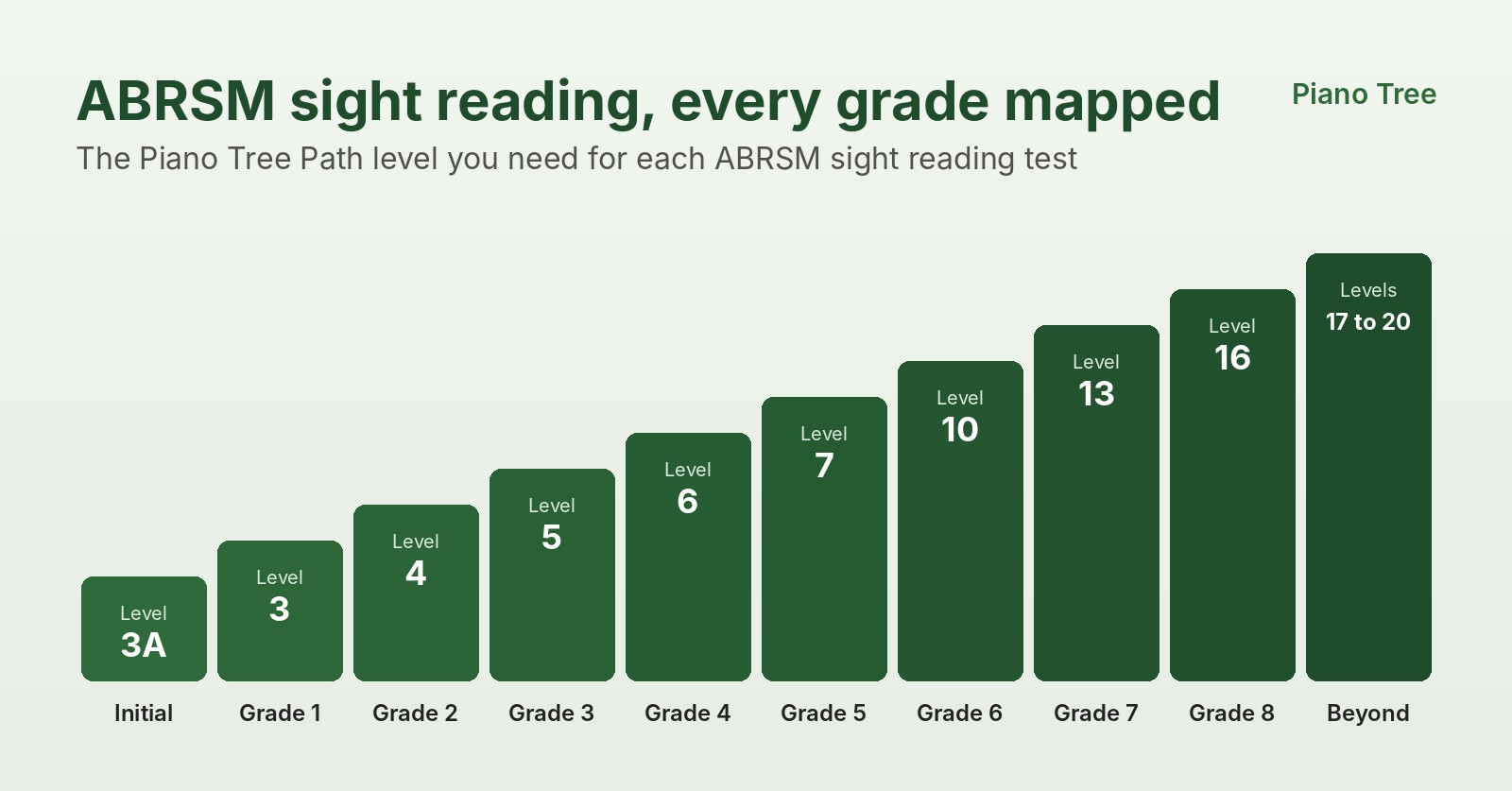
The Short Answer: Every Grade at a Glance
The Path is a ladder, so each grade builds on everything before it. When you can read every level up to the one in the table fluently, at a steady pulse and without stopping, you're ready for that grade's test. For Grade 3, that means everything up to the end of Level 5. The fourth column shows which bands of Piano Tree's free Sight Reading Test match each grade.| ABRSM grade | What the test asks (new at this grade) | Ready once you've mastered everything up to | Sight Reading Test to aim for | Full guide |
|---|---|---|---|---|
| Initial | 4 bars in 4/4 (or 6 in 2/4), hands separately, C major or D minor | Level 3A | Beginner, Late Beginner | Initial Grade |
| Grade 1 | 3/4, G and F major, A minor, any five-finger position | Level 3 | Late Beginner, Early Intermediate | Grade 1 |
| Grade 2 | Hands together, D major, E and G minor, ties | Level 4 | Early Intermediate, Intermediate | Grade 2 |
| Grade 3 | Up to 8 bars, 3/8, two-note chords, simple semiquavers | Level 5 | Intermediate, Late Intermediate | Grade 3 |
| Grade 4 | About 8 bars, 6/8, upbeats, chromatic notes | Level 6 | Late Intermediate, Early Advanced | Grade 4 |
| Grade 5 | 8 to 12 bars, four new keys, four-part chords, syncopation | Level 7 | Late Intermediate, Early Advanced, Advanced | Grade 5 |
| Grade 6 | 12 to 16 bars, triplets, 5/8 and 9/8, clef changes, pedal | Level 10 | Advanced, Late Advanced | Grade 6 |
| Grade 7 | 16 to 20 bars, 7/8, tempo changes, 8va, una corda | Level 13 | Late Advanced, Expert | Grade 7 |
| Grade 8 | About a page, 12/8, B and D flat major, spread chords, ornaments | Level 16 | Expert | Grade 8 |
| After Grade 8 | ABRSM's diplomas no longer test sight reading | Levels 17 to 20 | Master | Diploma |
From Grade 6 the gaps get wider, because the tests get longer and the steps between grades get bigger. Music isn't an exact science, so read a little into the next level too. It gives you more confidence in the exam room.
Every ABRSM Parameter, and Where the Path Teaches It
ABRSM publishes the elements that can appear in each sight reading test, and they build up: once something is introduced, it can appear at every later grade. The Path introduces the same elements, one small step at a time. Here is where each element arrives:| Element | First in the ABRSM test | First in the Piano Tree Path |
|---|---|---|
| 4/4 time | Initial | Level 1A |
| D minor | Initial | Level 1E |
| Quavers | Initial | Level 3A |
| 3/4 time | Grade 1 | Level 1 |
| G and F major, A minor | Grade 1 | Level 1 |
| Accidentals | Grade 1 | Level 1 |
| Groups of four quavers | Grade 1 | Level 3 |
| Hands together | Grade 2 | Level 2 |
| D major and G minor | Grade 2 | Level 1 |
| Tied notes | Grade 2 | Level 1 |
| E minor, dotted crotchet and quaver | Grade 2 | Level 3 |
| 3/8 time, B flat major, B minor | Grade 3 | Level 3 |
| E flat and A major, two notes in one hand | Grade 3 | Level 4 |
| Simple semiquavers | Grade 3 | Level 5 |
| 6/8 time | Grade 4 | Level 3 |
| Upbeats and chromatic notes | Grade 4 | Regular from Level 4 |
| C minor | Grade 5 | Level 1 |
| Chords over a bass (four-part texture) | Grade 5 | Level 4C |
| E and A flat major, F sharp minor | Grade 5 | First at 4E, regular in Level 7 |
| Syncopation | Grade 5 | Level 6A |
| F minor | Grade 6 | Level 6 |
| 9/8 time | Grade 6 | Level 7 |
| Triplets | Grade 6 | Level 9 |
| B and D flat major | Grade 8 | Level 8 |
Look at the two columns together and a pattern appears. Every element starts in the Path no later than the level you need for its grade, and many start much earlier. 6/8 arrives at Level 3, long before Grade 4. B and D flat major arrive at Level 8, eight levels before you need them for Grade 8. That's deliberate. A new element should feel familiar by the time the exam asks for it, not brand new.
The rest of the list, from Grade 6's clef changes and pedal to Grade 7's tempo changes and 8va and Grade 8's spread chords and ornaments, comes through real music. From Level 11 the Path is mostly Baroque, Classical and Romantic repertoire, so you meet these markings the way they appear in real scores.
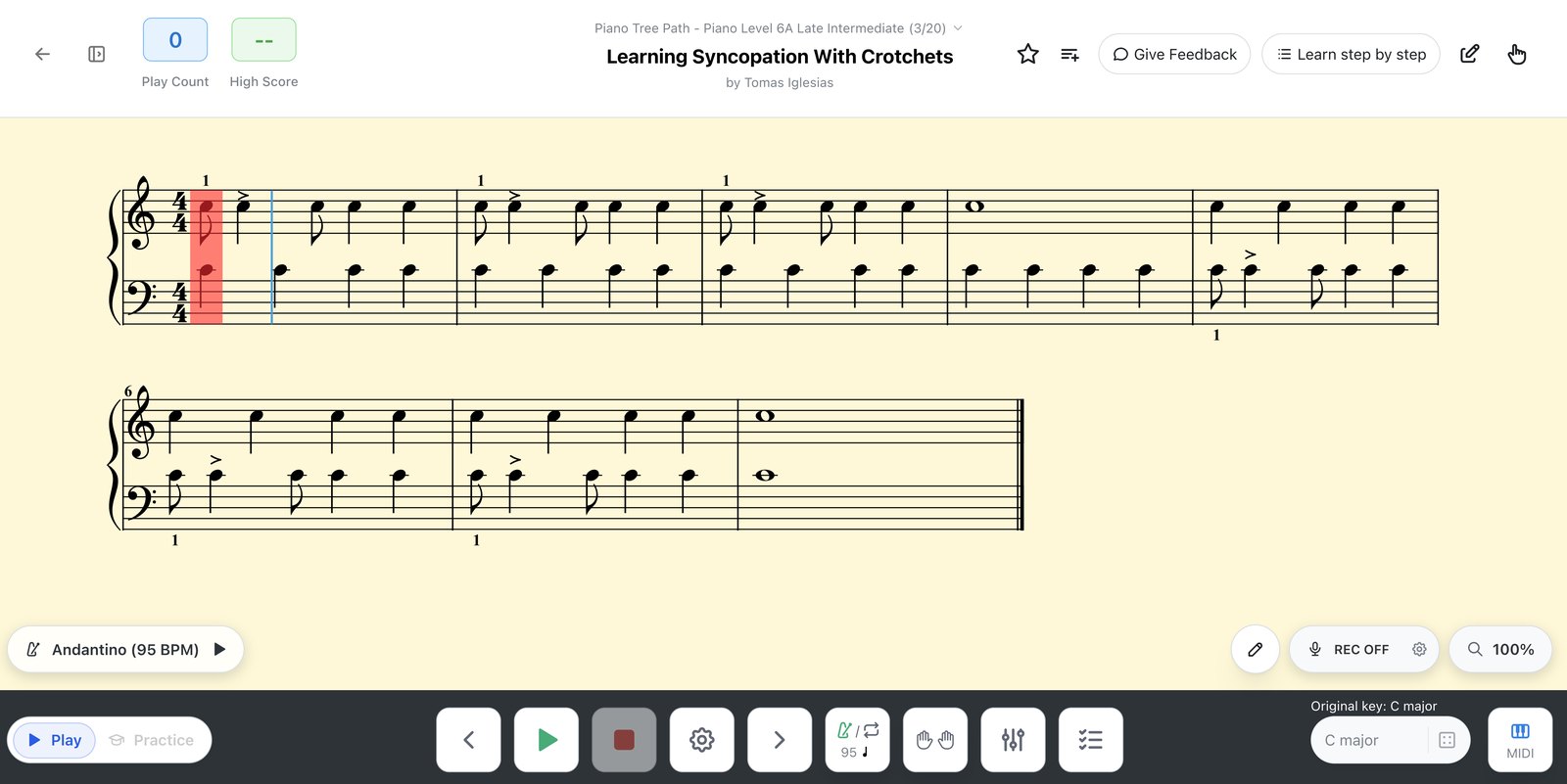
Learning Syncopation With Crotchets, Level 6A: syncopation starts as a one-note rhythm exercise before it moves into the pieces. ABRSM first asks for it at Grade 5.
Why 100 Small Steps Instead of Nine Grades
An exam grade tells you where you're going. It doesn't give you the road. Between two ABRSM grades there is often a big jump: Grade 5 alone adds four new keys, four-part chords, syncopation and longer tests, all at once. A student who only practises "Grade 5 tests" meets all of that together.The Path has 20 levels, each split into five sub-levels, A to E. That's 100 steps, and each one adds very little. Take the hardest keys. When they arrive at Level 8, we lower everything else first, so the music is very easy but in five sharps or five flats. Then 8B, 8C, 8D and 8E add texture and rhythm, step by step, until those keys feel like any other.
A grade label tells you the destination. The Path is the road, one small step at a time.
The other half of the answer is quantity. To move up a reading level, a student needs to read a lot of music at the level they're on, something closer to two hundred pieces than four. Each Path level holds around 100 pieces, and the Supplementary Pieces add another 100 per level. That's why we organise by small steps and not by grade: a handful of specimen tests per grade isn't enough reading to change anyone's level.
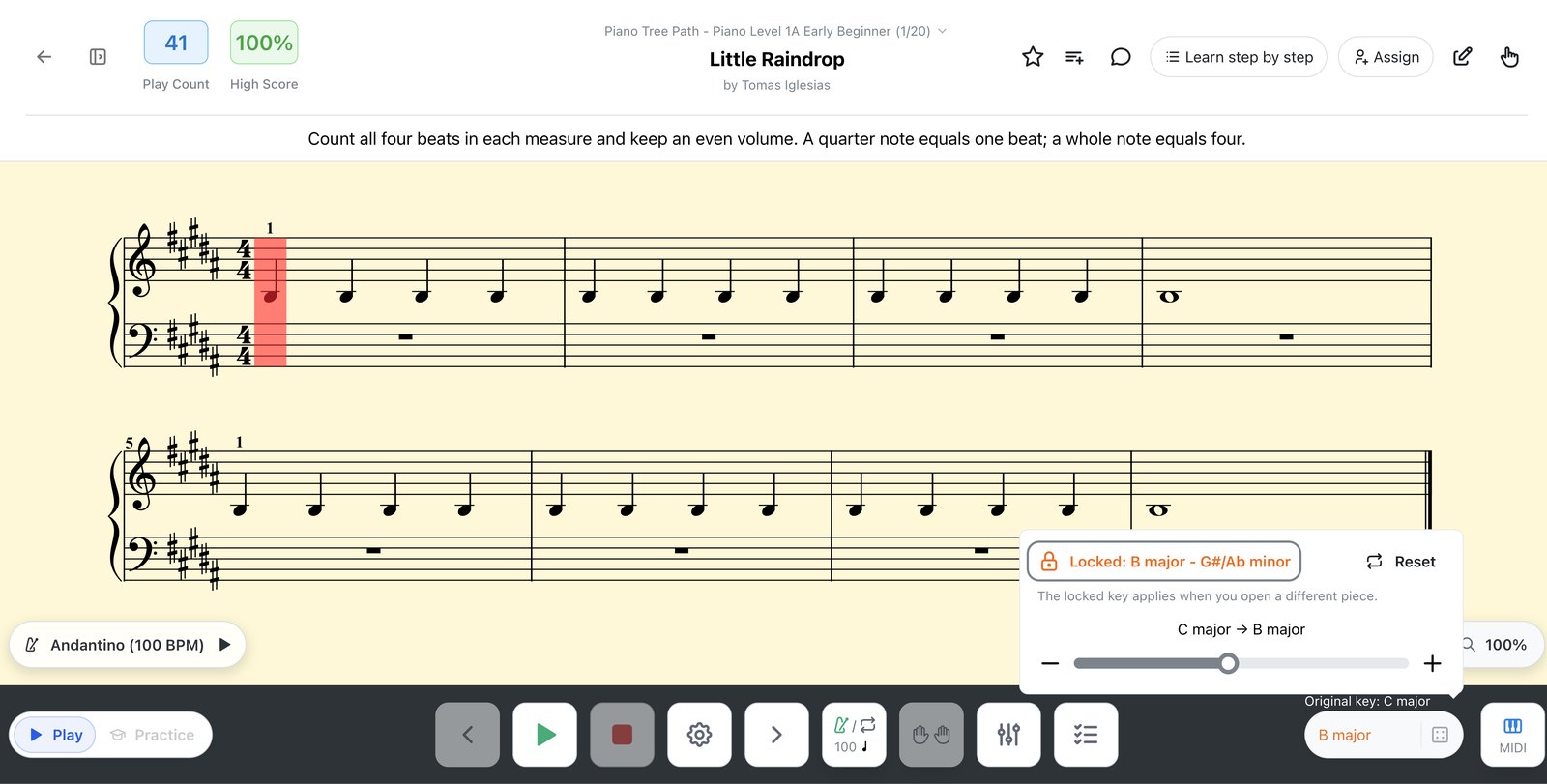
Key lock: Little Raindrop, from Level 1A, moved to B major. Every piece you open after this stays in B major until you unlock it, which is a quick way to make Grade 8's new keys feel easy.
Reading Level and Pieces Level Are Not the Same
Sight reading tests are set below your exam pieces, and that gap grows with every grade. So the levels where you'll find music at the standard of your exam pieces are higher than the levels that prepare you for the sight reading test:| ABRSM grade | Sight reading: ready once you've mastered up to | Exam-standard pieces: look at these levels |
|---|---|---|
| Initial | Level 3A | Up to 3B |
| Grade 1 | Level 3 | 3 and 4 |
| Grade 2 | Level 4 | 5 and 6 |
| Grade 3 | Level 5 | 7 and 8 |
| Grade 4 | Level 6 | 9 and 10 |
| Grade 5 | Level 7 | 11 and 12 |
| Grade 6 | Level 10 | 13 and 14 |
| Grade 7 | Level 13 | 15 and 16 |
| Grade 8 | Level 16 | 17 and 18 |
| Diploma | Levels 17 to 20 | 19 and 20 |
ABRSM's Own Sight-Reading Trainer App
ABRSM makes its own app, Piano Sight-Reading Trainer. It covers Grades 1 to 5, with a fixed set of 155 pieces written for it. That's a useful set of exam-style tests for those grades, and you can use it alongside Piano Tree.The difference is how much you can read, and how far it goes. 155 pieces across five grades is about 30 per grade. To move up a reading level, I believe a student needs closer to 200 pieces per level. Piano Tree gives you that, with around 100 pieces in each Path level, another 100 in the Supplementary Pieces, and more than 1,400 Paul Harris pieces on top, and it goes further in both directions: Initial Grade at the start, and Grades 6, 7 and 8 at the top, where the tests get longest and most students need the most help.
| ABRSM Sight-Reading Trainer | Piano Tree | |
|---|---|---|
| Grades covered | 1 to 5 | Initial to Grade 8, and beyond |
| Pieces | 155, fixed | 25,000+ graded pieces |
Why Piano Tree for ABRSM Sight Reading
Here's what you get, and why I think it matters for an ABRSM student. Everything below is in the app today.Real music, written and chosen by people
Piano Tree is built by a team of piano teachers, composers and software engineers, all of them pianists. Many of the early Path pieces were written by us for a specific level, so each one teaches exactly one new thing. From there the Path moves into real Baroque, Classical and Romantic repertoire, the kind of music you play in your exam pieces. The cadences were realised from figured bass, and the backing tracks were written by composers on the team, following each piece's harmony. None of the music is generated by a computer. The only thing the app randomises is the key some exercises are served in.
That matters for reading. Random notes don't teach you to read music, the same way a list of random words doesn't teach you to read a language. Real music has phrases, harmony and patterns, and that's what your eyes learn to recognise.
The free Sight Reading Test
Eleven tests cover the whole Path, from Early Beginner (Level 1A) to Master (Levels 17 to 20). Each one gives you a Piano Reading Level and tells you which level to start from. Use the table above to see which test matches your grade.
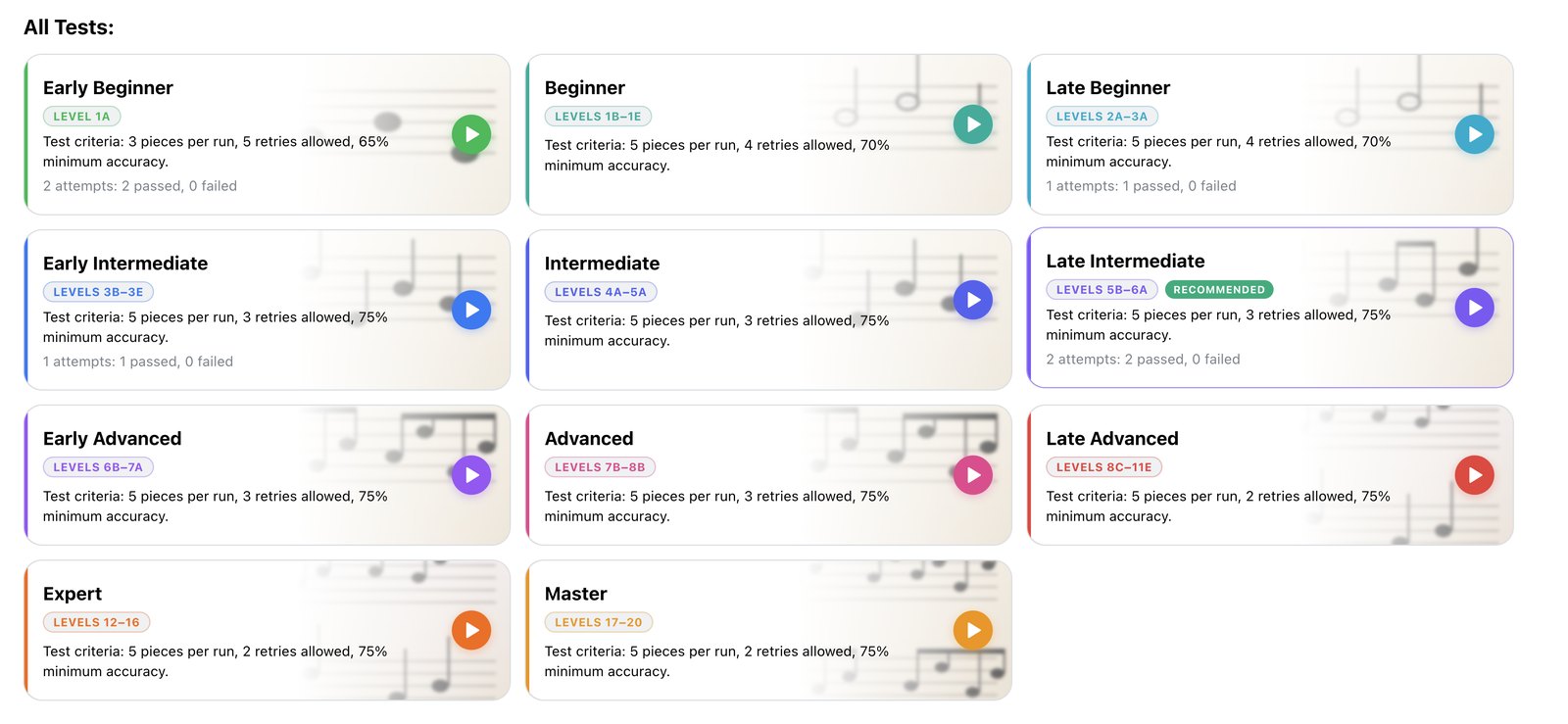
The free Sight Reading Test. Each of the eleven tests covers a band of Path levels and gives you a Piano Reading Level.
Paul Harris's books, as published
Paul Harris is one of the UK's leading music educators, with more than 600 publications, and the creator of Simultaneous Learning. His Improve your sight-reading! series is the one many UK teachers reach for, and from Grade 1 up, each book includes practice tests in the style of the ABRSM sight reading test. We license his books from Faber Music, and they're in Piano Tree as published, with the music as he wrote it: Improve your sight-reading!, A Piece a Week and his sight reading duets, more than 1,400 pieces in all. Each book has a place on the Path:
| Improve your sight-reading! | Pieces | Piano Tree level |
|---|---|---|
| Initial Grade | 119 | 1 |
| Grade 1 | 187 | 1 |
| Grade 2 | 180 | 3 |
| Grade 3 | 159 | 4 |
| Grade 4 | 127 | 5 |
| Grade 5 | 112 | 6 |
| Grade 6 | 104 | 7 |
| Grade 7 | 92 | 9 |
| Grade 8 | 80 | 12 |
Feedback on every note
Play on a MIDI keyboard or an acoustic piano through the microphone. Each note is marked as you play, and timing shows whether you were early or late, not just right or wrong. The microphone hears chords of up to six notes, even in fast music. That matters for the exam, because ABRSM's examiners put fluency and rhythm first. A wrong note played in time costs far less than a right note played late. More on that in ABRSM Sight Reading: What Examiners Are Listening For.Rhythm on its own
The Rhythm book in the Sight Reading Focus Pack isolates rhythm, so new metres and patterns, such as 3/8 and semiquavers, get their own practice before they turn up in a test.
Music theory, Initial to Grade 8
The Learn tab has Music Theory from Initial to Grade 8, with theory exams to test yourself. Grades 1 to 8 follow ABRSM theory, and the Initial grade is our own: ABRSM theory starts at Grade 1, so we wrote a grade that leads into it. You'll need Grade 5 theory, or one of ABRSM's accepted alternatives, to enter ABRSM Grades 6, 7 or 8. Theory and reading help each other: knowing the harmony lets you read chords and progressions instead of single notes.
Read ahead and transposition
Set read ahead from one beat up to several bars, so your eyes stay ahead of your hands. Transpose any piece to give your weakest exam key extra practice, or lock a key for the whole app.
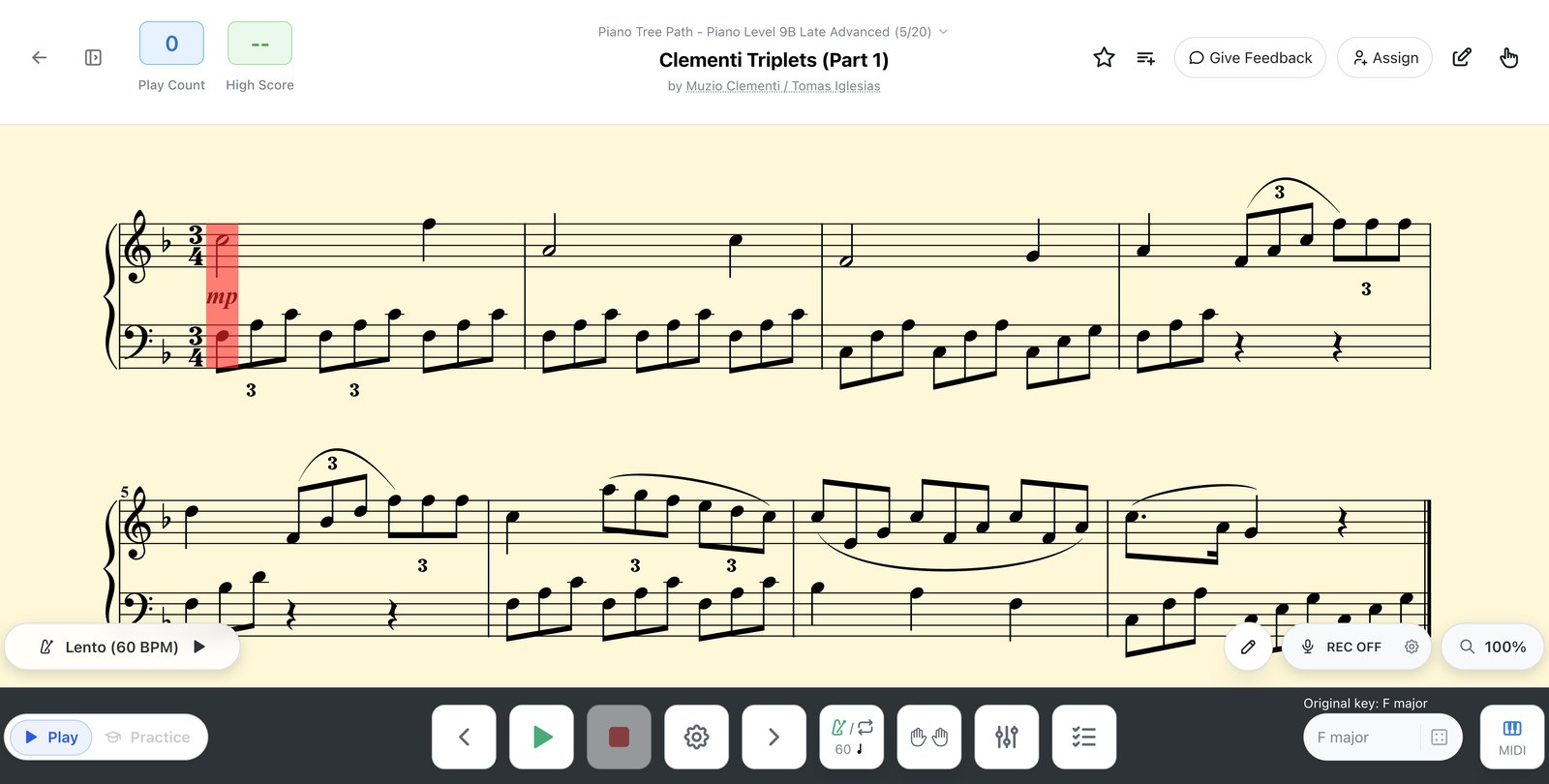
Clementi Triplets (Part 1), Level 9B: triplet broken chords in the left hand under a singing melody. Triplets start at Level 9, so they're familiar well before Grade 6 readiness at Level 10.
A Simple Plan for Exam Term
- Find your level. Take the free Sight Reading Test. If your Piano Reading Level sits below the level you need for your grade, that's normal, and it tells you exactly where to begin.
- Read 15 minutes a day. Four to six short new pieces at your level, each prepared for 30 seconds and then played once without stopping. That's the exam routine, every day. Here's a full 15-minute routine.
- Move up when it feels easy. Sight reading should feel on the easier side, like reading a book. When a sub-level stops feeling like work, move to the next one.
In my studio, students who keep this up see a clear change in about three months. Starting a term before the exam is ideal.
Piano Tree is a piano sight reading app built by piano teachers: 25,000+ graded pieces, real-time feedback on notes and timing by MIDI or microphone, from first notes to diploma level. The free plan includes hundreds of pieces and unlimited sight reading tests, with no credit card.
Find your level: try Piano Tree freeCommon Questions
What is the best app for ABRSM sight reading?
Look for four things. It should cover every grade you'll take, from Initial to Grade 8. It should give you enough new music, hundreds of pieces per level, not dozens. It should listen to you and mark your notes and your timing. And its levels should map clearly to ABRSM's published parameters, like the table on this page. Piano Tree was built by piano teachers to do all four.
Does ABRSM have its own sight reading app?
Yes. ABRSM's Piano Sight-Reading Trainer covers Grades 1 to 5 with a fixed set of 155 pieces. For Initial, for Grades 6 to 8, or for more reading at any grade, use Piano Tree alongside it.
Is Piano Tree graded to ABRSM?
Yes, for sight reading. Every Path level is mapped to ABRSM's published sight reading parameters, from Initial to Grade 8, and the table at the top of this page shows which levels prepare you for each grade. Piano Tree is aligned with ABRSM, not affiliated with or endorsed by it.
Which Piano Tree levels prepare me for ABRSM Grade 5 sight reading?
Once you've mastered everything up to Level 7. Syncopation starts at 6A, so it's already familiar by then, and the new Grade 5 keys are regular in Level 7. For Grade 5 exam pieces, look at Levels 11 and 12.
Why are the Path levels lower than the levels for my exam pieces?
Because ABRSM sets its sight reading tests below the standard of your pieces. Your daily reading should be easier than your pieces too. That's how fluency is built.
Does Piano Tree have ABRSM's specimen tests?
No. ABRSM publishes its own books of specimen tests. Piano Tree gives you thousands of pieces that cover the same parameters, level by level, plus Paul Harris's Improve your sight-reading! books, as published, with ABRSM-style practice tests from Grade 1 to Grade 8.
Does Piano Tree have ABRSM music theory?
Yes. The Learn tab has Music Theory Grades 1 to 8, following ABRSM theory, with theory exams to test yourself. There is also an Initial grade that we wrote ourselves, because ABRSM theory starts at Grade 1 and younger students need a step before it.
Can I practise on an acoustic piano?
Yes. Piano Tree listens through the microphone on web, iOS and Android, or you can connect a MIDI keyboard.
Do ABRSM diplomas test sight reading?
Not any more. The DipABRSM Quick Study has gone, and the ARSM, LRSM and FRSM are performance diplomas. If you want a diploma that rewards your reading, LCM's standard format still includes it. Our diploma guide has the details.Does this work for other exam boards?
Yes. Each grade guide also covers Trinity, AMEB, LCM and RCM. ABRSM publishes the clearest parameters, so we use it as the reference here.
About the Author
Tomas Iglesias is a pianist, composer and piano teacher based in Auckland, New Zealand. He directs the School of Musical Arts, has taught piano for more than 15 years, and is one of the founders of Piano Tree. He holds a BMus from the University of Auckland, and studied harmony with Matteo Messori, figured bass with Nicola Canzano, partimento with Peter van Tour and orchestration with Norman Ludwin. His composition work includes film and orchestral music.
Exams are where I see whether the reading work pays off. Since 2024, my students at the School of Musical Arts have taken 36 ABRSM piano exams, up to Grade 8, and 22 of them passed with distinction.
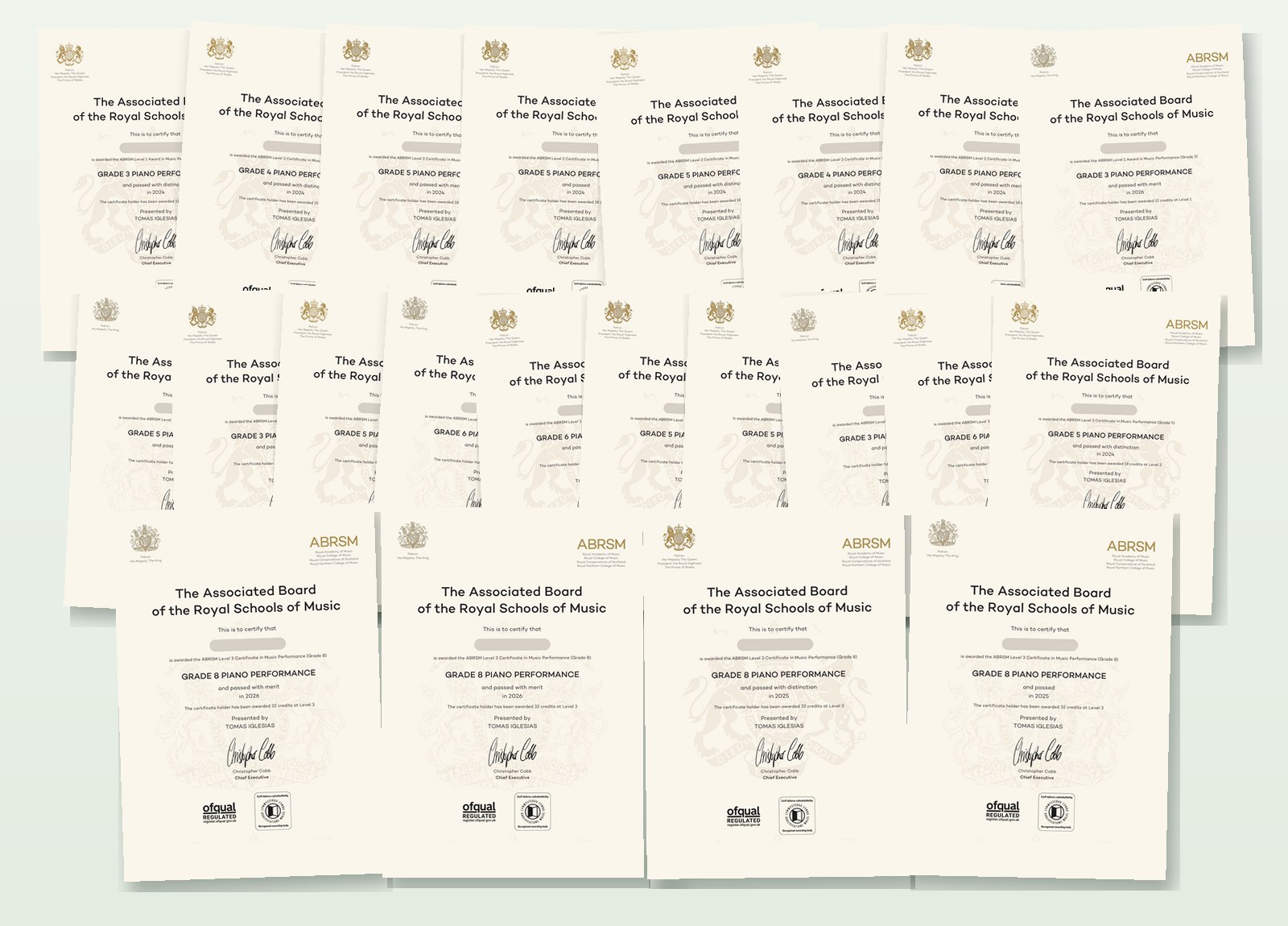
A selection of my students' ABRSM certificates, 2024 to 2026. Student names are hidden for privacy.
Sources and How We Checked
- ABRSM, Practical Music Grades: Piano Syllabus 2027 & 2028, Qualification Specification: sight reading parameters for Initial to Grade 8, preparation time, marks and marking criteria. ABRSM states the sight reading requirements are unchanged from the 2025 & 2026 syllabus, which remains valid until 31 December 2027.
- ABRSM diploma requirements for ARSM, LRSM and FRSM (Music Performance), from 2024.
- ABRSM Piano Sight-Reading Trainer, App Store listing: grades covered and number of pieces.
- Piano Tree Path levels and element starts, and the Paul Harris book levels, checked against the app in November 2026.
- All checked in November 2026. Piano Tree is not affiliated with ABRSM, Trinity College London, AMEB, LCM or RCM.
Part of the Piano Tree sight reading series. The full grade guides: Initial, Grade 1, Grade 2, Grade 3, Grade 4, Grade 5, Grade 6, Grade 7, Grade 8 and Diploma.